

Last Updated: November 26, 2026
Quick Summary
You need to replace a basement egress window when it no longer opens freely, the glass or frame is damaged, or water is getting in around it. Any one of those problems makes the egress window unsafe as an emergency exit. A window that sticks halfway open fails both the escape and firefighter-entry tests.
- A window that won’t open at all is a same-week safety hazard, even if the glass is perfect.
- The clear opening must measure at least 5.7 sq ft, with a minimum clear height of 24 inches and clear width of 20 inches.
- The sill height must be no more than 44 inches from the floor, and the window must open from inside without tools.
- A window well cover that screws down or locks is a code problem because you must be able to get out without tools.
- A basement egress window project typically runs from about $2,500 for a straight swap up to $8,000 or more when a new opening is cut.
Table of Contents
- When to Replace a Basement Egress Window
- 7 Warning Signs Your Egress Window Needs Replacement
- Repair or Replace? Decision Criteria for Homeowners
- Basement Egress Window Code: What Your Opening Must Meet
- Basement Egress Window Size Chart and Clear Opening Measurements
- Basement Egress Window Well: Drainage, Covers, and Escape Access
- Basement Egress Window Cost and What Changes the Estimate
- Schedule Your Egress Window Assessment
- Frequently Asked Questions
When to Replace a Basement Egress Window
You need to replace a basement egress window when it no longer opens freely, the glass or frame is damaged, or water is getting in around it. Any one of those problems makes the window unsafe as an emergency exit. This guide walks you through the warning signs, the code requirements, and the repair-or-replace call.
An egress window is a basement opening large enough for a person to climb out of in an emergency, and large enough for a firefighter to enter. That second job is the one homeowners forget. A window that sticks halfway open fails both tests.
Below, we’ll show you exactly how to inspect your own window, rank each problem by urgency, and decide when a repair is enough and when replacement is the only safe answer. But first, here’s what most guides get wrong: they treat every crack as a death sentence. Plenty of window problems are fixable. The trick is knowing which ones.
7 Warning Signs Your Egress Window Needs Replacement
Watch for seven signals: cracked glass, a bent or rotted frame, rust that stops the sash from sliding, water staining around the opening, cold drafts, a window that won’t fully open, and an opening that no longer meets egress size rules. Let’s take them in order.
Cracked or Broken Glass and Frame Damage
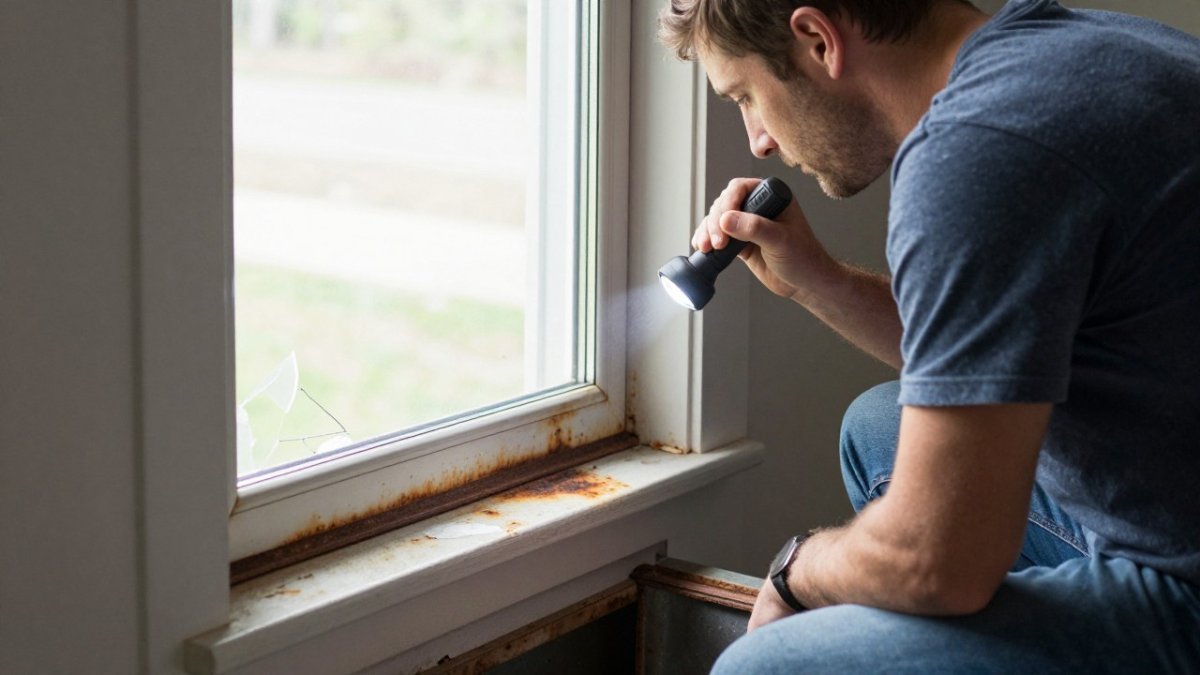
A single hairline crack in a corner pane is a repair. A crack that runs across the glass, or glass that has gone cloudy between the panes, means the unit is done. Broken glass in an egress window is a safety hazard, not a cosmetic issue. Frame damage is the bigger tell. Look for rot in wood frames and bends in steel ones. If the frame has warped, the window will never seal right again.
Rust, Corrosion, and Sticking Window Operation
Steel basement windows rust. That’s normal. What matters is where the rust sits. Surface rust on the sill cleans up fine. Rust in the track or hinge, the kind that makes the sash grind and stick, is a different story. Test it: open the window fully. If you have to force it, or it won’t stay open on its own, the hardware is failing. In a fire, you won’t have time to fight a stuck sash.
Leaks, Water Intrusion, and Drafts
Water stains on the sill, peeling paint around the opening, or a damp smell near the window all point to water intrusion. Drafts are the quieter cousin. Hold your hand near the frame on a cold day. Feeling air means the seal has failed. Left alone, leaks rot the frame and soften the surrounding wall. That turns a window swap into a bigger repair.
Repair or Replace? Decision Criteria for Homeowners
The decision generally runs on three questions, what failed, how bad it is, and whether the failure affects the escape path. Answer those and the call usually makes itself.
Step 1: Identify what actually failed
Egress window problems fall into four buckets, and each has a different repair ceiling:
- Hardware and seals, latches, hinges, weatherstripping, glazing tape. These are the cheapest fixes and rarely justify replacement on their own.
- Glass unit, a single cracked pane or a failed sealed unit (cloudy between panes). Repairable if the frame is sound and the crack doesn’t cross the escape opening.
- Frame and sash, rot, warping, bending, or rust that has eaten into the track. This is where repair costs climb fast because the frame carries the window’s structural and sealing performance.
- Opening and well, the rough opening is undersized, the sill is too high, or the well doesn’t drain. These are code and safety issues, not window issues, and a new window alone won’t fix them.
Step 2: Rank urgency, not just damage
A cracked pane in a window that still opens smoothly is a monitor-and-schedule item. A window that won’t open at all is a same-week safety hazard, even if the glass is perfect. Use this three-tier ranking:
- Immediate (fix or replace now): glass broken through the escape opening, sash won’t open or won’t stay open, frame separated from the wall, or standing water in the well after rain.
- Near-term (schedule within a season): rust in the track that requires force to operate, a crack that crosses the pane, drafts you can feel by hand, or water staining without active leaking.
- Monitor (inspect quarterly): surface rust on the sill, a hairline corner crack, minor paint peeling, or a well drain that clears slowly but still drains.
Step 3: Apply the repair-versus-replace test
- Repair it if: the glass is intact or a single pane is cracked, the frame is straight and solid, the window opens with one hand, and the clear opening already meets egress size.
- Replace it if: the frame is bent, rotted, or rusted through; the sash sticks or won’t stay open; the sealed unit has failed; or the clear opening is undersized.
- Replace it now if: the glass is broken through the escape path, the window won’t open at all, or water is actively entering the basement around the frame.
Watch out: a window that passes the size test but sticks halfway open still fails as an emergency exit. Operation is part of the code, not a comfort feature, don’t let a cosmetic repair hide a stuck sash.
If you’re weighing options and want to see what replacement involves, our guide to basement egress window replacement options and costs lays out the choices side by side.
Basement Egress Window Code: What Your Opening Must Meet
Most basements need an egress window once they become a sleeping room or finished living space. The rules come from the building code your local inspector enforces, and they cover opening size, sill height, and how the window operates.
The core requirements are generally consistent across the country:
Local amendments vary, so confirm the exact figures with your city or county building department before you buy anything. If the basement is or will be a bedroom, our breakdown of basement bedroom egress window requirements covers the specifics in detail.
Basement Egress Window Size Chart and Clear Opening Measurements
Measure the opening, not the window. That’s the mistake we see most. A window can look large and still fail the clear opening test once the sash and frame are subtracted.
| Measurement | Minimum Requirement | How to Check |
|---|---|---|
| Clear opening area | 5.7 sq ft | Width x height of the open space |
| Clear height | 24 inches | Measure the open gap, top to bottom |
| Clear width | 20 inches | Measure the open gap, side to side |
| Sill height | 44 inches max | Floor to bottom of opening |
| Operation | Opens from inside, no tools | Test it by hand |
Open the window fully, then measure the actual gap a person would climb through. Write the numbers down. If any one falls short, the window needs to be resized or replaced.
Basement Egress Window Well: Drainage, Covers, and Escape Access
A window well is only doing its job if it drains and stays clear. Water pooling in the well can lead to leaks at a basement window, and it can freeze.
Check three things. First, the drain at the bottom of the well. Clear any leaves or debris blocking it. Second, the gravel bed, which should sit below the window sill. Third, the cover. A cover keeps rain and debris out but must still let you climb out. Our guide to choosing basement window well covers explains which styles keep drainage working and escape access open.
Watch out: a cover that screws down or locks is a code problem. You must be able to get out without tools.
Basement Egress Window Cost and What Changes the Estimate
Most homeowners searching this topic want a number, and most guides won’t give one. Here’s the honest version: a basement egress window project typically runs from about $2,500 for a straight swap into an existing opening up to $8,000 or more when a new opening is cut through a foundation wall and a well is added. The spread is wide because the window is often the smallest line item.
What the estimate is actually made of
Pricing depends on the scope of the project. Ask for a quote from Berry Basements for current pricing based on your specific basement.
Scenarios that move the number most
For a full cost breakdown by scenario, see our guide to the cost to install a basement egress window.
Schedule Your Egress Window Assessment
If you’ve checked your window and found a sticking sash, a cracked pane, or water staining, don’t wait for the next storm to confirm it. A failed egress window is a safety issue first and a comfort issue second.
At Berry Basements, we’ve served homeowners since 2017 as licensed basement contractors. We handle waterproofing and structural changes, and our collaborative process keeps you involved from planning to execution.
Get started with Berry Basements and get a free estimate on your egress window project. Before you book, you can read our guide to DIY vs professional egress window installation to weigh both paths.
A sticking window or a damp sill is easy to ignore until it isn’t. The safest move is a professional assessment that checks the opening against current code and spots water damage before it spreads. Berry Basements brings licensed contractors, a collaborative planning process, and expert handling of waterproofing and structural work to every project. Get started with Berry Basements and get a free estimate for your basement egress window.
Frequently Asked Questions
How much does it cost to replace a basement window with an egress window?
Basement egress window cost depends on the opening size, whether excavation or window well work is needed, and the material you choose. A straight swap into an existing code-compliant opening costs far less than cutting a new opening through the foundation. Factors that move the estimate include well depth, drainage corrections, and finish work inside. Berry Basements offers a free estimate for your project.
Can a damaged egress window be repaired instead of replaced?
Sometimes. A failed seal, a worn latch, or a stuck sash can often be repaired and keep the unit in service. Replacement becomes the better call when the frame is rusted through, glass is cracked, the opening no longer meets basement egress window code, or water intrusion has rotted the surrounding structure. If the unit still opens fully and the clear opening measures correctly, repair is worth pricing first.
How long does a basement egress window last?
Steel and aluminum frames in a damp basement can corrode sooner than other materials. The window well matters too: a well that pools water shortens the life of any frame. Inspect the unit each spring for cracks, rust, and sticking operation, and check that the clear opening still matches your basement egress window size chart before any basement renovation.
Is it illegal to sleep in a basement without an egress window?
In most jurisdictions, a basement bedroom cannot legally be used as sleeping space without a compliant egress window. Requirements are adopted and amended locally, so confirm the current basement egress window code with your local building department before finishing a bedroom downstairs.
