

Last Updated: November 27, 2026
Quick Summary
You childproof basement windows by limiting how far they open to no more than 4 inches, locking the frame, clearing climbable furniture, and covering the window well. Use both a lock and a stop, add guards and cord safety, and keep every release openable by an adult for fire escape.
- A gap wider than 4 inches lets a small child slip through, so cap the opening at 4 inches.
- Use both a window lock and an adjustable stop, since a loose original lock defeats a stop alone.
- Choose a well cover that is load-rated and latched, not a thin dome or loose grate.
- Never screw down a well cover on an egress window with no inside release.
- Practice the guard or cover release once so it is not a surprise during a fire.
Table of Contents
- How Do You Childproof Basement Windows?
- Window Locks, Stops, and Pins That Restrict Opening
- Choosing Window Guards for Child Safety
- Sliding Window Child Safety Lock Options
- When a Baby Proof Window Screen Makes Sense
- Installing a Basement Window Well Cover for Child Safety
- Emergency Egress and Fire Safety With Childproofing
- Schedule a Free Basement Safety Assessment
- Frequently Asked Questions
How Do You Childproof Basement Windows?
You childproof basement windows by limiting how far they open, locking the frame, clearing climbable furniture, and covering the window well.
Basement windows carry risks that upstairs windows do not. They sit low to the floor, often near a play area.
Below, we’ll show you how to childproof basement windows, and where a professional install makes more sense.
The Consumer Product Safety Commission window covering safety guidance treats cord and fall hazards as serious risks for young children, so plan for both.
Window Locks, Stops, and Pins That Restrict Opening
A window lock keeps the sash shut, while a stop or pin limits how far it opens. For child safety, a common goal is a window that opens no more than 4 inches (CPSC Urges Families to Protect Children During National Window Safety Week).
That 4-inch rule is the number to remember. A gap wider than 4 inches lets a small child slip through. Most safety hardware is built around that limit.
Here is how the main options compare:
| Hardware | What It Does | Best For | Notes |
|---|---|---|---|
| Window lock | Holds the sash closed | Double-hung, sliding | Basic first step |
| Adjustable stop | Limits opening distance | Double-hung | Set to 4 inches |
| Window pin | Locks sash at a set gap | Vinyl windows | Drill-in install |
| Window wedge | Fills the gap above the sash | Renters | Removable, no tools |
A common mistake is installing a stop but leaving the original lock loose. Use both.
Watch out: a stop set wider than 4 inches gives a false sense of safety. Measure the actual opening, not just the hardware setting.
Choosing Window Guards for Child Safety
Window guards for child safety are barriers that cover the opening while still letting air in. They work well on basement windows that sit at floor level or open wide.
Guards come in two main types:
- Fixed guards screw into the frame and stay put.
- Removable guards release with a tool or key for cleaning and escape.
For a basement, pick a guard rated for the window size and check that the bars are close enough together that a child cannot pass through.
What most guides miss is the release side. Make sure an adult can open the guard quickly in an emergency.
Sliding Window Child Safety Lock Options
A sliding window child safety lock pins the moving panel so it cannot slide past a set point. Basement sliders need a lock that fits the track, not a generic latch.
Common options include:
- Track locks clamp onto the rail and block the panel.
- Ratchet stops let you set the gap and lock it.
- Keyed latches add a layer adults control.
Measure your track depth before buying. A lock that sits too loose will slide out of place. Also check that the lock does not stop the window from closing fully, which can let in rain and pests.
For renters, a clamp-style track lock needs no drilling and comes off clean at move-out.
When a Baby Proof Window Screen Makes Sense
A baby proof window screen is a reinforced screen that resists pushing and tearing. It makes sense on basement windows that stay open for airflow in a playroom or bedroom.
Standard insect screens are not safety barriers (CPSC Urges Families to Protect Children During National Window Safety Week). A child can push through one. A reinforced screen adds a physical layer, but it does not replace a lock or a stop.
Screens help most when:
- The window opens for ventilation.
- The opening is already limited to 4 inches.
- The screen is anchored to the frame, not just clipped in.
Skip a screen-only approach. It gives a false sense of security on its own.
Installing a Basement Window Well Cover for Child Safety
A basement window well cover for child safety does two jobs: it caps the well so a child cannot fall in or climb down, and it keeps rain, snow, and debris out of the well. Most generic window guides stop at “buy a cover.” The basement-specific work is choosing a cover that is load-rated, latched, and still compatible with escape.
Why the Well Itself Is the Hazard
A basement window sits low, and the well outside it is a pit. A toddler who leans on a flimsy cover, or a child who steps onto an open well, faces a fall of several feet onto concrete or gravel.
A common pattern is a well that is open on top with only a loose grate or a thin plastic dome. Those are not barriers. A child can push a light dome aside, and an unlatched grate can be lifted.
What to Look For in a Child-Safe Well Cover
- Load rating. Choose a cover rated to hold a person’s weight, not just shed rain. Polycarbonate and aluminum grates are common; thin acrylic domes are not designed as walking surfaces.
- Positive latch or lock. The cover should fasten to the well or wall so a child cannot lift it. A cover that only rests in place is a trip hazard, not a safeguard.
- Bar spacing on grates. If you use a grate, check that the openings are small enough that a small child cannot pass through or get a limb stuck.
- Escape compatibility. If the window is a required escape route, the cover must open from the inside without a key or special tool, or be a hinged model an adult can push open.
- Corrosion and weather exposure. Wells collect water. Look for hardware and fasteners rated for outdoor, wet conditions so the latch does not seize.
Installation Steps for a Basement Well Cover
- Measure the well opening inside edge to inside edge, and measure the well depth so the cover clears the window sash.
- Clear debris and inspect the well walls for cracks, loose mortar, or a failing retaining wall before anchoring anything.
- Set the cover in place and mark the anchor holes. Confirm the cover sits flush and does not rock.
- Drill pilot holes and fasten with the supplied anchors or masonry fasteners sized for the well material.
- Install the latch or lock, then test it from the inside. An adult should be able to release it quickly.
- Check the fit after the first heavy rain. Standing water or a lifted edge means the cover needs adjustment.
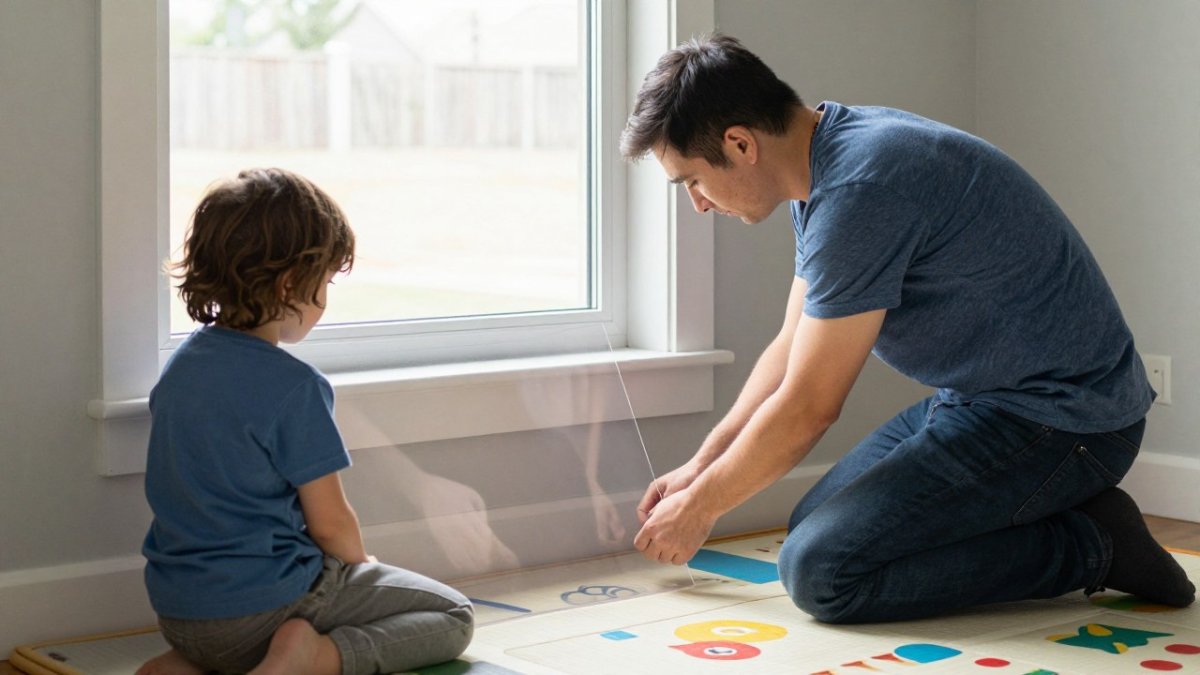
Watch out: a cover that is screwed down with no inside release can turn a required escape window into a trap. If the window is the only egress from a sleeping area, use a hinged or removable cover an adult can open from inside.
Before you buy, compare well materials so the cover and well work together. Our guide on the best materials for basement window wells covers the options side by side. If you are still picking a cover, this guide on how to choose basement window well covers breaks down the fit and style choices.
Emergency Egress and Fire Safety With Childproofing
Every childproofing step must leave a clear escape route. A window that cannot open in a fire is a hazard, not a safeguard. This is the part most window-childproofing guides skip, and it matters most in a basement, where the window may be the only way out of a sleeping area.
The Tension Between Childproofing and Egress
Child-safety hardware is designed to slow a child down. Fire code is designed to let an adult out fast. The two goals pull in opposite directions, so the hardware you choose has to satisfy both. The workable pattern is hardware that a child cannot defeat but an adult can release in seconds without a key stored across the room.
A common mistake is a fixed guard or a screwed-down well cover on the only egress window. That passes a child-safety check and fails a fire-safety check.
What Counts as an Escape Window
Building and fire codes set minimum opening dimensions for an emergency escape and rescue opening. The exact figures vary by code edition and local amendment, so confirm the requirement with your local building or fire department before you rely on a window as egress.
If your basement window is not a compliant escape opening, childproofing it is still worthwhile, but do not count it as the family’s exit. Plan a second way out.
Childproofing That Preserves Escape
- Use removable or hinged guards on egress windows, with the release reachable from inside and out of a child’s reach.
- Choose stops and latches an adult can override without a key, or keep the key in a fixed location near the window that a child cannot reach.
- Keep the well cover openable from inside if the window is an escape route.
- Do not block the window with furniture, shelving, or a play structure on either side.
- Practice the release once so it is not a surprise during a fire.
Check these points:
- Can an adult open the window and guard in under a minute?
- Is the release tool stored nearby, out of a child’s reach?
- Does the window meet egress size for a bedroom?
- Is the path from the basement floor to the window clear?
If your basement window is small or fixed, it may not count as a proper escape window. Our article on whether basement egress windows are a safety must-have explains what to look for. If your window falls short, review basement egress window replacement options and costs before you finalize any childproofing plan.
Schedule a Free Basement Safety Assessment
Some basement windows need more than hardware. A low window well, a window that will not open, or a frame that has shifted all call for a pro look.
At Berry Basements, we are licensed basement contractors serving the area since 2017.
When you are ready, we will assess your windows, well, and play area, then map out the safest fix.
A basement playroom should feel safe, not risky.
Frequently Asked Questions
What is the 4-inch rule for window safety?
The 4-inch rule means no window opening should be wider than 4 inches at any point. A 4-inch gap is narrow enough that a young child’s head cannot pass through, which reduces the risk of a fall. Apply it to every basement window by using adjustable stops, window pins, or a sash limiter. Check the gap after installation by trying to pass a 4-inch object through the opening. If it fits, tighten the hardware.
Are window guards safe to use on basement windows?
Window guards for child safety are safe when they are installed correctly and have a quick-release mechanism for adults. On basement windows, the main concern is egress. Any guard covering a sleeping room or a designated escape window must open from the inside without tools or keys. Look for guards that are designed for fall prevention and include an emergency escape release. Test the release monthly.
How can I secure a basement window without blocking emergency escape?
Use hardware that limits opening rather than sealing it. Adjustable stops and window pins keep the sash at 4 inches or less while still allowing an adult to remove or release them in seconds. Avoid screwing guards permanently into the frame. For window wells, choose a cover with a hinged or lift-out section rated for egress. Walk through the release with every adult in the home so it works under stress.
Can renters childproof basement windows without permanent changes?
Yes. Tension-mounted window stops, removable sash limiters, and pressure-fit guards require no drilling and come out cleanly at move-out. Window wedges and adhesive-backed cord cleats are also renter-friendly. For window wells, ask the landlord in writing before adding a cover, since it may affect the lease. Keep a copy of the approval and photograph the window before and after installation to protect your security deposit.
