

Last Updated: October 23, 2026
Quick Summary
Essential home theater equipment for finished basements includes a display (TV or projector), surround sound system with front speakers and subwoofer, AV receiver, and proper wiring infrastructure. Basements require unique planning for moisture control, acoustic treatment, and cable management due to concrete walls, humidity, and lower ceilings.
- Projectors work best in basements because basements are naturally darker than upstairs rooms.
- A complete surround sound setup includes front left, center, and right speakers, surround speakers, a subwoofer, and an AV receiver.
- Use in-wall rated cables and keep power cables separated by at least 12 inches from audio/video cables to avoid interference.
- Maintain humidity between 30 and 50 percent using a dehumidifier to protect equipment from moisture damage.
- Viewing distance should be 1.5 to 2.5 times the screen diagonal for a TV or 1.2 to 1.5 times screen width for a projector.
Table of Contents
- Why Basement Home Theater Equipment Requires Different Planning
- Home Theater Projector vs TV: Choosing Your Display
- Surround Sound Systems for Basement Theaters
- AV Receiver and Component Connections
- Home Theater Seating Layout and Viewing Distance
- Finished Basement Theater Wiring and Power Planning
- Acoustic Treatment and Sound Isolation
- Basement Environmental Protection and Equipment Durability
- Frequently Asked Questions
Why Basement Home Theater Equipment Requires Different Planning
A finished basement is fundamentally different from an upstairs room. It’s enclosed, often has lower ceilings, concrete walls, and potential moisture concerns. These factors change everything about how you approach essential home theater equipment for finished basements.
Most homeowners treat a basement theater like any other room. They buy a TV, add some speakers, and call it done. That approach fails because basements have unique acoustic properties, environmental challenges, and spatial constraints that demand specific planning.
At Berry Basements, we’ve guided homeowners through complex basement projects. The ones that succeed start with understanding these differences upfront. The ones that struggle?
The key insight: essential home theater equipment for finished basements isn’t just about buying the right gear.
Here’s what changes in a basement compared to a living room:
- Moisture exposure, Basements naturally hold more humidity, even finished ones
- Hard surfaces, Concrete and drywall create acoustic problems without treatment
- Limited headroom, Lower ceilings affect speaker placement and viewing angles
- Complex infrastructure, Existing HVAC, plumbing, and electrical systems complicate cable routing
- Temperature swings, Seasonal temperature changes stress equipment
Before you buy a single component, plan for these realities. We’ll walk through exactly how.
Home Theater Projector vs TV: Choosing Your Display
The first major decision is your display technology. Both projectors and TVs work in basements, but they solve different problems.
A TV is straightforward. It sits on a stand or mounts to a wall. It needs a clear line of sight from your seating area.
A projector requires a projection screen, throws light onto it from a distance, and needs a darker room to shine. Explore entertainment basement ideas with projector screens to see how other homeowners have designed their setups.
Key differences to consider:
| Factor | TV | Projector |
|---|---|---|
| Setup complexity | Simple | More involved |
| Image size | Fixed by TV size | Scalable with screen size |
| Room brightness needed | Works in bright rooms | Needs dim lighting |
| Maintenance | Minimal | Lamp/filter replacement |
| Cost for large image | Expensive for 80″+ | More affordable |
| Wall space required | Large wall needed | Screen + ceiling space |
For most basements, a projector makes sense. You get a theater-quality experience without mounting an enormous TV. The trade-off is that you need to control light and manage the equipment properly.
If you choose a TV, mount it at eye level when seated. Your viewing distance should be 1.5 to 2.5 times the screen diagonal. A 65-inch TV works best at 8 to 16 feet away.
For a projector setup, learn about hidden cable management for basement home theaters to keep your installation clean and safe.
Surround Sound Systems for Basement Theaters
Sound makes or breaks a basement theater. A great picture with mediocre audio feels flat. A good picture with immersive surround sound feels like a real theater.
Basement acoustics are challenging. Hard concrete walls and floors bounce sound around, creating echoes and dead spots. Your surround sound system needs to overcome this.
A complete surround sound setup includes:
- Front left, center, and right speakers, These handle dialogue and main action
- Surround speakers, Placed to the sides or slightly behind seating for ambient effects
- A subwoofer, Reproduces low frequencies that speakers can’t handle
- An AV receiver, Processes the audio signal and powers the speakers
The center channel is critical. It anchors dialogue to the screen. If you skimp anywhere, don’t skimp here. A poor center channel makes movies hard to follow.
Speaker Placement and Room Acoustics
Speaker placement determines how sound travels through your basement. Poor placement wastes expensive equipment.
Front speakers should be at or slightly above ear level when seated. Angle them toward the listening area.
Surround speakers go on side walls, 1 to 2 feet above ear level. They should be 90 to 110 degrees from the center viewing position. This placement creates an immersive sound field without drawing attention to the speakers themselves.
The subwoofer placement matters more than most people think. Low frequencies bounce around a room differently than midrange and treble. A subwoofer in a corner can boom.
Start with the subwoofer in a corner. Listen to a few scenes. If bass sounds boomy or uneven, move it to the center of a wall. You might need to experiment.
Acoustic treatment solves many of these problems. Explore soundproofing techniques for basement media rooms to control reflections and improve sound quality. You don’t need to treat every wall.
AV Receiver and Component Connections
Your AV receiver is the hub.
Choose a receiver rated for your speaker configuration. A 5.1 system needs a receiver with at least five channels of amplification. A 7.1 system needs seven.
Connections matter. Use HDMI for video sources. HDMI carries both video and audio in a single cable.
For older equipment or devices without HDMI, use RCA cables. Keep RCA audio cables away from power cables to avoid interference.
Your receiver should have enough HDMI inputs for your devices. If you have a streaming box, Blu-ray player, gaming console, and cable box, you need at least four inputs.
Mount your receiver in an equipment rack or on a shelf with good ventilation. Receivers generate heat. If air can’t circulate around it, it will overheat and shut down.
Home Theater Seating Layout and Viewing Distance
Seating layout affects how you experience the content. Poor layout makes people uncomfortable. Good layout keeps everyone engaged.
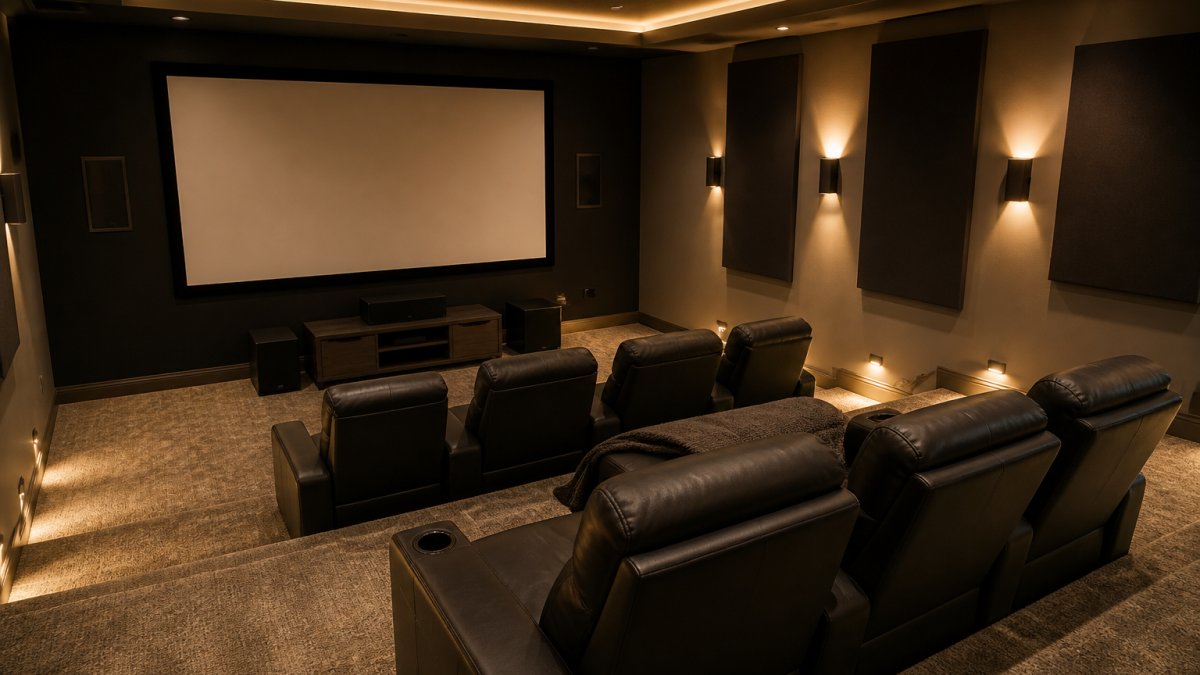
Your primary viewing distance determines screen size and speaker placement. Measure from your seating to where your display will be.
If your seating is 12 feet from the screen, a 55-inch to 65-inch TV works well. A projector screen 100 to 110 inches wide is comfortable.
Arrange seating in rows if space allows. The front row should be at least 8 feet from the screen.
Reclined seating is popular in basements. It’s comfortable for long movies. Make sure recliners have enough clearance to recline fully without hitting walls or other furniture.
Consider design ideas for basement theaters to see how other homeowners have arranged their spaces. Layout affects both comfort and acoustics.
Finished Basement Theater Wiring and Power Planning
Wiring is where most basement theater projects go wrong. Homeowners run cables haphazardly, create fire hazards, and damage equipment with power surges.
Plan your wiring before construction. Identify where each component will go: receiver, speakers, subwoofer, display, streaming devices. Map out cable routes.
You need dedicated power circuits for your home theater. A 20-amp circuit for your AV receiver and display is standard. If you have multiple displays or high-powered amplifiers, run separate circuits.
Install power outlets near where equipment will sit. Don’t run power cables across the floor or through walls without conduit. Use surge protectors to guard against power spikes.
GFCI outlets are required in basements by electrical code. They protect against shock in damp environments. Check with your local building department for specific requirements in your area.
In-Wall Cable Routing and Safety
Running cables inside walls requires care. Improper installation creates fire risk and damages equipment.
Use in-wall rated cables. These are designed to resist fire and won’t release toxic fumes if they overheat. Standard cables aren’t rated for in-wall use.
Never run power cables and audio/video cables in the same conduit. Power cables create electromagnetic interference that degrades audio and video quality.
HDMI cables are limited by distance. Standard HDMI works reliably up to 50 feet.
Get detailed guidance on hidden cable management for basement home theaters to learn safe routing techniques that protect your equipment and keep your installation clean.
Drill holes in studs carefully. Avoid existing plumbing and electrical lines.
Label all cables at both ends. When you need to troubleshoot or add equipment later, labels save hours of frustration.
Acoustic Treatment and Sound Isolation
Basement walls and floors are hard surfaces. Sound bounces off them, creating echoes and reflections that degrade audio quality. Acoustic treatment absorbs these reflections.
You don’t need to treat every surface. Strategic placement of absorption panels behind speakers and in corners makes a noticeable difference. Panels absorb midrange and treble frequencies.
Learn soundproofing techniques for basement media rooms to understand how acoustic materials work and where to place them for maximum benefit.
Common acoustic treatments include:
- Absorption panels, Mounted on walls to reduce reflections
- Bass traps, Placed in corners to control low-frequency buildup
- Diffusers, Scatter sound instead of absorbing it, useful for maintaining acoustic liveliness
- Acoustic door seals, Reduce sound leakage in and out of the theater room
Start with absorption behind your center speaker and on the walls behind your surround speakers. Add bass traps in corners where the subwoofer sits. Listen for improvement. Add more treatment if needed.
Acoustic treatment also helps isolate sound from the rest of your home. If your basement is below bedrooms, sound isolation is important.
Basement Environmental Protection and Equipment Durability
Basements are humid. Even finished basements with vapor barriers have more moisture than upstairs rooms.
Protect your equipment by controlling humidity. A dehumidifier keeps moisture levels between 30 and 50 percent (the EPA).
Monitor humidity with an inexpensive hygrometer. They cost under $20 and give you real-time readings. If humidity climbs above 60 percent, run the dehumidifier.
Ventilation helps. Make sure your basement has adequate air circulation. If your HVAC system includes basement returns, they should be open and unobstructed.
Insulate your equipment rack or shelving to prevent condensation. When warm air hits a cold surface, moisture condenses on it.
Surge protection is non-negotiable. Power surges from lightning, grid switching, or equipment failure can destroy expensive components instantly.
Check your equipment connections every six months. Look for corrosion on RCA connectors, HDMI ports, and speaker terminals. Clean corroded connections with a pencil eraser or contact cleaner.
Building a home theater in a finished basement is achievable when you plan for its unique challenges.
Berry Basements has guided homeowners through complex basement projects that integrate home theater systems with the structural and environmental demands of finished basements. We manage the infrastructure challenges, waterproofing, HVAC integration, electrical planning, and acoustic design, so your theater equipment performs reliably. Get a free estimate to discuss how a professionally finished basement can support your home theater vision while protecting your investment.
Frequently Asked Questions
What is the most important piece of home theater equipment for a basement?
The AV receiver is the central hub that processes audio and video signals from all sources and routes them to your display and speakers. Without a quality receiver, even expensive speakers and displays will not perform well. It handles surround sound decoding, amplification, and equipment switching, making it the foundation of any home theater setup.
Is a projector or TV better for a basement home theater?
Projectors work best in basements with controlled lighting and larger screens (120+ inches), creating an immersive cinematic experience. TVs offer superior brightness for rooms with ambient light and require less installation complexity. Basements favor projectors because you can control darkness and the room’s enclosed nature maximizes the viewing impact. Choose based on your room’s light control capability and desired screen size.
How do moisture and humidity affect home theater equipment in finished basements?
Moisture can damage speakers, corrode connections, and degrade wiring insulation. Finished basements need proper waterproofing, dehumidification, and climate control before installing expensive equipment. Electronics and speakers should be elevated off floors and kept away from walls prone to condensation. Ensure your basement finishing includes vapor barriers and ventilation systems before investing in audio and video gear.
What surround sound configuration works best in a basement theater space?
A 5.1 or 7.1 surround sound system is ideal for most basement theaters. Place front left and right speakers at ear level on either side of your display, center speaker above or below the screen, surround speakers on side walls at 90-110 degrees from the seating area, and a subwoofer in a corner to manage bass. Acoustic treatment with sound-absorbing panels and bass traps improves clarity and reduces echo in enclosed basement spaces.
