

Last Updated: November 9, 2026
Quick Summary
Basement lighting for home offices means building all of a room’s light from fixtures alone, since a basement office has no window and no daylight to fall back on. Layer ambient, task, and accent light, and place fixtures around the desk rather than around the room.
- A ceiling under 8 feet rules out deep pendant fixtures and pushes light sources closer to your eyes.
- Dimmable, flicker-free LEDs rated around 4000K with a CRI of 90 or higher are a common choice for a basement office.
- Two recessed cans slightly in front of and to either side of the desk beat four cans spread evenly across the ceiling.
- A standard 15-amp, 120-volt circuit is rated for 1,800 watts, with continuous load kept to 80 percent.
- Swapping a bulb or hanging a surface fixture is reasonable DIY; new circuits and panel work belong to a licensed electrician.
Table of Contents
- Why Basement Lighting for Home Offices Needs a Different Plan
- How to Light a Basement Office: A Step-by-Step Plan
- Basement Lighting Ideas for an Unfinished Ceiling
- The Best Light Bulbs for a Basement Office
- Killing Glare on Monitors and Webcams
- Circuit Capacity, Load, and Dimmable Controls
- DIY vs. Hiring a Licensed Basement Contractor
- Get a Lighting Plan With Your Free Estimate
- Frequently Asked Questions
Why Basement Lighting for Home Offices Needs a Different Plan
A basement office has no window, a low ceiling, and no daylight to fall back on. For broader strategies, see how to brighten a basement without natural light. That changes everything about how you light it.
Berry Basements finishes lower levels for homeowners who work from them daily. The lighting plan comes early, not last. Get it wrong and you get headaches, glare on the monitor, and a room nobody wants to sit in.
The Three Problems Every Basement Office Shares
Every basement workspace runs into the same three issues:
- No daylight. The sun never reaches the room, so every hour of light has to be made.
- Low ceilings. A ceiling under 8 feet rules out deep pendant fixtures and pushes light sources closer to your eyes.
- Cold, flat surfaces. Concrete and drywall bounce light poorly, so shadows sit longer and the room feels dim even when it isn’t.
Fix those three and the rest of the plan falls into place.
How to Light a Basement Office: A Step-by-Step Plan
The best basement office lighting comes from layers: ambient light for the room, task light for the desk, and accent light for depth. Build all three, and place them around the desk rather than around the room.
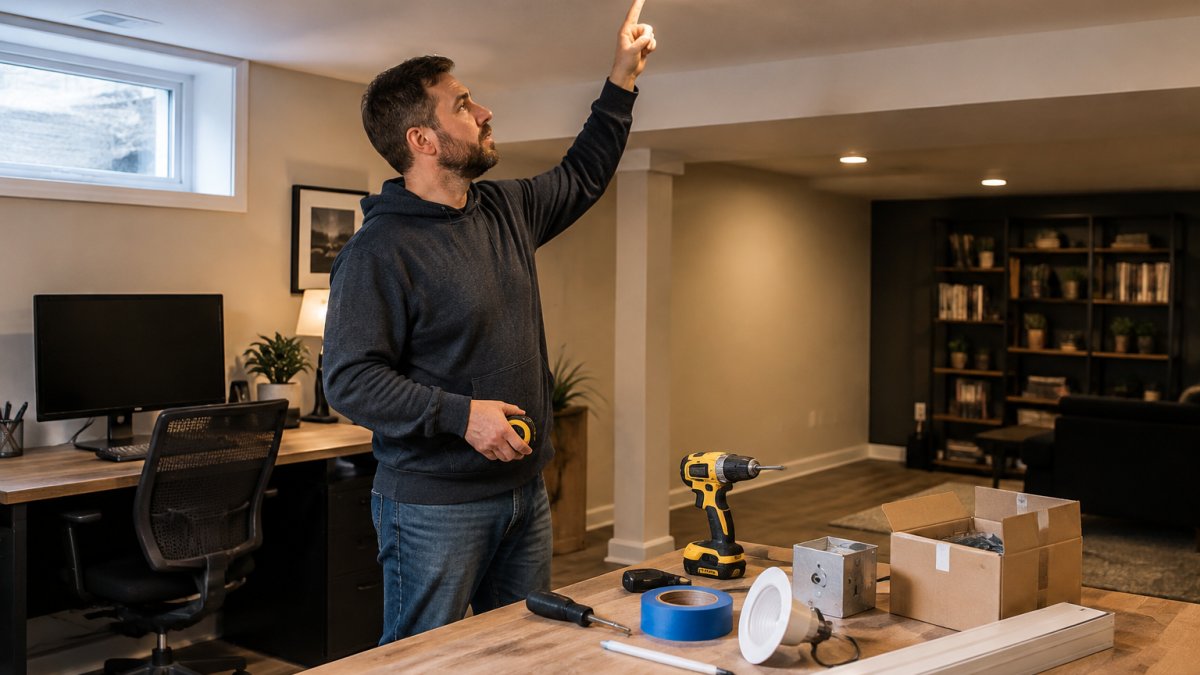
Total time: a weekend for a simple layout, longer if you add circuits.
Difficulty: moderate. Wiring work belongs to a licensed electrician.
Step 1: Map the Room and the Work
Measure the ceiling height, the desk position, and where the monitor faces. If there is any natural light at all, plan around it first; our guide on how to maximize natural light in a dark basement covers the ways to pull in and stretch whatever daylight exists.
Expected result: a simple sketch showing desk, monitor, and ceiling obstacles.
Step 2: Build the Layers
Start with ambient lighting for general brightness, add task lighting over the desk, then a little accent lighting for depth. Recessed lighting or a flush mount handles ambient. A desk lamp or under-cabinet strip handles task. Skip the accent layer and the room looks flat.
Step 3: Place Fixtures Around the Desk, Not the Room
Put light where you work. Two recessed cans slightly in front of and to either side of the desk beat four cans spread evenly across the ceiling. Keep the light source out of your line of sight and off the screen.
Watch out: placing a fixture directly above and behind your chair throws your shadow onto the keyboard. Offset it.
Basement Lighting Ideas for an Unfinished Ceiling
An unfinished ceiling is an advantage, not a problem. Open joists give you room to run cable and hide it, and you can choose surface-mounted fixtures without cutting drywall.
Good options for exposed joists:
- Track lighting aimed at the desk and walls
- Surface-mounted LED fixtures screwed to the joists
- Pendant lights dropped only where the ceiling allows
For clean ways to run and conceal cable between joists, see how to hide electrical wiring in basement ceilings. If you are still choosing a look, our roundup of contemporary basement lighting trends shows what is current.
The Best Light Bulbs for a Basement Office
Dimmable, flicker-free LED fixtures rated around 4000K with a CRI of 90 or higher are a common choice for a basement office. Warm white suits a lounge; a workspace generally needs cooler, higher-CRI light, and the fixture you put it in matters as much as the bulb itself.
Kelvin, Lumens, and CRI in Plain Terms
- Kelvin measures color temperature. 2700K is warm white, 3000K is soft white, 3500K is neutral, 4000K is cool white, and 5000K is daylight.
- Lumens measure brightness. More lumens, more light; watts only tell you power draw.
- CRI measures how true colors look under the light. Aim for 90 or higher; 80 is common in builder-grade fixtures and makes skin tones and paperwork look dull.
For a home office, 4000K is a common middle ground. It keeps you alert without the blue-heavy harshness of 5000K. If you take a lot of video calls, 3500K to 4000K with CRI 90+ reads as natural on camera and avoids the greenish cast that low-CRI LEDs throw on skin.
The Specs That Actually Matter at the Desk
Kelvin and lumens get all the attention, but four other numbers decide whether a basement office feels good to work in for eight hours:
- Beam angle. A narrow 15-25 degree beam punches a hot spot on the desk; a 60-120 degree beam spreads light evenly. For ambient cans, wider is better; for task accents, narrower is fine.
- Flicker. Cheap LEDs flicker at rates the eye does not consciously see but the brain registers as strain. Look for “flicker-free” or a driver rated at low percent flicker, and avoid dimming below about 10 percent on non-compatible dimmers.
- Dimming range. A fixture that dims to 1 percent gives you a soft evening mode; one that bottoms out at 20 percent is a work light only.
A Circadian Angle for a Windowless Room
Most basement-office advice stops at “pick 4000K and move on.” A windowless office has no natural cue for the body clock, so the light temperature has to do that job.
Bulb vs. Integrated Fixture
Screw-in LED bulbs in existing cans are a lower-cost option, though they inherit the can’s beam pattern and may not dim smoothly on older dimmers. Integrated LED fixtures are generally built around their driver, so flicker and dimming tend to be more predictable, though they cost more up front and are harder to replace.
Here are the bulb and fixture specs the article says matter most at the desk.
| Spec | Value | Note |
|---|---|---|
| Color temperature | 4000K | Common middle ground for a home office |
| Video call range | 3500K to 4000K | With CRI 90+ reads natural on camera |
| CRI | 90 or higher | 80 makes skin tones and paperwork look dull |
| Beam angle, ambient cans | 60-120 degrees | Wider spreads light evenly |
| Beam angle, task accents | 15-25 degrees | Narrow beam punches a hot spot |
| Dimming range | 1 percent | Soft evening mode; 20 percent is work light only |
| 4-inch recessed LED output | 600-900 lumens | Match count to the room |
| 6-inch recessed LED output | 900-1,200 lumens | Match count to the room |
Killing Glare on Monitors and Webcams
Glare is the number one complaint in basement offices. The fix is diffused light and the right angles.
- Never place a fixture in front of the monitor; it reflects straight into your eyes.
- Use indirect lighting bounced off a wall or ceiling.
- Put a light source behind the camera, not behind your head, so video calls show a lit face instead of a silhouette.
Low-glare setups reduce eye strain and look better on camera. Both matter when you spend the day on video.
Circuit Capacity, Load, and Dimmable Controls
Adding fixtures means adding load, and basements are the room most likely to already be near a circuit’s limit. Before you buy a single can, find out what the existing circuit can carry and whether the panel has room for a new breaker. A licensed electrician can confirm this in a short visit, but you can do most of the homework yourself first.
The Load Math, in Plain Terms
A standard 15-amp, 120-volt general-purpose circuit is rated for 1,800 watts, and the usual practice is to keep a continuous load at no more than 80 percent of that. A 20-amp circuit has higher capacity. LED fixtures generally draw modest wattage, so lighting is typically a small part of a circuit’s load. The lighting is rarely the problem.
How to Check Before You Buy
- Find the breaker. Turn off the basement circuit and confirm which outlets and fixtures go dark. If the lights and the desk outlets are on the same breaker, you are sharing capacity.
- Read the panel label. The breaker amperage is printed on the switch; 15A and 20A are the common basement sizes.
- Add up the big loads. Anything with a motor or a heating element, dehumidifier, space heater, fridge, treadmill, is the load that matters. Lighting is a rounding error by comparison.
- Check panel space. A new circuit needs a free slot and a breaker that matches the panel brand. Older panels sometimes have no room, and some legacy panels are a bigger conversation than a lighting project.
When Plug-In Beats New Wiring
If the panel is full, the ceiling is finished, or the budget is tight, plug-in solutions are a legitimate answer rather than a compromise. A plug-in track or a cord-and-plug LED strip on a switched outlet gives you task and accent light without opening a wall. The trade-off is visible cord runs and one more thing competing for outlet space; the upside is that it is reversible, rentable, and safe without a permit.
Dimmable Controls
Dimmable controls can be worth the added cost. A dimmer lets the same room shift from bright work light to soft evening light. Pair dimmable LED fixtures with a dimmer rated for LED loads, older incandescent dimmers often cause flicker, buzz, or a narrow usable range with LED drivers. If you are running two lighting circuits for cool and warm light, put each on its own dimmer so you can tune the mix rather than just the level.
DIY vs. Hiring a Licensed Basement Contractor
Swapping a bulb or hanging a surface fixture is a reasonable DIY job. Running new circuits, cutting into a finished ceiling, or tying into the panel is not. Electrical work carries real risk, and mistakes hide behind drywall.
If you are unsure which type of contractor to call, our guide on remodeling vs. custom contractors explains how to choose.
Get a Lighting Plan With Your Free Estimate
A basement office lives or dies on its lighting plan.
At Berry Basements, we have finished lower levels across the area since 2017, and we build lighting into the design from day one.
Get started with Berry Basements and a free estimate on your basement office, and turn the darkest room in the house into the best one to work in.
Frequently Asked Questions
How many lumens do I need for a basement office?
Aim for about 30 to 50 lumens per square foot of floor area for general ambient light, then add task light directly over the desk. A 100-square-foot office lands around 3,000 to 5,000 lumens total, split across several fixtures rather than one bright source. Spread the output over four to six recessed or flush-mount fixtures so light distribution stays even, and put a dimmable desk lamp or under-cabinet strip at the work surface for detail tasks.
What is the best lighting for a basement office with no windows?
Layer ambient, task, and accent light, and run everything on dimmers. Use 3000K to 4000K LED fixtures with a CRI of 90 or higher so skin tones and documents look accurate on video calls. Add a daylight-spectrum desk lamp for morning hours and warm the room to 2700K in the evening to support circadian rhythm. Diffused fixtures and indirect cove lighting keep the windowless space from feeling like a cave.
What color temperature is best for a home office?
4000K cool white suits focused work and video conferencing because it reads as neutral daylight on camera. 3000K warm white works well for mixed-use offices and evening hours. Avoid 5000K and above for long sessions, since the blue-heavy output can feel harsh in a low-ceiling basement. Tunable-white smart bulbs let you shift from 4000K in the morning to 2700K after dinner without changing fixtures.
Can I add office lighting to an unfinished basement ceiling?
Yes. Surface-mounted track lighting, flush-mount fixtures, and plug-in LED shop lights all work without drywall, and they let you reposition light as the layout changes. Track heads aim at the desk and wall wash to reduce shadows. Keep cords and outlets on a dedicated circuit, and confirm the existing electrical load and circuit capacity before adding fixtures. A licensed contractor can check capacity and pull permits if the work requires them.
