

Table of Contents
- Why Basement Lighting Matters for Modern Spaces
- Recessed Lighting for Basement Ceilings
- Layered Lighting for Basement Functionality
- LED Strip Lighting and Architectural Accents
- Basement Lighting Ideas for Low Ceilings
- Basement Lighting Color Temperature and Mood
- Smart Lighting and Control Systems
- Pendant Lights and Statement Fixtures
- Frequently Asked Questions
Last Updated: October 8, 2026
Why Basement Lighting Matters for Modern Spaces
Basement lighting transforms underutilized lower levels into functional, inviting spaces. At Berry Basements, we’ve seen how strategic basement lighting trends impact usability and resale value.
A poorly lit basement feels cramped and cold, even with a perfect layout. Contemporary basement lighting trends focus on layered ambient, task, and accent lighting for flexible, comfortable environments.
Modern design mixes fixture types, controls light color, and integrates smart controls, making basements feel like intentional living spaces rather than storage areas.
Recessed Lighting for Basement Ceilings
Recessed lighting provides clean, unobtrusive illumination, mounting flush to maximize headroom.
Spacing matters: fixtures sit roughly 4-6 feet apart. A 9-foot ceiling needs one fixture per 50 square feet; lower ceilings require tighter spacing.
LED recessed lighting is standard for basements, where lights run longer than upstairs. LEDs use less energy and produce less heat, reducing strain on climate control.
Recessed lighting alone can feel flat, so contemporary basement lighting trends combine recessed lights with other fixture types for depth and character.
Layered Lighting for Basement Functionality
Layered lighting combines ambient, task, and accent light, giving homeowners control over mood and functionality.
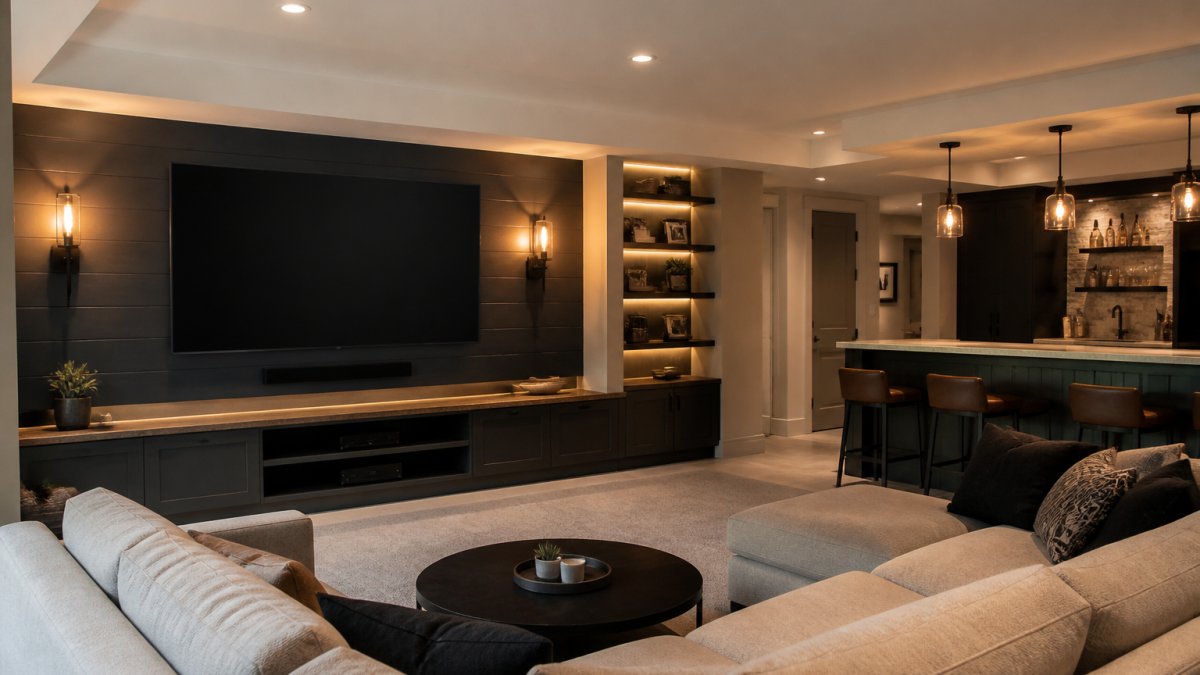
Ambient, Task, and Accent Light Combinations
Ambient lighting provides overall illumination, typically 70-80% of total output. Recessed lights, flush-mount fixtures, and surface-mounted ceiling lights deliver it, ensuring safe navigation and visibility.
Accent lighting highlights architectural features, artwork, or focal points via wall sconces, track lighting, and LED strips. It uses roughly 10-20% of total output but dramatically improves character.
Contemporary basement lighting trends emphasize this three-layer approach because it adapts to different uses, dimming ambient light for movies while keeping task lighting on for guests.
LED Strip Lighting and Architectural Accents
LED strip lighting is essential for contemporary basement design, fitting tight spaces and highlighting features other fixtures cannot reach.
Cove lighting, strips mounted in ceiling recesses, creates soft, indirect illumination that reduces harsh shadows and glare, and makes low ceilings feel higher by drawing the eye upward.
Shelf lighting under floating shelves, cabinets, or ledges illuminates storage while adding depth, using minimal energy and almost no heat.
Tray ceiling lighting highlights architectural elements and separates spaces. LED strips in tray or coffered recesses enhance existing structural detail, combining contemporary basement lighting trends with what’s already there.
Modern LED strips offer dimmer controls and color temperature options, integrating easily with smart systems. Installation requires electrical work; a professional contractor ensures safe, code-compliant placement.
Basement Lighting Ideas for Low Ceilings
Low ceilings are the defining constraint of most basements, where generic advice falls apart.
Start by measuring usable height, not ceiling height
Finished ceiling height and usable height differ. Before you shop, measure floor to the lowest obstruction overhead:
- Exposed joists: A nominal 8-foot basement with 2×10 joists and a subfloor above often leaves 7 feet 4 inches to 7 feet 8 inches of clear space between joists.
- HVAC ducts and plumbing: Supply trunks, return ducts, and drain lines frequently drop 8-14 inches below the joists. A soffit built around them can leave 6 feet 6 inches or less in that zone.
- Structural beams: Steel or wood beams may hang 8-12 inches below the joists, creating a low band across the room.
Write those numbers down, they determine which fixture families are eligible.
Fixture choices by clear height
- 7 feet 6 inches and above: Standard recessed cans, shallow-profile flush mounts, and low-profile linear fixtures all work. Keep pendants over counters only, never over walkways.
- 7 feet to 7 feet 6 inches: Switch to shallow recessed housings (often 3-4 inches deep) or surface-mounted LED panels that add less than 2 inches below the ceiling. Avoid anything with a visible drop.
- 6 feet 8 inches to 7 feet: Surface-mounted fixtures and wall sconces become the primary tools. Recessed cans may still fit between joists if the housing is rated for the cavity depth, but confirm before cutting.
- Below 6 feet 8 inches: Treat the ceiling as off-limits for hanging fixtures. Rely on wall sconces, cove lighting tucked into soffits, under-shelf strips, and floor or table lamps.
Working around joists, ducts, and beams
Recessed cans need 3 to 6 inches of clear cavity above them, space that exists only between joists and where no duct or pipe runs. A practical approach:
- Map the bays. Note which joist bays are clear, which carry ducts, and which carry plumbing. Recessed cans go only in clear bays.
- Soffit the obstructions. Build a soffit around ducts and beams, then run LED strip or linear fixtures along the soffit face to turn the obstruction into a lighting feature instead of a dark band.
- Use the beam as a divider. A low beam is a natural place to change lighting strategy, recessed cans on one side, cove or strip lighting on the other, which also visually separates zones.
Wall sconces: the low-ceiling workhorse
Sconces direct light up and down the wall rather than across the ceiling, adding illumination without consuming headroom. Mount them so the fixture center sits roughly 60 to 66 inches above the floor.
Cove and perimeter lighting to fake height
Indirect light washing up a wall or across a ceiling draws the eye upward and makes a low ceiling feel higher.
Room-by-room low-ceiling plans
- Media room: Perimeter cove lighting at 2700K for ambient glow, plus two or three narrow-beam recessed cans aimed at the screen wall. No pendants.
- Home office: A wall-mounted task light or under-cabinet strip at the desk, plus a sconce behind the monitor to reduce glare. Skip the overhead fixture entirely.
- Home gym: Surface-mounted LED panels or linear fixtures between joists, 4000K-5000K, positioned so you are not lifting directly under a shadow.
- Bar or lounge: Sconces and under-counter strips at 2700K-3000K. If you want pendants, hang them only over the bar top and keep the bottom edge at least 30 inches above the counter.
- Playroom: Surface-mounted fixtures with diffused lenses to soften shadows, plus under-shelf strips at toy storage. Avoid anything a child can reach or swing from.
Clearance rules of thumb
- Keep any hanging fixture at least 6 feet 8 inches above the floor in walkways.
- Over a counter or bar, hang pendants 30-36 inches above the surface.
- Keep recessed cans at least 18 inches from walls unless the fixture is specifically designed for wall-washing.
- Leave at least 3 inches of clearance above a recessed housing for airflow and driver heat.
Low ceilings and tight joist bays make DIY recessed installation risky. Cutting into a joist or drilling through a duct can compromise structure or airflow. If you are unsure what is inside a bay, have a licensed electrician or contractor confirm before you cut.
The takeaway for low basements
Stop trying to light a low basement from the ceiling alone. Combine wall sconces, cove or strip lighting, and a few carefully placed surface-mounted or shallow recessed fixtures, and the room reads as intentional, layered, and comfortable.
Basement Lighting Color Temperature and Mood
Color temperature is the most controllable variable in a basement, since lower levels receive so little natural light that artificial color casts dominate.
The Kelvin ranges and where they belong
- Warm (2700K-3000K): Amber-toned light that flatters skin and wood. Best for media rooms, lounges, wine bars, and any seating area where you want people to linger. In a windowless room, 2700K can read slightly dim, so pair it with higher output rather than a cooler color.
- Neutral (3500K-4100K): The workhorse range for multipurpose basements. It keeps colors honest without the blue cast of daylight, which is why it works well in home gyms, craft rooms, and open recreation areas that shift between tasks.
- Cool (5000K-6500K): Crisp and alert. Reserve it for home offices, workshops, laundry and utility zones, and anywhere you need to read fine detail or judge color. In a relaxation space, cool light makes a basement feel like a garage.
Why CRI matters more than most homeowners expect
CRI is scored 0-100 and describes how faithfully a light source renders color versus natural daylight.
Beam angle decides whether the room feels flat or layered
Beam angle is the spread of light leaving the fixture, in degrees.
Matching color temperature to the room, not the whole basement
Running one color temperature across an entire basement is why gyms feel sleepy and media rooms feel harsh. Contemporary practice is to set a base ambient temperature and vary it by zone:
- Media room: 2700K ambient, dimmable to near-zero, with narrow accent beams on the screen wall.
- Home office: 4000K task lighting at the desk, 3000K ambient behind you to reduce screen glare.
- Home gym: 4000K-5000K overhead so you can see form and footing, with a warmer accent on any feature wall.
- Bar or lounge: 2700K-3000K pendants and sconces, deliberately dim, with CRI 90+ so bottles and glassware look right.
- Playroom or craft area: 3500K-4000K, high CRI, so kids can see what they are doing and colors read true.
Dimming and color stability
Cheaper LED drivers can flicker, buzz, or shift color as you dim, a real problem in a basement.
Pick your color temperature before you pick fixtures. Once recessed cans are cut into a ceiling, changing Kelvin means changing every lamp, and matching a discontinued lamp months later is harder than it sounds.
A quick planning rule
Set one ambient color temperature for the whole basement so the space feels unified, then allow task and accent zones to deviate by no more than about 1,000K.
Smart Lighting and Control Systems
Smart lighting systems integrate recessed fixtures, strip lighting, pendants, and sconces into one platform.
Dimmer controls adjust brightness to match activities and moods, extending LED life and cutting energy use.
Voice control through smart home platforms adds convenience, especially in large recreation spaces or when your hands are full.
Scheduling automates lighting by time of day or occupancy, and motion sensors improve safety in utility areas, useful in finished basements where lighting needs change frequently.
Smartphone apps provide remote control from anywhere, useful for security, letting you turn lights on before arriving home to create the impression of occupancy.
Contemporary basement lighting trends emphasize smart controls because they maximize flexibility without structural changes; retrofitting with smart-compatible LED fixtures is straightforward and cost-effective.
Pendant Lights and Statement Fixtures
Pendant lights serve as both functional and decorative elements, providing focused task lighting over bars, islands, or dining areas.
Globe pendants create mid-century modern aesthetics popular in contemporary basement design.
Linear pendant fixtures suit contemporary spaces with clean lines, working well over longer counters or tables and complementing modern architectural details.
The key to pendant lighting is height: hang them 30-36 inches above a counter or bar for comfortable task lighting without glare.
Statement fixtures in entryways or focal areas establish the basement’s design character. A dramatic pendant or chandelier above a seating area signals intentional design.
Transforming a basement into a functional, attractive living space requires thoughtful lighting planning.
At Berry Basements, we understand that lighting is integral to basement renovation success.
Frequently Asked Questions
What color lighting is best for a basement?
Warm white light (2700K to 3000K) creates an inviting atmosphere in basements, while cooler tones (4000K to 5000K) work better for task-focused areas like home offices or gyms. Layering both warm and cool temperatures across different zones gives you flexibility to adjust mood and function. Avoid overly cool lighting in social spaces, as it can feel harsh and uninviting in basement environments.
Are recessed lights a good choice for a basement?
Recessed lighting is an excellent choice for basements because it provides full-room illumination without consuming headspace, which is critical in finished basements with lower ceilings. LED recessed fixtures are energy-efficient and produce minimal heat. However, recessed lights alone can create dark corners and glare, so they work best as part of a layered lighting plan that includes task and accent lighting for a balanced, inviting space.
How many lighting layers should a basement have?
A basement should have at least three lighting layers: ambient (overall illumination from recessed or flush-mount fixtures), task (focused light over workspaces, bars, or seating areas), and accent (highlighting architectural features or creating mood). This layered approach allows you to adjust brightness and atmosphere based on the activity, making the space feel more functional and welcoming than single-source lighting.
What are the best lights for a basement?
The best basement lighting combines recessed ceiling fixtures for ambient light, LED strip lighting for architectural accents, wall sconces for soft indirect illumination, and pendant lights or track lighting for task areas. LED fixtures are preferred across all types because they’re energy-efficient, long-lasting, and produce less heat. Choose moisture-resistant fixtures rated for basement environments, and pair them with dimmers and smart controls for maximum flexibility in different zones.