

Table of Contents
- Why Low Ceilings Make Basement Lighting Tricky
- Recessed Lighting for Low Ceilings: Wafer and Pancake Options
- Flush Mount vs. Semi-Flush Mount Fixtures for Tight Spaces
- Track Lighting and LED Panels for Joist-Mounted Ceilings
- How to Brighten a Dark Basement Without Lowering the Ceiling
- Best Light Color Temperature for Basements (and Why It Matters)
- Smart Home Integration and Zone Lighting for Basements
- Conclusion: Choosing the Right Low-Ceiling Lighting Plan
- Frequently Asked Questions
Last Updated: September 15, 2026
Why Low Ceilings Make Basement Lighting Tricky
Most basement lighting ideas for low ceilings fail because the fixtures eat the headroom you’re trying to preserve. A standard recessed can housing needs 5 to 6 inches of cavity depth above the drywall, and a surface-mounted fixture protrudes downward (energy.gov). In a basement with 7-foot ceilings and ductwork below the joists, every inch counts.
This guide from Berry Basements covers seven lighting strategies for tight vertical clearance, from ultra-thin wafer lights to wall-mounted solutions that use zero ceiling space, plus which fixtures fit where and the installation details most guides skip.
The core problem isn’t brightness but geometry: you need even light distribution without a fixture body hanging into your walking space.
Hanging a standard pendant or chandelier in a basement with 7-foot ceilings creates a head-strike hazard. Building codes in many jurisdictions require a minimum clearance below ceiling-mounted fixtures in habitable spaces, so check local requirements before installing anything that extends more than a few inches down.
Recessed Lighting for Low Ceilings: Wafer and Pancake Options
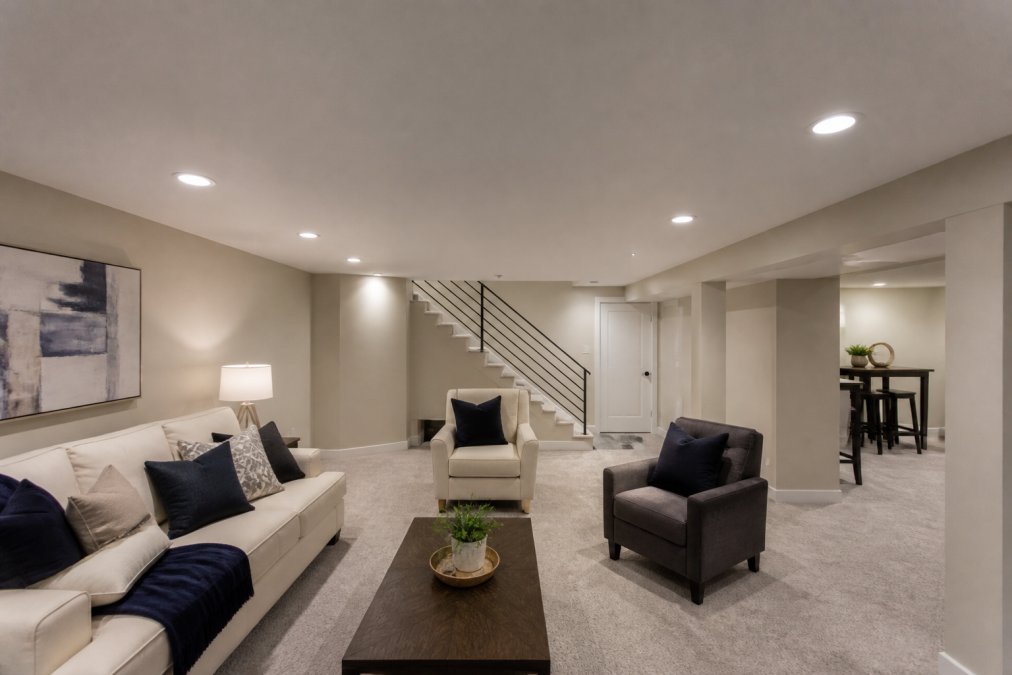
The best recessed lighting for low ceilings uses wafer or pancake-style LED downlights, which install in as little as 1 inch of ceiling depth. They eliminate the housing can entirely: a thin driver box sits above the drywall, and the light panel clips flush to the ceiling.
For basements with shallow joist bays or furred-down ceilings, this is often the only recessed option that works. The DOE lighting standards and LED efficiency guidance confirms that integrated LED downlights also deliver better energy efficiency than legacy bulb-and-housing setups.
Wafer Lights vs. Traditional Housings
| Feature | Wafer LED | Traditional Housing |
|---|---|---|
| Ceiling depth needed | Under 1 inch | 5-6 inches |
| Installation | Cut hole, clip in | Frame, wire, trim |
| Best for | Shallow joists | Deep cavities |
| Look | Flush, modern | Recessed can |
The trade-off: wafer lights require cutting into drywall. If your basement has an exposed or concrete ceiling, skip to the surface-mount options below.
The Clearance Math Most Guides Skip
A standard 2×8 or 2×10 floor joist leaves a shallow cavity once you account for subfloor, wiring, plumbing, and ductwork. A traditional recessed can needs 5 to 6 inches of clear depth above the drywall, which is why it often fails in basements. A wafer light needs roughly 1 inch for the panel plus a driver box typically 1 to 2 inches deep, and that box is the real constraint: it must sit where no joist, pipe, or duct blocks it.
Before buying fixtures, measure clear depth in several bays, not just one; bays near the HVAC trunk line are usually shallowest. If a bay has less than about 2 inches of clear space, plan for a surface-mount or track fixture there instead.
Spacing and Layout for Even Light
Recessed downlights are usually spaced so the distance between fixtures roughly equals the ceiling height. On a 7-foot ceiling, that means a grid of 4-inch or 6-inch wafer lights on 6-foot centers, with the first row 2 to 3 feet off each wall so light washes the perimeter instead of pooling in the middle. Tighter spacing with smaller apertures gives more even coverage and fewer shadows than a few large cans.
Keep fixtures at least 2 feet from any wall you plan to light with a sconce or strip, and avoid placing a downlight directly over a seating position where it casts a shadow on a face.
Ratings, Dimmers, and Flicker
Two ratings matter in a basement. An IC-rated (insulation contact) fixture is required where insulation sits close to the fixture, common in rim-joist areas and exterior walls. An airtight rating matters because basement ceilings often separate conditioned from unconditioned space. Both are printed on the fixture label.
Wafer lights are integrated LED, so dimming depends on the driver. Use a dimmer listed as compatible with the specific fixture and look for smooth low-end dimming; cheap drivers and mismatched dimmers are the most common cause of flicker and buzz.
DIY vs. Professional Installation
Cutting holes and clipping in wafer lights is within reach for a confident DIYer, but three things push the job toward a licensed electrician:
- Running new circuits or adding a dimmer switch where no switch leg exists.
- Working around ductwork and plumbing in shallow bays, where a misplaced hole can hit a pipe.
- Permits and inspection. Many jurisdictions require an electrical permit for new recessed lighting circuits, and the work must pass inspection.
A practical middle path: have an electrician run and terminate the circuit and switch, then cut and clip the fixtures yourself. Before any cutting, confirm what is above the drywall with a stud finder, a borescope, or a small test hole in an inconspicuous spot.
Never cut into a ceiling bay until you have confirmed there is no wiring, plumbing, or ductwork in the path. In basements, supply and drain lines often run below the joists, and a blind cut can be expensive to repair.
Flush Mount vs. Semi-Flush Mount Fixtures for Tight Spaces
Flush mount fixtures sit directly against the ceiling with no gap, making them the safest choice when vertical clearance is minimal. Semi-flush mounts drop a few inches on a short stem or collar, adding visual interest but costing headroom.
For a low basement ceiling, flush mount wins almost every time: an integrated LED flush mount provides even ambient lighting, installs on a standard junction box, and adds nothing to fixture height. Semi-flush models make sense only when your ceiling clears 8 feet and you want a decorative focal point.
A common mistake is buying a semi-flush fixture for a 7-foot ceiling because it looks better in the showroom. In practice, it hangs into sightlines and feels cramped.
Track Lighting and LED Panels for Joist-Mounted Ceilings
Track systems and LED panels mount flat to the ceiling or suspend on minimal hardware, giving directional control without deep installation, useful where joists run exposed or you can’t cut large holes.
A track kit with adjustable heads lets you aim light toward a bar, home gym corner, or media wall, while LED panels offer broad, diffused light across a wider area with a very slim profile.
When Track Systems Beat Recessed Lights
Choose track lighting when you need flexibility and can’t commit to fixed hole locations, ideal for exposed joists, concrete ceilings, or rentals needing less permanent modification. Visible hardware is the trade-off, but a slim track reads as intentional in an industrial-style basement.
How to Brighten a Dark Basement Without Lowering the Ceiling
Brightening a dark basement is about layering light, not adding more of it. A single overhead source creates harsh shadows and gloomy corners; combine three layers so light bounces off walls and floors.
Layering Ambient, Task, and Accent Light
- Ambient lighting: Flush mounts or wafer downlights for overall illumination.
- Task lighting: Under-cabinet LED bars over a bar, desk, or workspace.
- Accent lighting: Wall sconces or LED strips that wash light up a wall to make the ceiling feel taller.
Wall sconces are the underrated hero here. They use zero ceiling height and direct light upward, which visually lifts a low ceiling. According to Illuminating Engineering Society lighting recommendations, layered lighting also reduces glare and eye strain compared with a single bright source.
Match the Light to the Zone, Not the Whole Room
Most low-ceiling guides treat the basement as one space with one switch. In practice, a finished basement is three or four rooms sharing a ceiling, each wanting different light:
- Home office or study: Bright, even task light at 3500K to 4000K, with a desk lamp or under-shelf strip so the work surface is lit without glare on a monitor.
Use Wall and Floor Reflectivity to Fake Height
Placement Rules That Keep Light Off the Ceiling Plane
Paint the ceiling a flat white and keep it lighter than the walls. A bright ceiling reflects more light downward and reads as higher than a dark one, a trick that costs nothing during a renovation.
In a low-ceiling basement, the fastest visual gain comes from three moves: light the walls instead of the ceiling, keep the ceiling the brightest surface in the room, and give each zone its own control. None of these require lowering the ceiling or adding a single fixture.
Best Light Color Temperature for Basements (and Why It Matters)
Here’s how the scale breaks down:
Smart Home Integration and Zone Lighting for Basements
Conclusion: Choosing the Right Low-Ceiling Lighting Plan
Frequently Asked Questions
What are the best lighting fixtures for basements with low ceilings?
Wafer LED downlights and flush mount fixtures work best because they sit nearly flat against the ceiling. Wafer lights are under an inch thick and need no housing can, so they fit shallow joist spaces. Flush mounts install directly on a junction box and add almost no vertical bulk. Both keep ceiling clearance intact while delivering even, diffused light across the room.
How can I make a low-ceiling basement feel taller with lighting?
Direct light upward or outward instead of straight down. Wall sconces that wash light up the wall draw the eye vertically. Recessed lights placed near walls create a perimeter glow that makes the ceiling feel higher. Keep color temperature in the 3000K to 4000K range to mimic daylight, and use dimmable fixtures so you can adjust brightness for different activities without harsh shadows.
What color temperature is best for basement living spaces?
Stick with 3000K to 4000K for most basement living areas. Warm white at 3000K suits home theaters and lounges, while 4000K brightens playrooms, gyms, and home offices. Avoid anything above 5000K because it reads as clinical. Smart bulbs let you shift color temperature by activity, so one fixture can serve multiple zones.
Are recessed lights the best choice for low basement ceilings?
They are one of the best options when you have at least a few inches of joist depth. Wafer-style recessed lights need less than an inch of clearance and install in shallow ceilings where traditional housings will not fit. If your ceiling is concrete or you cannot cut into it, surface-mount downlights that mimic the recessed look are a solid alternative.