

Table of Contents
- Why Basement Window Treatments Matter for Privacy and Daylight
- How to Compare Privacy and Light Control Across Treatments
- Roller Shades and Blackout Options for Basement Windows
- Cellular Shades for Basement Windows
- Faux Wood Blinds and Aluminum Blinds for Basements
- Blackout Curtains for Basement Windows
- Privacy Window Film for Basement Windows
- Light-Filtering Shades for Basement Windows
- Frequently Asked Questions
Last Updated: October 12, 2026
Why Basement Window Treatments Matter for Privacy and Daylight
Basements sit partially below ground, so natural light is limited and privacy concerns differ from upper floors. The right basement window treatments control daylight while blocking outside views, especially important when windows sit near ground level.
Privacy and daylight aren’t binary, the key is knowing what each treatment delivers and where it falls short.
This guide compares blackout curtains, cellular shades, roller shades, blinds, and privacy film with honest pros and cons.
How to Compare Privacy and Light Control Across Treatments
The best basement window treatment depends on how much privacy you need versus how much natural light you want, two goals that often work against each other.
Privacy by Time of Day and Viewing Angle
Privacy isn’t all-or-nothing, what matters is when and from where someone might look in. A basement bedroom needs nighttime privacy; a gym prioritizes daytime privacy; a media room needs total darkness.
Viewing angles matter too: some treatments block straight-on views but allow sight lines from above or below. Top-down cellular shades block upper views while keeping the bottom open for light; blackout curtains block everything but require full closure; privacy film works at any angle but cuts light.
Light Control and Daylight Retention
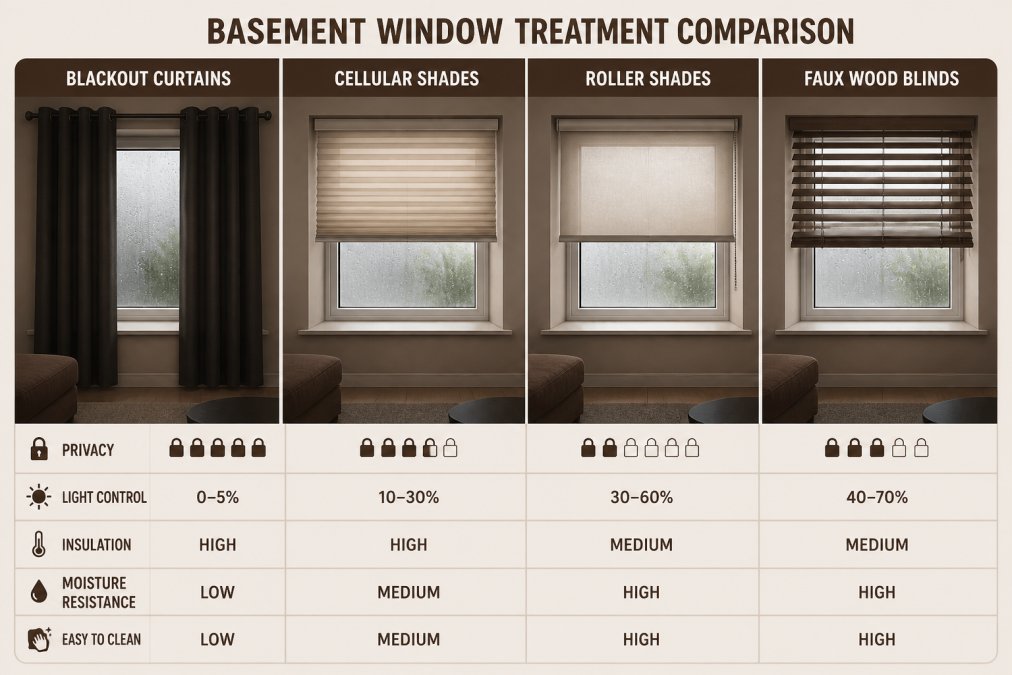
Basements naturally lack daylight, so maximize what little you have unless darkness is the goal. Light-filtering shades preserve daylight while maintaining privacy; blackout options eliminate light almost entirely; roller and cellular shades offer an adjustable middle ground.
One thing most guides miss: moisture. Basements are humid. This is why moisture-resistant materials matter more in basements than anywhere else in your home.
| Treatment Type | Privacy Level | Daylight Retained | Moisture Resistant | Best For |
|---|---|---|---|---|
| Blackout Curtains | Complete | Minimal | Good | Bedrooms, home theaters |
| Cellular Shades | High | Moderate | Fair | Balanced privacy and light |
| Roller Shades | Moderate | High | Good | General use, easy control |
| Faux Wood Blinds | Moderate | High | Excellent | Basements with humidity |
| Privacy Film | Complete | Reduced | Excellent | Permanent solution, minimal maintenance |
| Light-Filtering Shades | Low | High | Fair | Daytime privacy, maximum light |
Roller Shades and Blackout Options for Basement Windows
Roller shades are the workhorse of basement window treatments: fabric on a spring or clutch tube, pulled down to cover the glass and retracted into a cassette or exposed roll.
Light-filtering roller shades use semi-opaque fabric.
Blackout roller shades add a coated backing (often white or silver reflective) that blocks essentially all visible light, the right call for a shift-work bedroom, a media room, or any space where you project a screen without ambient wash.
The Time-of-Day Privacy Trap
Here’s the nuance most guides skip: light-filtering roller shades give privacy during the day because the outside is brighter than the inside. At night that flips, with interior lights on, the shade becomes a shadow screen, and silhouettes are visible from outside, especially from a window well at eye level. If your window faces a sidewalk, driveway, or neighbor’s window, plan a blackout or room-darkening layer for evening.
Measuring for a Basement Window
Basement windows are frequently smaller and shallower than main-floor windows, so measure before you buy:
- Inside mount (shade sits inside the frame): measure width at the top, middle, and bottom and use the narrowest number. Most roller shade brackets need at least 2 inches of flat mounting depth, more for a cassette, many basement frames are too shallow.
- Outside mount (shade overlaps wall or trim): measure the width you want to cover and add 2 to 4 inches per side for light control and privacy, the more forgiving option for shallow or uneven frames.
- Height: for a blackout roller shade, add 2 to 3 inches of overlap at the bottom so light does not leak under the hem.
Egress Windows: Do Not Block the Exit
If your basement has an egress window, required by many state and local codes for sleeping rooms, the covering must not obstruct the opening. Mount the shade so the full opening and any operable sash or latch stay clear, and avoid valances or cassettes that reduce the clear opening. Check local code and the manufacturer’s instructions first.
Moisture and Condensation
Basement air is often cooler and more humid than upstairs. When warm, moist interior air meets a cold pane, condensation forms, and a shade pulled tight against the glass traps that moisture, feeding mildew on the fabric and staining the frame. Two fixes: leave a small gap for air circulation, and choose a moisture- or mildew-resistant fabric.
If your basement windows sweat in winter, run a dehumidifier and keep shades slightly open during the day. Trapped condensation is the leading cause of musty odors around basement windows.
Cost and Where Roller Shades Fit
Roller shades are among the most affordable options per window, and blackout versions cost only modestly more than light-filtering. For a basement with several small windows, they’re the fastest, least expensive way to get consistent privacy and light control. Their main limitation is a single control point, up or down, no slat-level fine-tuning.
Cellular Shades for Basement Windows
Cellular shades, also called honeycomb shades, fold fabric into cells that trap a layer of air between window and room. That air layer makes them the most insulating treatment commonly sold, and insulation matters more in a basement because walls and floors contact cool soil year-round.
How the Cell Structure Affects Privacy and Light
- Single-cell shades have one row of cells: lighter, less expensive, and more daylight passes through. From outside during the day, the window looks softly lit but not transparent.
- Double-cell shades have two rows: better insulation, more light blocked, more privacy, but they cut more of the daylight you’re trying to preserve.
- Top-down/bottom-up operation lowers the shade from the top while keeping the bottom open, or raises it from the bottom while keeping the top covered. This is the single most useful feature for a ground-level basement window: block the upper glass a passerby sees through while leaving the lower portion open for daylight.
Privacy by Time of Day
Like light-filtering roller shades, most cellular shades give reliable daytime privacy because the exterior is brighter than the interior. At night with interior lights on, silhouettes can be seen from outside, particularly from a window well at eye level. If nighttime privacy matters, choose a room-darkening or blackout cellular shade, or plan a curtain layer for evening.
Moisture and Condensation in Basements
Cellular shades handle basement humidity better than flat fabric shades in one respect: the cell structure holds fabric slightly away from the glass, allowing some air circulation and reducing the surface where condensation collects. Still, no cellular shade is immune to a persistently damp window. If your windows sweat heavily, fix the moisture source first, grading, gutters, a dehumidifier, or window-well drainage, before investing in any fabric treatment.
Cleaning and Maintenance
Cellular shades are low-maintenance: dust the exterior face with a vacuum brush or dry microfiber cloth, spot-clean with mild detergent and water, and never soak or machine-wash them, the cells will collapse. In a humid basement, check the bottom rail and sides periodically for mildew.
Matching the Shade to the Room
This is where cellular shades earn their cost, because the right cell count and opacity depend on how the room is used:
| Room Use | Recommended Cellular Shade | Why |
|---|---|---|
| Basement bedroom | Double-cell, room-darkening or blackout | Nighttime privacy and sleep quality |
| Media or theater room | Double-cell, blackout | Eliminates ambient light wash on the screen |
| Home office | Single-cell, light-filtering, top-down/bottom-up | Daylight for video calls, privacy from the street |
| Playroom or family room | Single-cell, light-filtering | Maximum daylight, daytime privacy |
| Laundry or utility area | Single-cell, moisture-resistant | Durability in a humid, low-traffic space |
| Gym or workout room | Single-cell, light-filtering | Daylight and airflow, privacy from neighbors |
Cost and Trade-offs
Cellular shades cost more than basic roller shades, and the price rises with cell count, custom sizing, and motorization, for a basement with several windows, the total adds up quickly. The trade-off is worth it when you need insulation, noise reduction, or top-down/bottom-up flexibility no roller shade offers. If you just want to block views cheaply, roller shades or privacy film will do; for a comfortable, quiet, energy-efficient room you use every day, cellular shades are usually the best balance.
For most finished basements, the winning combination is a light-filtering cellular shade with top-down/bottom-up operation for daytime privacy and daylight, plus a blackout layer (curtain or second shade) for nighttime privacy in bedrooms and media rooms.
Faux Wood Blinds and Aluminum Blinds for Basements
Blinds offer adjustable privacy and light control through tilting slats.
Faux wood blinds resist moisture and won’t warp or swell like real wood, durable, easy to clean, and unfazed by basement humidity.
The advantage of blinds is precision control: adjust the slat angle for exactly the light and privacy you want at any moment.
Faux wood blinds look more finished than aluminum and complement most basement décor.
Blackout Curtains for Basement Windows
Blackout curtains are the traditional approach to complete light and privacy control.
The downside: they require full closure to work, so wanting daylight means partially opening them and compromising privacy.
For basement bedrooms or home theaters where darkness is the priority, blackout curtains deliver. For spaces needing flexibility between privacy and daylight, they’re less ideal.
Privacy Window Film for Basement Windows
Privacy film adheres directly to the glass, a permanent solution that blocks views while allowing light through, depending on the type.
Frosted or opaque films eliminate outside views while diffusing light into the room.
The disadvantage: installation is permanent, and removing film if you change your mind or move is labor-intensive. Some films also reduce light more than others, so test samples before committing.
Light-Filtering Shades for Basement Windows
Light-filtering shades let natural light through while maintaining daytime privacy.
The trade-off: they don’t provide complete privacy at night when interior lights are on, someone looking closely might see movement or silhouettes.
Light-filtering shades are affordable, easy to install, simple to operate, and low-maintenance in humid environments.
Choosing the right basement window treatments depends on your needs.
When you’re planning a basement renovation, window treatments are just one piece. Whether you’re finishing a basement bedroom, building a home theater, or creating a gym space, we work with you to ensure every element, including window treatments, serves your vision.
Frequently Asked Questions
What are the best basement window treatments for blocking light at night while maintaining daytime privacy?
Blackout curtains and cellular shades with blackout liners offer the strongest light-blocking performance. Cellular shades provide dual-cell construction that traps air and blocks most daylight, while blackout curtains hang over the entire window frame for complete darkness. Roller shades with blackout fabric also work well and take up less space. For daytime privacy without total darkness, faux wood blinds with adjustable slats let you control the angle of view while retaining some natural light.
How do privacy window films compare to traditional window treatments for basement windows?
Privacy window film adheres directly to the glass and creates a frosted or decorative effect that blocks visibility from outside while allowing light to pass through. It’s a permanent solution that doesn’t require cleaning or adjustment like blinds. However, it reduces light more than light-filtering shades and cannot be easily removed or adjusted. Window film works best for basement windows where you want consistent privacy without daily control, such as in bathrooms or bedrooms. Treatments like cellular shades offer more flexibility if you want to adjust privacy and light throughout the day.
Are cellular shades a good choice for basement windows with moisture concerns?
Cellular shades can work in basements if you choose moisture-resistant options. Single-cell shades are more moisture-resistant than double-cell designs because they have fewer air pockets where condensation can collect. Look for shades with a moisture-resistant coating and ensure proper ventilation in your basement to minimize condensation buildup. Faux wood blinds and roller shades are generally more durable in damp conditions. If your basement has active moisture or condensation issues, address the underlying cause first through waterproofing or dehumidification before installing fabric-based treatments.
What window treatments work best for small basement windows without blocking all natural light?
Light-filtering shades are designed specifically for this balance. They allow diffused daylight to enter while obscuring the view from outside. Roller shades in light-filtering fabric, cellular shades with a single cell, and faux wood blinds with adjustable slats all provide options. For very small windows, inside-mount roller shades or cellular shades take up minimal space and can be cut to width for a custom fit. Roman shades also work well for small openings. Avoid full blackout options if you need daylight; instead, use adjustable treatments so you can control light throughout the day.
How do I measure and install window treatments on small or unusually shaped basement windows?
Measure the width and height of the window opening at three points (top, middle, bottom) and use the smallest measurement for inside-mount installations to ensure a proper fit. For outside-mount treatments, measure the frame and add 2-3 inches on each side for full coverage. Small basement windows often benefit from inside-mount shades or blinds to avoid light gaps. Egress windows require special attention: ensure treatments don’t block emergency exit access and consider outside-mount options that don’t interfere with operation. Many retailers offer cut-to-width shades for custom sizing. Professional installation is recommended for unusual shapes or if your basement has structural considerations.