

Last Updated: November 24, 2026
Quick Summary
The homeowner owns the materials once they pay for them, and the contractor owns materials they bought and have not yet been reimbursed for. In a basement renovation, whoever pays first usually owns first, and whoever owns first carries the risk of loss.
- A common hybrid split has the contractor buy rough materials while the homeowner picks and pays for finishes.
- Delivery does not automatically transfer ownership; if the contract is silent, ownership usually follows payment.
- Ask for a certificate of insurance naming the materials coverage and policy limits.
- Special-order tile, flooring, and fixtures commonly carry a restocking fee, often a percentage of the item price.
- Keep every receipt, invoice, delivery ticket, change order, and lien waiver from day one.
Table of Contents
- Who owns materials in a basement renovation?
- Who buys materials for a remodel: homeowner or contractor?
- Basement renovation contract materials clauses to insist on
- Title transfer, risk of loss, and who pays for damage
- Contractor leftover materials policy: surplus, returns, and restocking fees
- Receipts, invoices, and proof of payment when disputes start
- Get your free estimate from Berry Basements
- Frequently Asked Questions
Who owns materials in a basement renovation?
The homeowner owns the materials once they pay for them, and the contractor owns materials they bought and have not yet been reimbursed for.
A basement renovation moves a lot of material through a house: framing lumber, insulation, drywall, flooring, tile, fixtures, and finish trim.
Projects often turn tense when nobody wrote down who was buying the tile. Below, we break down the purchasing split, the contract language that protects you, and what happens to unused materials.
Federal Trade Commission guidance on home improvement contracts
Who buys materials for a remodel: homeowner or contractor?
There is no single rule. The split depends on the contract, and both models are common.
Homeowner-purchased materials are items you buy and pay for directly.
Contractor-purchased materials are items the contractor buys and bills you for, often through a trade account.
What most guides miss is the paperwork gap. If you buy the tile and it arrives cracked, you own the problem.
A purchasing responsibility matrix
Use this as a starting draft, then adjust it with your contractor before signing.
| Material type | Who buys | Who owns it | Who handles returns |
|---|---|---|---|
| Framing lumber, sheathing | Contractor | Homeowner after payment | Contractor |
| Insulation, drywall | Contractor | Homeowner after payment | Contractor |
| Waterproofing membrane | Contractor | Homeowner after payment | Contractor |
| Flooring and tile | Either (state it) | Buyer until paid | Buyer |
| Light fixtures, hardware | Homeowner | Homeowner at purchase | Homeowner |
| Vanities, fixtures | Either (state it) | Buyer until paid | Buyer |
| Surplus and leftovers | Per contract | Per contract | Per contract |
The rule to remember: whoever pays first usually owns first, and whoever owns first carries the risk.
Basement renovation contract materials clauses to insist on
Get the materials terms in writing before anyone orders a box. A verbal “we’ll figure it out” is how disputes start.
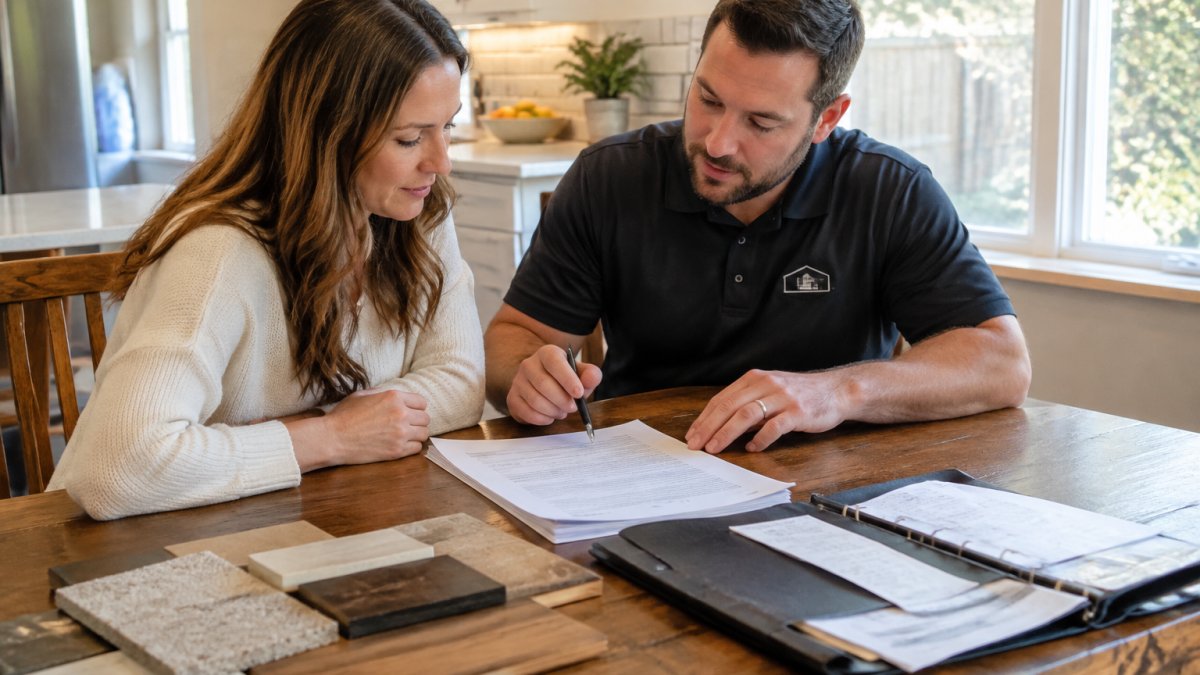
Your basement renovation contract materials section should name, in plain language:
- Who purchases each category of material, by name
- When title transfers from contractor to homeowner
- Who stores materials and where, plus who insures them
- The allowance amounts for finishes, and what happens if you go over
- The substitution rule: no swap without your written approval
A written agreement that lists materials by category beats a general promise every time. If a clause is vague, ask for a sentence that names the item and the owner.
The renovation contract checklist
Print this and take it to the signing table.
- Materials list attached, by category
- Purchasing responsibility named for each category
- Title transfer point stated
- Allowance amounts written in dollars
- Substitution approval process described
- Storage location and insurance named
If a contractor resists putting these in writing, that tells you how the project will go.
For a deeper walkthrough of contract language, see what a basement renovation contract should include.
Title transfer, risk of loss, and who pays for damage
Ownership and risk are two different things, and this is where most homeowners get surprised. A contract can make you the owner of a stack of drywall while the contractor still carries the risk if it gets wet. Get both terms in writing and make them match.
The four ownership stages
Legal ownership of renovation materials generally moves through four stages, and each one can be set differently in the contract:
- After purchase. The buyer, homeowner or contractor, owns the material when the sale is complete. If the contractor buys on a trade account, the supplier may retain a security interest until the invoice is paid, which is why paid invoices and lien waivers matter later.
- After delivery. Delivery does not automatically transfer ownership. If the contract is silent, ownership usually follows payment, not the drop-off. A delivery ticket signed on site is proof of receipt, not proof of title.
- After installation. Installation rarely changes ownership by itself. Once you own the material, you own it installed or not. What changes is risk: the contractor typically carries responsibility for workmanship and damage during installation.
- After final payment. Final payment and lien waivers close the loop.
Risk of loss: who pays when something breaks, walks, or floods
Risk of loss is the financial responsibility for materials that are stolen, damaged, or destroyed before installation. Three mechanisms decide it:
- The contract clause. Look for a sentence saying who insures materials on site and who bears loss before installation. If it is missing, ask for it.
- The contractor’s insurance. General liability typically covers third-party property damage; an installation floater or builder’s risk policy covers materials waiting to be installed. Ask for a certificate of insurance naming the materials coverage and policy limits.
- Your homeowner’s policy. Your policy may cover materials you own on your property, but may exclude materials a contractor is storing for future installation, and a claim can affect your premium. Call your agent before the first delivery.
Watch out: if the contract says title passes at delivery but says nothing about insurance, you may own materials the contractor has no obligation to protect.
Storage and site protection checklist
Most damage and theft losses trace back to storage, not installation. Walk the site before materials arrive and confirm:
- Lockable storage. A locked garage, pod, or interior room beats an open carport. Drywall and lumber should be off the floor on spacers.
- Dry location. Stored drywall and wood absorb moisture. Keep them out of damp corners and away from open foundation walls before waterproofing is complete.
- Delivery scheduling. Stagger deliveries so finishes do not sit on site for weeks before installation.
- Inventory and photos. Photograph each delivery with a date stamp and keep the delivery tickets.
- Theft response. If copper, fixtures, or tools disappear, file a police report the same day, insurers and contractors usually require it.
- Subcontractor access. Know who has keys and when. A shared lockbox with a changeable code beats an open door.
If a dispute escalates past a conversation, know when and how to terminate a basement renovation contract.
Contractor leftover materials policy: surplus, returns, and restocking fees
Leftover material is one of the most common sources of quiet friction. A contractor leftover materials policy should be written, not assumed, and it should answer three questions for every category: who owns the surplus, who pays for returns, and who gets the credit.
Who owns the leftovers
The default rule follows payment. If you paid for the extra box of tile, the leftovers are yours. If the contractor bought the material and billed you, the leftovers are yours after you pay that invoice, minus anything needed for warranty repairs.
The practical problem is that most contracts never say which of those applies. A single sentence, “surplus materials purchased by the contractor and billed to the owner become the owner’s property on payment; the contractor may retain a reasonable quantity for warranty repairs”, prevents most arguments.
Returns, restocking fees, and credits
Returns are where money quietly disappears. Plan for these mechanics before ordering:
- Restocking fees. Special-order tile, flooring, and fixtures commonly carry a restocking fee, often a percentage of the item price. Ask the supplier for the fee in writing before ordering.
- Return windows. Many suppliers measure the window in days from delivery, not installation. Materials that sit for a month may be unreturnable by the time the project reaches them.
- Open boxes and cut items. Opened boxes usually cannot go back, and cut or custom items are almost never returnable. Order custom pieces from measured dimensions and accept that offcuts are a cost.
- Credit destination. Decide in advance whether return credits go to the homeowner or against the contractor’s invoice. If the contractor paid and you reimbursed, the credit should come back to you on the final invoice, itemized.
- Receipts for returns. Ask for the supplier’s return receipt and attach it to the final invoice so the credit is traceable.
A practical approach: agree in advance that a set quantity of surplus, one box of tile, a half-gallon of paint, a few spare boards, stays with the house for future repairs, labeled and stored dry. Everything else goes back for credit, and the credit appears as a line item on the final invoice.
Custom, special-order, and allowance items
Custom and special-order materials deserve their own clause because they are the least returnable and most likely to be over-ordered.
Watch out: a final invoice that shows a lump-sum “materials” line with no return credits is impossible to audit. Ask for returns and credits itemized before you make the final payment.
If billing feels off, learn the signs of a bad basement renovation contractor before the project gets further along.
Receipts, invoices, and proof of payment when disputes start
Paper wins arguments. Keep a folder, digital or physical, from day one.
What to keep:
- Every receipt for materials you bought
- Every contractor invoice, marked paid or unpaid
- Delivery tickets signed at drop-off
- Photos of materials on arrival, with dates
- Change orders, signed by both sides
- Lien waivers from subcontractors at each payment
Lien waivers are your protection. Ask for one from each sub at each draw.
If a receipt or invoice dispute starts to feel like a pattern, that is a signal. Our guide on warning signs of a bad contractor covers what to watch for next.
Get your free estimate from Berry Basements
The cleanest way to avoid a materials fight is to settle the terms before the first delivery truck arrives.
We work through a collaborative process with our clients. We handle complex tasks such as waterproofing so that the project is managed from planning to execution.
Ready to price your project? Read our 2026 cost guide and request a quote. If you would rather talk it through, book your basement renovation consultation online.
A materials dispute can stall a project for weeks and cost more than the materials themselves.
Frequently Asked Questions
Do contractors keep extra materials after a basement renovation?
Only if the contract says so. Materials a contractor buys and bills to you are generally yours once paid for, and leftover boxes of flooring, tile, or trim should be handed over or credited. A clear contractor leftover materials policy in the written agreement should state who keeps surplus, who pays restocking fees on returns, and how any credit is calculated. Ask before signing, and get the answer in writing rather than a verbal promise.
Should a contractor provide receipts for renovation materials?
Yes, when materials are billed at cost or through an allowance. Receipts and invoices let you confirm what was bought, what it cost, and what was returned. For fixed-price contracts, you may not see every receipt, but you should still get a written list of included materials and finishes. Keep your own copy of every receipt, invoice, and change order, because they are your proof of payment if a lien or dispute ever comes up.
Who is responsible for damaged or missing materials during a remodel?
It depends on who holds title and possession at the time. Once materials are delivered to your property and accepted, risk of loss usually shifts to you unless the contract says otherwise. A good agreement names who insures materials, who covers theft from an open site, and who pays for replacements after damage. Ask your contractor for a certificate of insurance before work starts so you know their policy covers on-site materials.
Can a contractor charge for unused materials?
They can charge for materials they purchased for your project, but not for materials never used and never returned without explanation. Allowances should be reconciled with receipts, and surplus should be returned for credit or left with you. If a contractor wants to charge for leftovers, the contract should say so up front. Review the final invoice line by line and ask for documentation on any material charge you do not recognize.
