

Table of Contents
- Why Skip the Wet Bar and Explore Other Basement Entertainment Options
- Basement Game Room Ideas That Bring Families Together
- Basement Home Theater Ideas for Movie Nights and Events
- Basement Snack Station Ideas for Easy Entertaining
- Basement Lighting Ideas to Set the Right Mood
- Multi-Use Lounge Spaces for Casual Gathering
- Planning Your Basement Entertainment Space: What to Consider
- Frequently Asked Questions
Last Updated: October 9, 2026
Why Skip the Wet Bar and Explore Other Basement Entertainment Options
A basement wet bar requires extensive plumbing, specialized electrical work, and ongoing maintenance. It’s also a single-purpose fixture that limits how you use your space.
The shift away from wet bars reflects how homeowners actually entertain.
This guide covers practical basement entertainment alternatives that maximize your investment and space.
Basement Game Room Ideas That Bring Families Together
A game room turns your basement into a social hub. Pool tables, foosball, arcade games, and board game tables create natural gathering points without requiring plumbing or complex electrical work.
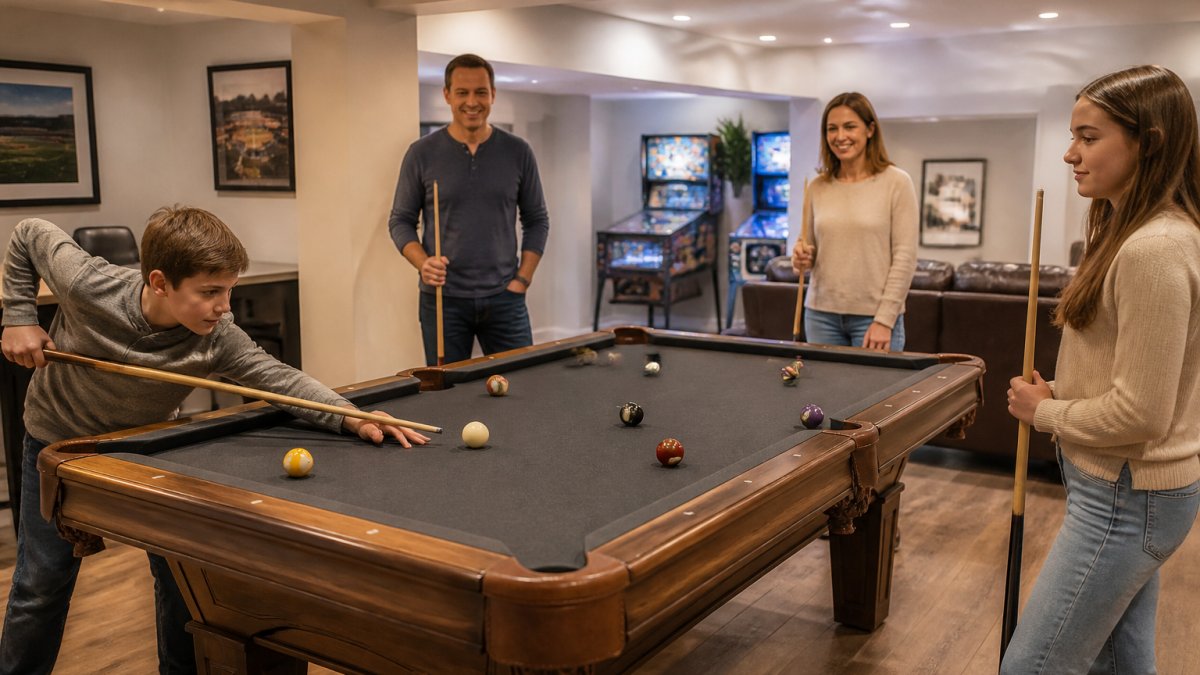
Game rooms work because they’re inclusive. A wet bar excludes children and anyone who doesn’t drink alcohol. A game room welcomes everyone.
Pool Tables, Foosball, and Arcade Games
Pool tables anchor a game room. They require a level floor, 10-12 feet of clear space, and basic lighting overhead.
The practical advantage: these fixtures are movable. Unlike built-in wet bar plumbing, you can relocate them if your needs change.
Arcade games and foosball tables cost less upfront than wet bar construction and deliver consistent entertainment value.
Board Game Lounges and Card Tables
A dedicated board game area needs comfortable seating, good task lighting, and a sturdy table. This setup costs far less than a wet bar and appeals to broader demographics.
Board game lounges work for families with young children, adult game nights, and casual entertaining. Add shelving to display your collection, and you’ve created a focal point that encourages use.
Basement Home Theater Ideas for Movie Nights and Events
A home theater transforms your basement into an entertainment destination. Unlike a wet bar, a theater works for families, movie nights, sports viewing, and small events.
Modern home theaters don’t require a dedicated room. You can create theater-quality experience in a finished basement corner with the right setup.
Seating, Sound, and Screen Setup
Theater seating should recline and offer back support. A 65-85 inch screen works for most basements.
Placement matters. Position the screen to minimize glare from windows or lighting. Arrange seating so every seat has a clear view.
The electrical work is straightforward: outlets for the screen, receiver, and lighting controls. No plumbing required.
Concession Stand Elements Without Full Bar Plumbing
A concession setup gives you the “bar experience” without alcohol-focused infrastructure.
This approach works because it’s flexible. You control what you stock. Kids can grab snacks. Adults can enjoy beverages.
A countertop beverage cooler plugs into a standard outlet. A popcorn machine does the same. This is renovation-light compared to wet bar construction.
Basement Snack Station Ideas for Easy Entertaining
A snack station replaces the bar’s social function without the complexity. It’s a gathering point where guests help themselves to food and drinks.
Snack stations work for casual entertaining because they’re low-pressure. No bartender required. Guests move at their own pace. You can focus on conversation instead of drink-making.
Beverage Coolers and Dry Storage
A beverage cooler is the centerpiece. Wine coolers, beer fridges, or general-purpose coolers all plug into standard outlets.
Dry storage for snacks, crackers, chips, nuts, candy, goes in cabinets nearby. Open shelving displays attractive items like specialty waters or craft sodas.
This setup costs a fraction of wet bar plumbing. A quality beverage cooler runs $300-800.
Countertop Setup Without Wet Bar Plumbing
A simple countertop with a cooler, small sink (optional), and prep space works for most entertaining.
Countertop materials matter for durability. Laminate, quartz, or wood finishes all work.
The beauty of a snack station: it’s modular. Start simple with a cooler and shelving. Add a countertop later.
Basement Lighting Ideas to Set the Right Mood
Lighting is the single biggest lever on whether a basement feels like a cave or a destination. It’s also where most idea-list articles stop short, listing fixture types without telling you how to specify them.
Layered Lighting for Flexibility
Layered lighting means three distinct jobs handled by three distinct fixture groups, each on its own switch or dimmer zone:
- Ambient (general illumination): Recessed cans, surface-mounted or flush-mount ceiling fixtures. These set the baseline brightness for the whole room.
- Task (focused work): Pendants over a game table or snack counter, under-cabinet strips over a prep surface, a focused recessed can over a reading chair. Task light should be brighter and more directional than ambient.
- Accent (visual interest): LED strip in coves or under shelves, wall sconces, track heads aimed at art or a textured wall. Accent light is about depth and shadow, not brightness.
A common pattern in finished basements is a 60/30/10 split: roughly 60% of fixtures on ambient, 30% on task, 10% on accent. That ratio keeps the room from feeling flat without over-lighting it.
Fixture Types That Work in Lower Levels
Recessed lighting is the workhorse.
Pendant lights work over a game table, snack counter, or bar-height surface, anywhere you want a defined zone.
LED strip lighting goes in coves, under floating shelves, under counter overhangs, and along stair treads.
Floor and table lamps fill corners and reading nooks.
If your basement has a low ceiling, skip pendants over walkways and use wall sconces, cove strip, and recessed cans instead. Pendants over a table are fine; pendants over a path are a head-bump waiting to happen.
Specifications That Actually Matter
Choosing fixtures by appearance alone is how basements end up either dim or glaring. These are the numbers to plan around:
- Lumens (brightness): A finished basement entertainment area typically wants 10-20 lumens per square foot for ambient light, with task zones pushed higher. A 300-square-foot game room lands around 3,000-6,000 lumens of ambient light before task and accent are added.
- Color temperature (Kelvin): 2700K-3000K reads warm and residential; 3500K-4000K reads cooler and more commercial. For a basement entertainment space, 2700K-3000K is the safer default. Mixing temperatures in one room is the most common lighting mistake, pick one and stay consistent.
- Color rendering (CRI): Look for CRI 90 or higher. High-CRI fixtures make wood, fabric, and skin tones look natural instead of gray. This matters more in a basement, where there’s little natural light to compensate.
Pick your color temperature and CRI first, then your lumens, then your fixture style. Style is the last decision, not the first, and it’s the only one most idea lists talk about.
Smart Controls and Dimmers
Dimmers are not optional in an entertainment space. They’re what let one room serve movie night, game night, and cleanup without re-lamping.
- Dimmer compatibility: Not every LED is dimmable, and not every dimmer works with every LED. Check the fixture’s dimmer compatibility list before you buy. Mismatched dimmers cause flicker, buzz, or a narrow dimming range.
- Zoning: Put ambient, task, and accent on separate dimmers or zones. A single dimmer for the whole room forces you to dim the task light when you want to dim the ambient.
- Scene control: Smart switches and smart bulbs let you preset scenes, a bright “Setup” scene, a mid-level “Game” scene, a low “Movie” scene. Scene control is the difference between a lit basement and a programmable one.
Lighting Dark Corners and Reducing the Cave Effect
Basements read as caves for three reasons: low ceilings, no windows, and dark finishes. Lighting can fix the first two and partly compensate for the third.
- Wash the walls. A wall that receives light reads as a surface; a wall in shadow reads as a boundary. Sconces, wall-washer recessed cans, or strip light aimed at a wall all push the perceived edge of the room outward.
- Light the stairs and the entry. The transition into the basement sets the tone. A dark stairwell makes even a well-lit room feel like a descent.
- Use reflective finishes. Light-colored ceilings, semi-gloss paint on trim, and light countertops bounce light back into the room. This is the cheapest cave-fix there is.
Lighting by Zone
Different zones in the same basement want different lighting:
- Game room: Bright, even ambient plus a pendant or two over the table. Aim for higher lumens here, people are reading cards, aiming cues, and tracking movement.
- Home theater: Dimmable ambient only, with no fixture in the sightline to the screen. Wall sconces and cove strip are better than recessed cans near the screen wall. Blackout capability matters more than fixture count.
- Snack station: Task light over the counter, warmer accent light on the display side. Under-cabinet strip is the highest-value fixture here.
Modern and Contemporary Fixture Styles
Contemporary basement lighting tends toward clean lines and integrated fixtures: trimless recessed cans, linear LED strips, slim pendants with matte black or brushed brass finishes, and wall sconces with simple geometric shapes.
A practical note: contemporary fixtures are often smaller and lower-profile than traditional ones, which is an advantage in a basement with limited ceiling height.
Any fixture installed in a basement damp location, near a utility sink, in a laundry area, or anywhere moisture is present, should be rated for damp or wet locations. Standard dry-location fixtures can corrode or fail in those spots. Check the fixture’s UL listing before installing.
Review the U.S. Department of Energy’s guidance on LED lighting and color temperature
Multi-Use Lounge Spaces for Casual Gathering
A lounge area works alongside game rooms, theaters, and snack stations.
Comfortable seating is essential. Sectional sofas, recliners, or lounge chairs invite people to stay.
Lounge spaces benefit from warm, adjustable lighting. Floor lamps, table lamps, and dimmable overhead lights create comfortable atmosphere.
This space is multipurpose.
Planning Your Basement Entertainment Space: What to Consider
Planning is where a basement entertainment project succeeds or fails. The fixtures and furniture are the visible part; the ceiling height, obstructions, moisture, and electrical capacity are the parts that decide what’s actually possible. This section covers the constraints that matter and the numbers to plan around.
Ceiling Height and Layout Constraints
Basement ceiling height drives almost every other decision.
Here’s how ceiling height maps to fixture and furniture choices:
- 8 feet and above: Full flexibility. Recessed cans, pendants over tables, and standard ceiling fans all work.
- 7-8 feet: Recessed cans and surface-mounted fixtures are safe. Pendants over a table are fine if kept short; pendants over walkways are not.
- Under 7 feet: Skip anything that hangs. Use recessed cans, wall sconces, cove strip, and floor or table lamps. Track lighting mounted tight to the ceiling is a workable alternative to pendants.
Obstructions matter as much as height. HVAC ducts, plumbing runs, and structural beams create soffits and low spots that break up a ceiling grid. Two practical approaches:
- Work around them. Place recessed cans on a grid that avoids the soffit, and use the soffit itself as a place for strip light or a wall-wash.
- Box them in. Framing a soffit to hide ducts creates a clean ceiling plane but costs more and lowers clearance in that zone.
For game tables, plan on 10-12 feet of clear space around a pool table and roughly 4-5 feet around a foosball or card table.
Measure before you buy anything. Note ceiling height at the lowest point, outlet locations, window well positions, and any column or duct that interrupts the floor plan.
Moisture, Electrical, and HVAC Integration
Basements are the wettest, coolest, and most electrically constrained rooms in most homes. Any entertainment setup has to account for all three.
Moisture. A basement that smells musty or shows efflorescence on the walls has a moisture problem that lighting and furniture won’t fix. Common sources are poor grading, failed sump systems, and missing vapor barriers.
Electrical. Basement circuits are often already loaded with utility equipment. Before adding a beverage cooler, a projector, a gaming setup, and a dozen LED fixtures, have a licensed electrician evaluate the panel and the existing circuits. A few practical points:
- A standard 15-amp, 120-volt circuit supports roughly 1,440 watts of continuous load at the 80% rule of thumb. A beverage cooler, a popcorn machine, and a projector can add up quickly.
- Dedicated circuits for high-draw appliances, coolers, projectors, space heaters, prevent nuisance trips.
- GFCI protection is required in unfinished basement areas and near sinks. If your snack station includes a sink, plan for GFCI.
Any electrical work in a basement, new circuits, outlet additions, or fixture installation in damp areas, should be done by a licensed electrician and permitted where local code requires it. DIY electrical in a wet environment is a fire and shock risk, and it can void insurance coverage.
HVAC. Basements run cooler than the rest of the house and can feel damp even when they’re dry. Extending existing ductwork works if the system has capacity; if it doesn’t, a ductless mini-split or a supplemental zone is the common fix. Proper ventilation matters most in enclosed theater rooms, where a closed door and a full house of guests can turn the space stuffy within an hour.
What It Costs to Build Each Option
Costs vary widely by region, ceiling condition, and whether wiring already exists, but the ranges below reflect common patterns for a finished basement entertainment zone:
- Game room: Mostly furniture and fixtures. A quality pool table, foosball table, and arcade cabinet together can run from a few thousand dollars upward depending on brand and condition. Lighting and outlets are the main built-in cost.
- Home theater: Screen, seating, sound, and lighting. A modest setup with a soundbar and recliners sits in the low four figures; a dedicated room with a projector, surround sound, and tiered seating runs considerably higher.
- Snack station: A beverage cooler, countertop, shelving, and lighting. The cooler is the biggest single line item; the rest is cabinetry and finish work. Skipping the sink eliminates plumbing entirely.
The cheapest entertainment upgrade in a basement is almost always lighting plus furniture. The most expensive is anything that requires moving water, gas, or a drain. Plan around that hierarchy.
Matching the Option to the Room
Not every basement suits every option. A quick way to match:
- Low ceiling, no windows, one open room: Game room plus lounge, with recessed cans and wall sconces. Skip pendants and skip anything that needs plumbing.
- Low ceiling, enclosed room available: Home theater. The enclosure solves the light-control problem that an open basement can’t.
- Average ceiling, open plan: Snack station plus game room plus lounge, zoned by lighting. This is the most flexible configuration and the easiest to change later.
| Entertainment Option | Best For | Installation Complexity | Plumbing Required |
|---|---|---|---|
| Game Room | Families, all ages | Low | No |
| Home Theater | Movie nights, events | Medium | No |
| Snack Station | Casual entertaining | Low | Optional |
| Lounge Area | Gathering, relaxation | Low | No |
| Wet Bar | Alcohol-focused events | High | Yes |
Learn more about basement renovation best practices from the National Association of Home Builders
Frequently Asked Questions
What can I put in my basement instead of a wet bar?
Game rooms with pool tables and arcade games, home theaters with tiered seating, snack stations with beverage coolers, and multi-use lounges all make excellent alternatives to a wet bar. These options provide entertainment without requiring wet bar plumbing, are more family-friendly, and often appeal to a broader range of guests. The choice depends on your family’s interests and how you plan to use the space.
How can I make a basement entertaining without a bar?
Focus on activity-based entertainment. Create a game room with billiards and board games, install a home theater setup, build a snack station with a mini fridge and countertop, or design a lounge with comfortable seating and smart lighting. Combining two or three of these elements creates a versatile space that works for family nights, parties, and casual gatherings without the complexity or plumbing demands of a wet bar.
What are the best basement entertainment ideas for families?
Game rooms encourage interaction across age groups, home theaters work for family movie nights, snack stations keep refreshments accessible, and multi-use lounges adapt to different activities. Prioritize basement lighting ideas that set the mood, ensure adequate ceiling height for comfort, and plan for moisture control and electrical capacity. These elements combine to create a space where families naturally gather and enjoy time together.
Do I need special plumbing or electrical work for basement entertainment alternatives?
Unlike wet bars, most alternatives require minimal plumbing. Snack stations use countertop beverage coolers that plug in. Game rooms and home theaters need adequate electrical circuits for lighting, screens, and sound systems. All basement projects should address moisture control and HVAC integration to ensure comfort and durability. A licensed contractor can assess your basement’s current systems and plan upgrades safely.