

Last Updated: November 22, 2026
Quick Summary
A smart thermostat paired with a remote room sensor is the best thermostat for basement temperature control, because the sensor makes the system respond to the basement’s actual reading instead of a hallway upstairs. Match the thermostat to your heat source first, since line-voltage electric baseboard needs a dedicated line-voltage unit. Fix air leaks and insulation before buying, because a thermostat cannot heat a basement that loses heat through unsealed walls.
- Place a basement sensor four to five feet off the floor on an interior wall, away from registers and exterior walls.
- Line-voltage electric baseboard needs a line-voltage thermostat or a smart relay, not a low-voltage smart thermostat.
- Most smart thermostats need a C-wire, so check wiring and compatibility before buying.
- A separate thermostat for the basement makes sense when a home office, gym, or guest suite runs on its own schedule.
- Watch the dew point and run a dehumidifier in summer to keep condensation off cool basement walls.
Table of Contents
- What is the best thermostat for basement temperature control?
- Comparison Table: Smart Thermostats for Basements
- Choosing a Thermostat for a Cold Basement
- When a Separate Thermostat for Basement Zones Makes Sense
- How a Remote Temperature Sensor for Thermostat Accuracy Helps
- Thermostat Placement in Basement Spaces
- Get a Free Estimate for Basement Climate Upgrades
- Frequently Asked Questions
What is the best thermostat for basement temperature control?
A smart thermostat paired with a remote room sensor is one practical approach to basement temperature control, because basement air often differs from the temperature your main-floor thermostat reads. A sensor placed in the basement lets the system heat or cool based on that room’s actual reading, not a hallway two floors up.
That single difference solves most cold-basement complaints. At Berry Basements, we finish lower levels in the Grand Rapids area. Below, we break down which kinds of thermostats fit which heating setups, where to place sensors, and when a separate thermostat for the basement may be worth considering.
One warning before you shop: a thermostat cannot fix a basement that loses heat through unsealed walls and rim joists. Fix the envelope first, or you will pay to heat outdoor air.
Comparison Table: Smart Thermostats for Basements
| Model | Listed Price | Basement-Relevant Strength | Watch For |
|---|---|---|---|
| ecobee Smart Thermostat Premium | $244 | Remote sensors plus air-quality monitoring | Higher upfront cost |
| Google Nest Thermostats | $130-$250 | Wide model range, broad retail availability | Sensor support varies by model |
| Honeywell Home T9 | Not listed in our source | Multi-room sensing and room-by-room control | Sensor details need checking |
| Amazon Smart Thermostat | $80 | Lowest entry price | Limited published feature detail |
Prices above come from CNET’s smart thermostat comparison and Consumer Reports’ thermostat coverage. Treat them as starting points, not quotes.
Listed prices of smart thermostats for basements
Choosing a Thermostat for a Cold Basement
Start with your heat source, not the thermostat’s feature list. A thermostat for a cold basement only works if it can control what actually heats that space, and different basement heating setups call for different approaches.
Matching the Thermostat to Your Heating System
Forced-air furnace with basement ducts. This is the easy case. If the furnace serves the basement through supply registers and a return path, a standard low-voltage smart thermostat with a remote sensor will do the job. The thermostat controls the whole system, and the sensor tells it to weight the basement reading. Confirm the basement has at least one supply and a return path; a supply with no return pressurizes the room and pushes conditioned air out through gaps.
Hydronic heat (baseboard or radiant). Hot-water baseboard and in-floor radiant loops run on low-voltage zone valves or circulator pumps, so a mainstream smart thermostat can control them if the zone panel exposes a standard R/W terminal pair. The catch is response time: water-filled loops and slab radiant ramp slowly, so a thermostat that expects a fast furnace response will overshoot. Look for adjustable cycle rate or minimum run time in the settings, and set the swing wider than you would for forced air.
Electric baseboard and wall heaters. Line-voltage electric heat usually needs a dedicated line-voltage thermostat rated for the load, and most mainstream smart thermostats are low-voltage only. A low-voltage smart thermostat cannot switch a 240-volt baseboard circuit directly; you either buy a line-voltage smart thermostat or keep the existing line-voltage thermostat and add a smart relay. Check the heater’s nameplate wattage against the thermostat’s rating before buying.
Standalone heaters and mini-splits. A ductless mini-split has its own thermostat in the head unit and usually its own app, so a separate wall thermostat is redundant unless you want one dashboard. Portable and garage-style heaters often have built-in thermostats and are not controlled by a wall unit at all. In that case the basement thermostat question becomes a scheduling and circulation question, not a wiring one.
Before buying, confirm three things:
- Your system’s voltage and wire count
- Whether a common wire is present
- Whether the unit lists your equipment type as compatible
Watch out: a thermostat marketed as “works with electric heat” may still be low-voltage and require a relay; read the compatibility chart for your exact model, not the marketing page.
Humidity, Condensation, and Freeze Risk
Moisture matters as much as temperature in a below-grade room. Cold surfaces condense warm, humid summer air, and a thermostat reading alone will not tell you the wall is wet.
Watch the dew point, not just the temperature. Running a dehumidifier in summer keeps condensation off cool walls and stops that damp smell. In winter, keep the basement above freezing even when unused, since pipes in exterior walls sit closer to the cold.
Sealing air gaps around rim joists and penetrations helps both problems at once. Our guide on how to seal air gaps in basement wall assemblies walks through the spots that leak the most.
When a Separate Thermostat for Basement Zones Makes Sense
A separate thermostat for the basement pays off when the space is used on its own schedule. A home office, gym, or guest suite occupied at different hours than the main floor justifies its own zone.
Zoning means adding dampers to the ductwork and a second thermostat, so the basement heats only when someone is down there. That is real work, not a plug-and-play swap.
If your basement is finished and heated but never comfortable, read our breakdown of signs your basement needs a separate HVAC system before committing to a zone.
Wiring and HVAC Compatibility Checks
Most smart thermostats need a C-wire for steady power. Older basement setups often lack one, which means running a wire or using a manufacturer’s adapter.
Check compatibility before you buy:
- Photograph your current wiring before disconnecting anything
- Match wire labels to the new unit’s compatibility chart
- Confirm your system type appears on the supported list
- Test the old thermostat’s low-voltage reading with a multimeter
If the panel looks unfamiliar or the wires are unlabeled, stop and call an HVAC technician. Low-voltage wiring is safe to handle, but line-voltage electric heat is not.
How a Remote Temperature Sensor for Thermostat Accuracy Helps
A remote temperature sensor for thermostat accuracy fixes the core problem: your thermostat sits in a hallway that stays warm while the basement runs cold. The sensor reports the basement’s reading and the system responds to that number. That part is simple. Where most installs go wrong is placement and calibration, and almost no buying guide covers either for a below-grade room.
Where to Place a Basement Sensor
Mount the sensor at seated height, roughly four to five feet off the floor, on an interior wall. That height matches how the room is actually occupied and avoids the cold pocket that forms near the slab. Keep it at least a few feet from supply registers, exterior walls, and direct sun through a window well.
Avoid the spots that produce false readings in basements specifically:
- The corner behind the TV or media console, which traps heat
- Directly above a dehumidifier, which exhausts warm, dry air
- Against a rim joist or foundation wall, which runs colder than room air
- Inside a closed mechanical closet with the furnace or water heater
- Near a floor drain or sump pit, where evaporating water cools the air
If the basement is one open room, one sensor is enough. If it is divided into a finished rec room and an unfinished storage area, put the sensor in the space you actually occupy and let the storage area run cooler. A common pattern is one sensor per conditioned zone, not one per room.
How to Calibrate and Verify the Reading
Give the system a day to settle after installation, then compare the sensor reading against a separate thermometer placed at the same height a few feet away. Most smart thermostat apps allow a temperature offset of a few degrees; adjust it so the app matches the reference thermometer.
Then test the response. Set a schedule change and watch how long the basement takes to reach the target. A forced-air basement typically recovers faster than a hydronic or radiant one, and a sensor that reads accurately but sits in a dead-air corner will still cause short cycling. If the reading swings several degrees within minutes, the sensor is picking up a draft or a register, not the room.
Watch out: do not calibrate against a phone app or a cheap wall thermometer without checking it against a second reference; a single inaccurate thermometer will lead you to offset a sensor that was already correct.
Expect a short learning period while the schedule adapts, and recheck the offset after the first seasonal change, since basement humidity and slab temperature shift the reading more than they do on a main floor.
Thermostat Placement in Basement Spaces
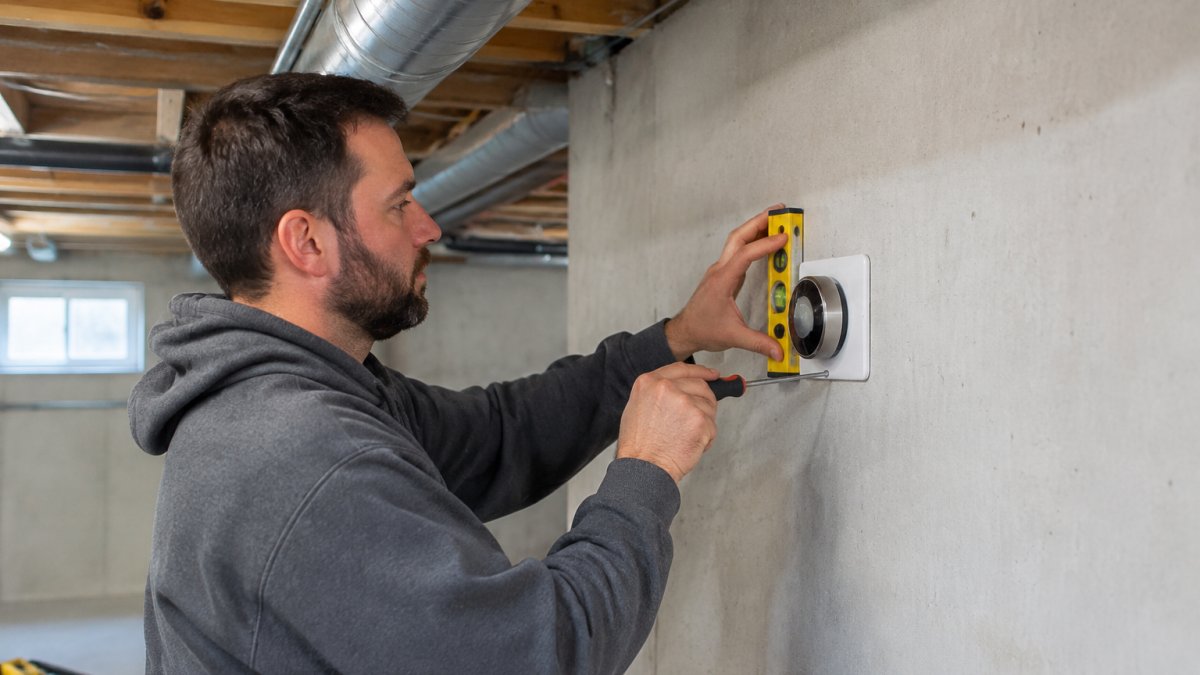
Mount the thermostat on an interior wall, roughly five feet off the floor, away from ducts, doorways, and sunlight. That height matches how the room is actually occupied and avoids the cold pocket near the slab.
Insulation changes the picture too. A well-insulated basement holds temperature longer, which makes sensor placement less critical. Our article on how insulation improves home energy ratings explains why the envelope comes first.
Get a Free Estimate for Basement Climate Upgrades
If your basement stays cold no matter what the thermostat says, the fix usually sits behind the drywall. Adding insulation, sealing gaps, and extending HVAC to the lower level can be part of a basement finishing project.
Berry Basements has been finishing lower levels since 2017, and we take a collaborative approach and work as licensed basement contractors.
Start with our basement finishing services, or if you are local, see our basement finishing work in Hudsonville, MI and request a free estimate.
A cold basement is rarely a thermostat problem alone. It is an envelope problem, an airflow problem, and sometimes a zoning problem, and they get solved together. Get started with Berry Basements and turn that lower level into a room your family actually uses.
Frequently Asked Questions
Should a basement have its own thermostat?
If your basement is a finished living space with its own heating zone, a separate thermostat gives you direct control instead of relying on the main floor’s readings. Basements often run several degrees cooler than upper floors, so a dedicated unit or a zoned system prevents the basement from being underheated while the rest of the house overheats. Check whether your HVAC system already has zone dampers before buying a second thermostat.
Can a smart thermostat help with a cold basement?
A smart thermostat helps when paired with a remote temperature sensor placed in the basement. The sensor reports the actual basement temperature, and the thermostat adjusts heating based on that reading rather than the hallway upstairs. Without a sensor, a smart thermostat mostly learns the schedule of the room it sits in.
Where should a thermostat be placed in a basement?
Mount it on an interior wall roughly 4 to 5 feet above the floor, away from supply registers, exterior walls, doorways, and direct sunlight. Avoid placing it near basement windows, laundry equipment, or space heaters, which skew readings. If the finished space is large or divided into rooms, keep the thermostat in the most-used area and add a remote sensor for the rest.
Can I use a thermostat with a space heater in my basement?
A standard wall thermostat controls central HVAC, not a plug-in space heater. Use the heater’s built-in thermostat or a smart plug with a temperature trigger instead. Keep heaters at least 3 feet from furniture and never leave them running unattended. For a basement you plan to use year-round, a zoned central system or ductless heat pump delivers more even heat than portable units.
