

Table of Contents
- Core Differences Between Matrix Basements and Local Contractors
- Questions to Ask Basement Contractors Before You Hire
- Performance, Efficiency, and Technical Specifications
- Basement Renovation Timeline: What to Expect
- How to Choose a Basement Contractor: Vetting and Comparison
- Cost-Benefit Analysis and Long-Term ROI
- Warranty, Reliability, and Risk Mitigation
- Which Option Is Right for Your Project
- Frequently Asked Questions
Last Updated: September 20, 2026
Core Differences Between Matrix Basements and Local Contractors
When comparing matrix basements vs local contractors, the core difference emerges clearly: Matrix Basements uses standardized systems and pre-engineered solutions applied regionally or nationally, while local contractors are independent professionals who customize their approach to each unique project. Matrix operations prioritize efficiency through repeatable processes; local contractors prioritize flexibility and personal attention.
Berry Basements operates as a local contractor, prioritizing collaborative design and custom solutions. Basement complexity varies dramatically, your HVAC layout, plumbing, moisture history, and structural conditions are unique to your space.
Questions to Ask Basement Contractors Before You Hire
Before signing with any basement contractor, you need answers to specific questions that reveal their reliability, expertise, and fit for your project.
Ask about licensing and insurance. Request proof of state licensing, liability insurance, and workers’ compensation coverage. This protects you if something goes wrong.
Ask for references and past projects. Request at least three references from similar projects completed in the last two years and photos of finished work. Call references and ask: Did they finish on time? Were there surprise costs? How did they handle problems?
Ask how they handle complexity. Ask: “How do you route around existing systems?” and “Have you dealt with moisture issues before?” Their answers reveal whether they’ve managed real basement challenges.
Ask about the timeline and schedule. Get a written timeline with specific milestones and ask how they’ll minimize disruption to your daily life.
Ask about warranty and guarantees. What happens if something fails after completion? A vague answer is a red flag. You want written warranty terms that cover workmanship and materials for a reasonable period.
Performance, Efficiency, and Technical Specifications
Basement renovation performance depends on how well the contractor manages multiple systems working in a confined space, and on understanding where failures most commonly occur.
Efficiency in execution means minimizing waste and coordinating trades properly. Matrix systems achieve it through standardized workflows; local contractors through experience managing unique conditions. Both fail differently: matrix systems struggle when basements deviate from their standard template; local contractors struggle if they lack experience with specific challenges.
Technical specifications determine durability. Your basement needs proper moisture management, ventilation, electrical grounding, and structural support, the foundation of 10+ year performance versus 5-year deterioration.
Moisture management is the highest-risk area, basements fail primarily due to water intrusion. Ask: “How will you manage water entering the foundation?” Key solutions: perimeter drainage systems (interior $3,000-8,000; exterior $5,000-15,000), vapor barriers (6-mil polyethylene or better), and dehumidification (keeping humidity below 50-60%). A contractor who doesn’t address all three is underestimating risk.
Matrix systems use standardized moisture solutions adequate for typical conditions but may fail in basements with seepage history or high water tables. Local contractors experienced in your area’s soil and water conditions can tailor solutions to your actual risk.
Ventilation and air quality directly affect usability. A bedroom must meet code for egress and fresh air exchange; recreation spaces need ventilation to prevent stale air and moisture. Ask: “How will you integrate fresh air into HVAC?” and “Will the space meet building code?” Vague answers are red flags.
Electrical safety and capacity prevents fires and ensures adequate power. Ask: “Will you upgrade the electrical panel if needed?” and “How many new circuits will you install?” Specific answers indicate proper planning; vague ones suggest inadequate assessment.
Structural integrity matters if adding, removing, or modifying walls. Ask: “Are any walls load-bearing?” and “Will you need a structural engineer’s review?” If they say “I’ll figure it out during demolition,” that’s a red flag.
Equipment and materials quality directly affects longevity. Use moisture-resistant drywall (“green board” or better), not standard drywall. Choose flooring carefully, carpet is poor in moisture-prone basements; LVP or engineered hardwood with proper underlayment performs better. Use moisture-resistant paint, not standard interior paint. All fixtures must be GFCI-protected for safety (code-required).
Contractors who cut corners on materials deliver basements that fail within 3-5 years. Those who specify moisture-resistant materials and proper installation build basements that perform for 10+ years.
Performance risk mitigation requires: (1) understanding your specific moisture and structural conditions, (2) specifying appropriate solutions rather than one-size-fits-all templates, and (3) using quality materials and proper installation. Matrix systems excel at factor 3 but may struggle with factors 1 and 2 if your basement is atypical. Local contractors experienced in your area can excel at all three, if they have a proven track record.
Ask contractors for examples of basements finished in homes with similar challenges to yours. Request references from homeowners whose basements have been finished for at least 3 years. Ask: “Have you had any moisture, mold, or structural issues?” Honest references reveal whether the contractor’s approach prevents common failures.
Basement Renovation Timeline: What to Expect
Timeline expectations separate realistic projects from ones that derail.
Most basement renovations take 4-12 weeks depending on scope. Simple finishing takes 4-6 weeks; projects with moisture remediation, HVAC modifications, or structural work take 8-12+ weeks. Typical breakdown: planning/permitting (1-3 weeks), demolition/prep (1-2 weeks), rough-in work (2-3 weeks), insulation/drywall/finishing (3-5 weeks), final touches (1-2 weeks).
Delays happen, unexpected structural issues, moisture problems, or supply chain delays can add weeks. Ask upfront: “What could delay this project, and how would you handle it?” Their answer reveals whether they’ve managed real projects.
How to Choose a Basement Contractor: Vetting and Comparison
Choosing the right contractor requires systematic evaluation, not just picking the lowest bid.
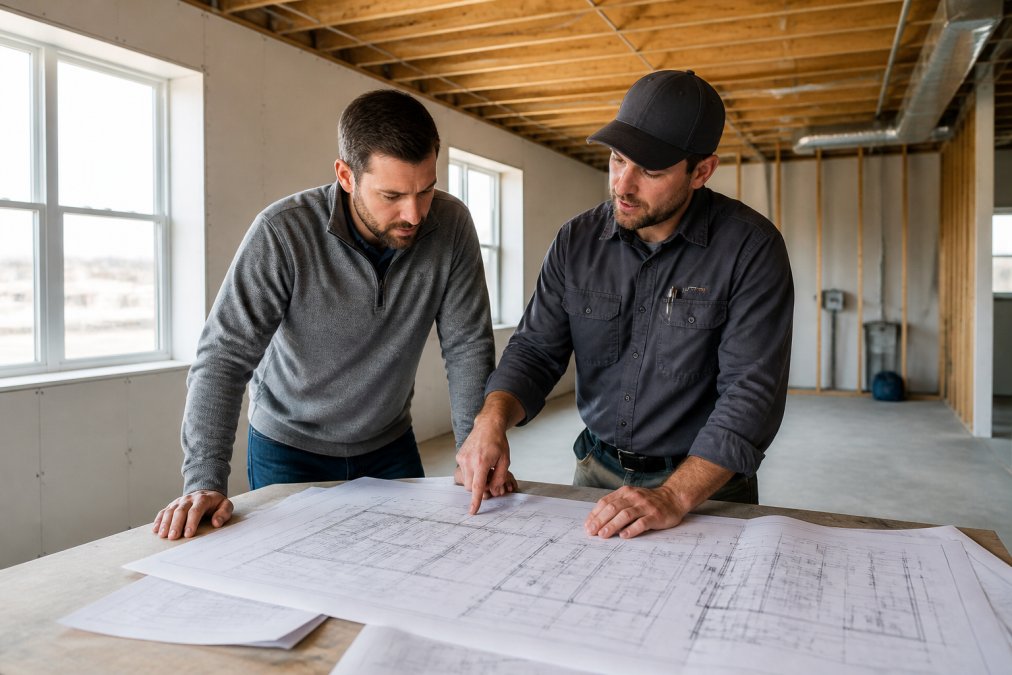
Start with credentials. Verify state licensing through your contractor licensing board. Unlicensed contractors may be cheaper but you lose legal recourse if work fails. Compare their approach. A contractor who listens and asks detailed questions about your space is ahead of one who pitches a standard solution. Evaluate communication. Will they answer questions? Explain technical decisions clearly? Follow up on concerns? Poor communication during sales predicts poor communication during the project.
Request written estimates from at least two contractors. Compare line-item details, not just total price. Ask what’s included and what’s not. Trust your instinct about fit. If something feels off during initial meetings, that feeling usually proves accurate.
Cost-Benefit Analysis and Long-Term ROI
Basement renovation cost varies widely based on scope, but understanding the financial picture requires more than ballpark estimates, it requires a framework for calculating your specific long-term return.
Immediate cost structure typically breaks down as: labor (40-60%), materials (25-40%), permits/inspections (3-8%), and contingency reserves (10-15%). Pricing depends on the scope of your project, local labor costs, materials selected, and complexity of existing utilities. Compare itemized estimates from at least two contractors to identify quality differences.
Long-term benefit calculation requires understanding three distinct value categories:
Functional value measures daily quality-of-life improvement. Calculate by asking: “How much would I pay monthly to rent equivalent space?” If comparable rental costs $400-600/month, a $40,000-50,000 basement investment pays for itself in 7-10 years of avoided rent, plus you own the asset.
Resale value recovery depends on your market. A finished basement typically recovers 70-80% of cost in strong markets, 50-60% in weaker markets. A $45,000 renovation might add $31,500-36,000 to appraised value. This matters only if selling within 5-10 years; if staying longer, functional value dominates.
Risk-adjusted value accounts for moisture, structural, or system failures. A basement built with proper waterproofing, drainage, and HVAC integration carries lower risk of costly repairs. One finished with shortcuts carries higher risk of mold or HVAC inefficiency within 3-5 years, potentially requiring costly remedial work.
ROI calculation framework:
-
Define your holding period. Are you staying 5 years, 10 years, or indefinitely? This determines whether resale recovery matters.
-
Calculate functional value. Multiply monthly rental equivalent by 12 months by your holding period. Compare this to your total renovation cost.
-
Estimate resale recovery. If selling within your timeframe, apply 50-80% recovery rate to your total cost based on your market strength.
-
Factor risk mitigation. Subtract 5-10% from total cost if you choose a contractor with a strong track record and warranty terms, reducing the likelihood of post-completion repairs.
-
Compare to alternatives. Would renting additional space, moving to a larger home, or investing the money elsewhere deliver better returns for your situation?
Example: A homeowner staying 10 years invests $48,000. Functional value: $500/month × 120 months = $60,000. Resale recovery: $36,000.
Warranty, Reliability, and Risk Mitigation
Warranty terms reveal how confident a contractor is in their work and how protected you are if problems emerge.
Which Option Is Right for Your Project
Your decision about matrix basements vs local contractors depends on your priorities, timeline, and project type.
Frequently Asked Questions
What’s the main difference between a proprietary basement system like Matrix and a local basement contractor?
Proprietary systems like Matrix Basements use standardized products, materials, and processes designed to work together as a complete package. Local contractors typically customize each project using individual components and methods tailored to your specific space. Matrix offers consistency and faster deployment; local contractors offer flexibility and often deeper integration with existing HVAC, plumbing, and structural elements. The choice depends on whether you prioritize standardization and speed or customization and site-specific expertise.
How do I verify the reputation of a basement finishing contractor?
Request references from completed projects in your area, ask to see photos or visit finished basements, check licensing and insurance credentials with your state’s contractor board, read online reviews on Google and the Better Business Bureau, and ask about warranty terms in writing. A reputable contractor should provide at least three local references and be willing to discuss past projects openly. Verify their license status and check for any complaints filed against them before signing a contract.
What should I look for in a basement contractor’s contract?
Look for a detailed scope of work that lists every task, material, and finish; a fixed completion date or realistic timeline with milestones; a warranty covering workmanship and materials; a payment schedule tied to project phases (not full payment upfront); liability insurance and workers’ compensation coverage; and clear terms for handling changes or unexpected issues. The contract should specify who handles permits, inspections, and code compliance. Avoid contractors who won’t put terms in writing or pressure you to sign before you’ve reviewed the full agreement.
Are basement finishing systems more expensive than hiring a local contractor?
Pricing depends on the scope of your project, local labor costs, materials selected, and complexity of existing utilities. Proprietary systems often have higher per-square-foot costs but may save time and reduce site-specific complications. Local contractors may offer lower material costs but could face unexpected expenses if structural or moisture issues emerge. Request quotes from both to compare total project cost, timeline, and warranty. Your budget, timeline, and project complexity should guide your decision rather than price alone.