

Table of Contents
- What Basement Renovations Actually Do to Home Value
- Basement Renovation Cost Per Square Foot vs. Resale Payback
- The Highest-ROI Finishing Touches That Add Value to Home Basement
- Basement Egress Window Requirements for Code Compliance
- Waterproofing and Moisture Control Before You Finish
- Regional Climate and Energy Efficiency ROI
- Common Mistakes That Decrease Basement Value
- Plan Your Basement Renovation for Maximum Equity
- Frequently Asked Questions
Last Updated: September 4, 2026
What Basement Renovations Actually Do to Home Value
A finished basement can add value, but the return is rarely what homeowners expect. Unlike a kitchen or primary bath, a basement conversion sits in a different category because of how appraisers treat below-grade space.
The most common surprise is the gap between what owners spent and what the appraisal says. The core issue isn’t renovation quality, it’s the distinction between finished square footage that counts as living area and space appraisers classify as storage or recreation only.
That distinction directly shapes your return on investment.
Basement Renovation Cost Per Square Foot vs. Resale Payback
Basement renovation cost per square foot runs far below main-floor additions, appealing to families needing space without a full footprint expansion. You are essentially building on land you already own, using volume that already exists beneath your home.
However, the resale payback follows a different math. According to Remodeling Magazine’s annual Cost vs. Value Report, basement finishing historically recovers less of its cost at resale than above-grade additions. The reason comes down to how buyers and appraisers perceive the finished space.
The National Cost Picture
Nationally, a midrange basement finish runs between $40 and $75 per square foot, depending on scope and region (remodeling.hw.net). That compares favorably to a main-floor addition at $150 to $250 per square foot, but the gap narrows when you account for the appraisal treatment of below-grade space.
The Cost vs. Value Report has shown that basement finishing recovers roughly 50% to 70% of its cost at resale in an average market. That trails above-grade additions, which often recover 60% to 80%. The difference is not about finish quality, it is about how appraisers classify the space.
Above-Grade vs. Below-Grade Square Footage: The Appraisal Reality
Appraisers distinguish sharply between above-grade living space and below-grade square footage. Above-grade area counts fully toward the gross living area used in comparable sales. Below-grade space, even when beautifully finished, is typically listed as a separate line item with a lower value per square foot.
When a comparable sale includes a finished basement, the appraiser extracts a dollar-per-square-foot value for that below-grade space, typically 30% to 50% of the value assigned to above-grade living area. So if your main floor appraises at $200 per square foot, your finished basement might contribute $60 to $100 per square foot.
That does not mean finishing your basement is a poor investment. View the project through two lenses: the resale return and the functional utility you gain while living there. Most families converting a basement for a home theater, gym, or extra bedroom are buying usable square footage at a fraction of the cost of moving.
The Cost Side: Where the Money Actually Goes
The line items that add the most appraisal value are also the ones that cost the most. The big-ticket items change the legal classification of the space:
- Egress windows: $3,500 to $8,000 installed, depending on window size, well depth, and whether you need to cut through a foundation wall.
- Bathroom rough-in and finish: $10,000 to $25,000, with the plumbing rough-in being the bulk of the cost.
- Waterproofing and drainage: $4,000 to $15,000, depending on the severity of the moisture issue.
- HVAC extension: $2,000 to $6,000 to add a supply and return run to the new space.
These are not optional upgrades. They determine whether your finished basement reads as living space or as a rec room in an appraisal. Skimping on them to save money upfront is the fastest way to cap your return.
A basement renovation is a value play only if you treat the expensive, invisible work, egress, plumbing, waterproofing, HVAC, as the foundation of the project. Cosmetic finishes are the last dollar you spend, not the first.
The Payback Math in Practice
Consider a 1,000-square-foot basement finished at $60 per square foot, a $60,000 investment. If your main floor appraises at $180 per square foot and the appraiser assigns 40% of that value to the basement, the finished space adds roughly $72,000 in appraised value.
But if the same basement lacks an egress window and a bathroom, the appraiser may classify it as a recreation room only, assigning a value closer to 20% of the above-grade rate. That drops the contribution to $36,000, a net loss of $24,000.
The difference between those two outcomes is not paint quality. It is the presence of features that make the space legally habitable and functionally independent.
The Highest-ROI Finishing Touches That Add Value to Home Basement
Certain improvements consistently deliver more appraisal impact than others. If your goal is to maximize what a future buyer will pay, prioritize these elements over purely cosmetic upgrades.
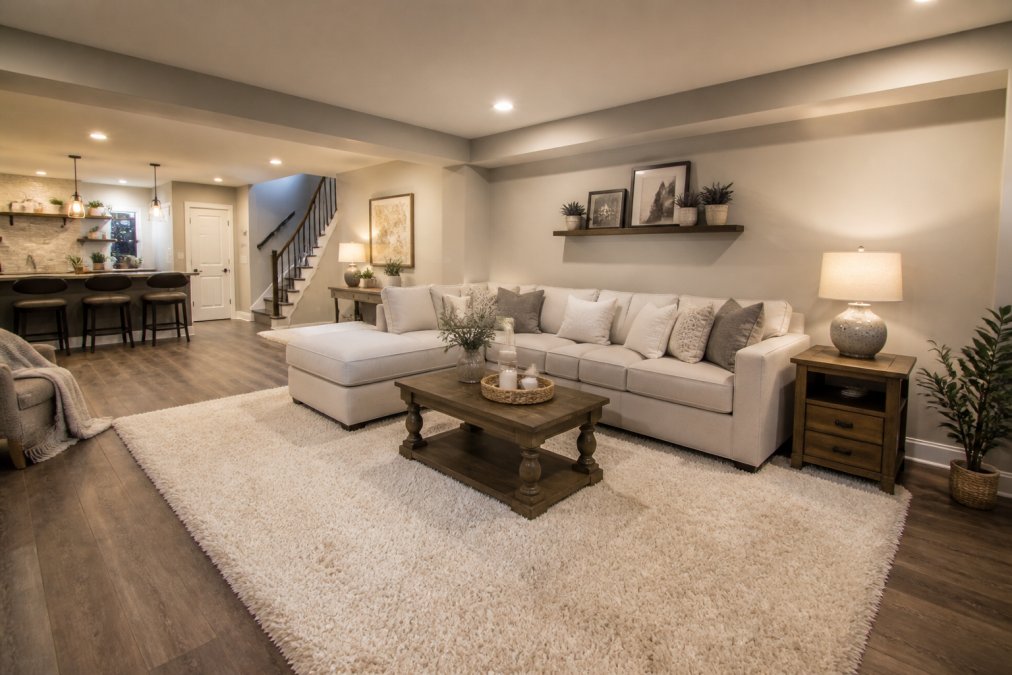
Adding a Bathroom to Basement Value
An egress window and a bathroom are the two features that most reliably shift an appraisal from “recreation room” to “living suite.” A full bath with a shower makes the space viable as a guest suite, an in-law apartment, or a rental unit.
The plumbing work is the expensive part, so positioning the bathroom near existing rough-ins or the main stack keeps costs manageable. A full bath with a shower changes the classification in a buyer’s mind.
Bedrooms, Egress Windows, and Functional Utility
A basement bedroom requires a legal egress window to meet building codes. Without it, the room cannot be called a bedroom in listings or count as one in an appraisal.
Beyond code, think about what makes a basement bedroom actually livable: ceiling height, natural light, and noise control. A windowless box will not command the same premium as one with a well-placed egress window bringing in daylight.
Basement Egress Window Requirements for Code Compliance
Basement egress window requirements exist to ensure occupants can escape in an emergency. The International Residential Code sets the baseline: the window opening must be large enough to climb through, and the sill height must be low enough to reach from the floor.
Most local jurisdictions in Kent and Ottawa Counties adopt these requirements, but verify specifics with your building department before framing. Getting the rough opening wrong means rework, and rework eats your budget.
The window well also matters. A properly installed well with a drain keeps water away from the foundation and provides a safe exit path, not an area to cut corners, since it involves both safety and moisture control.
Waterproofing and Moisture Control Before You Finish
Finishing a basement that has moisture problems is the single fastest way to destroy the value you are trying to create. Mold, musty odors, and water stains will surface within months, visible to any home inspector during a future sale. But “moisture control” is not a single fix, it is a diagnostic process that depends on where the water is coming from and how your regional climate behaves.
The Regional Climate Angle Most Guides Miss
Most national guides treat basement waterproofing as a one-size-fits-all checklist. That is a mistake. The dominant moisture threat depends on where you live, and the fix that works in one climate will fail in another.
In the upper Midwest and Northeast, the primary threat is seasonal groundwater. Heavy spring rains and snowmelt saturate the soil around your foundation, creating hydrostatic pressure that pushes water through cracks and porous concrete. The fix is exterior drainage: proper grading, functioning gutters, and a sump pump with a battery backup.
In the South and Southeast, high humidity and warm temperatures create condensation problems, even in basements that never see liquid water. The fix there is interior vapor management: a sealed vapor barrier, mechanical dehumidification, and insulation that does not trap moisture against cool foundation walls.
In arid western states, the problem is often the opposite, dry soil pulling away from the foundation, causing settling and cracking. The fix is controlled watering near the foundation, not more drainage.
Your local building department and a contractor who works in your region will know which pattern applies to you. Do not rely on a generic national checklist.
Diagnosing the Water Source Before You Spend
Before you install any waterproofing product, you need to know where the water is coming from. A simple diagnostic sequence separates the three main sources:
- Check the gutters and downspouts first. A downspout discharging directly against the foundation is the most common cause of basement moisture. Extend downspouts at least 6 feet from the foundation and confirm the soil slopes away at a rate of 1 inch per foot for the first 6 to 10 feet.
- Look for efflorescence. A white, chalky residue on foundation walls is a mineral deposit left by evaporating water. It tells you that liquid water is passing through the concrete, not just condensing on the surface.
- Test for condensation. Tape a 1-foot square of plastic sheeting to the wall and seal the edges. Leave it for 48 hours. If moisture appears on the wall side of the plastic, you have a vapor drive problem. If it appears on the room side, you have a humidity problem.
This diagnosis determines your fix. Exterior grading and gutter work costs a few hundred dollars. An interior French drain system with a sump pump runs $5,000 to $12,000. A dehumidifier and vapor barrier might cost under $2,000. Spending on the wrong solution is the real budget killer.
The Insulation Decision Is a Moisture Decision
In colder climates, the insulation you choose for your basement walls is not just an energy decision, it is a moisture decision. Fiberglass batts against a concrete foundation wall are a common mistake. The concrete stays cool, and warm interior air hits that cool surface, creating condensation inside the batt. The fiberglass soaks up the moisture, loses its R-value, and becomes a breeding ground for mold.
The standard fix is rigid foam board insulation directly against the foundation wall. Rigid foam has a closed-cell structure that resists moisture and provides a continuous thermal break. It also allows you to build a framed wall in front of it without trapping moisture between the foam and the concrete.
In warmer, humid climates, the priority shifts to a vapor barrier on the interior side of the wall assembly, combined with mechanical dehumidification. The goal is to keep humid interior air from reaching the cool foundation surface where it will condense.
Skipping waterproofing to save money upfront is the most expensive mistake in [basement renovation](/basement-renovation-vs-home-addition/). Moisture intrusion will ruin drywall, flooring, and insulation, forcing you to tear out finished work and redo it after the real problem is fixed. But the reverse is also true: installing a full interior drainage system when your only problem is a disconnected downspout is wasted money.
The Sump Pump Decision
If your basement sits below the local water table, a sump pump is not optional. The pump itself is inexpensive, $150 to $400 for a quality unit, but the installation, including the pit and discharge line, runs $1,500 to $3,000. The non-negotiable upgrade is a battery backup system. A primary pump that fails during a power outage, exactly when groundwater is rising, is worse than no pump at all.
A common pattern in flood-prone areas is to install a second pump with a separate float switch as a redundant system. The cost is modest compared to the damage a single failure can cause.
The Inspection Reality
When you sell your home, the buyer’s home inspector will look for evidence of past moisture problems. Water stains on the floor joists, a musty odor in the finished space, or a dehumidifier running constantly in the listing photos are red flags. A buyer who suspects moisture problems will either walk away or demand a significant price reduction.
A basement that is genuinely dry, verified by a professional moisture assessment and documented with a warranty from a qualified waterproofing contractor, is a selling point. That documentation is worth real money at the negotiating table.
The most valuable waterproofing investment you can make is the diagnostic work that tells you exactly what problem you are solving. Regional climate determines the dominant threat, and the right fix is the one that addresses your specific water source, not the most expensive system on the market.
Regional Climate and Energy Efficiency ROI
The Grand Rapids climate, with its cold winters and wet springs, makes insulation and moisture control central to basement value. A basement that stays warm and dry in January is worth more than one that feels damp and chilly, regardless of how nice the finishes look.
Insulation R-value matters here. Rigid foam board against the foundation walls performs better than fiberglass batts because it resists moisture and provides a continuous thermal break. Upgrading your HVAC capacity to serve the new space is also essential; a system sized only for the main floor will struggle to heat a finished basement.
Energy efficiency is a growing factor in home valuations, and buyers increasingly ask about utility costs. A well-insulated basement reduces heating bills and makes the entire home more comfortable.
Common Mistakes That Decrease Basement Value
Several errors can actively reduce what your basement contributes to home value. The most common is finishing without addressing moisture, which we have covered. Another is creating a floor plan that lacks flexibility, such as a single large open room that cannot serve as a bedroom or office.
Low ceiling height is another issue. Building codes require a minimum height for habitable space, and if your basement falls short, it cannot legally be finished as living area. Check this early, before you invest in design work.
Before you commit to a renovation plan, walk the space with a contractor who has handled the structural, HVAC, and plumbing complexity of basement work. A professional assessment of ceiling height, moisture risk, and egress options will save you from designing a space that cannot be built to code.
Plan Your Basement Renovation for Maximum Equity
A basement renovation that genuinely adds value starts with a clear understanding of appraisal reality, code requirements, and moisture management. The projects that pay off are the ones that create legal, dry, flexible living space that a future buyer can immediately use.
That is where working with experienced contractors matters. Berry Basements has handled complex basement renovations across the Grand Rapids area since 2017, managing everything from waterproofing to structural changes with a collaborative process that prioritizes your needs. Our commitment to quality without cutting corners means the finished space not only enhances your family’s enjoyment today but also holds its value when you sell.
| Improvement | Primary Benefit | Appraisal Impact | Relative Cost |
|---|---|---|---|
| Egress window | Code compliance, safety, natural light | High (enables bedroom classification) | Moderate |
| Full bathroom | Guest suite or rental potential | High | High |
| Waterproofing | Prevents mold and structural damage | Critical (protects all other value) | Moderate |
| Insulation upgrade | Lower heating costs, comfort | Moderate | Low to Moderate |
| Cosmetic finishes | Daily enjoyment | Low | Varies |
The decision to finish a basement is as much about how you will use the space as it is about resale. If you are expanding for a growing family or creating a dedicated home theater, the daily value is real. For the best of both worlds, plan the renovation so it maximizes functional utility and meets the standards that appraisers recognize.
Get started with Berry Basements and request your free estimate to see how a professionally finished basement can transform your home.
Frequently Asked Questions
How much value does a finished basement add to a home?
A professionally finished basement typically recovers 50% to 70% of its renovation cost in added resale value, though this varies by market and project scope. In appraisal terms, finished below-grade space is usually valued at 30% to 50% of the rate for above-grade living space. To maximize basement value, focus on durable finishes, proper egress windows, and a functional layout that serves as true living area, not just a storage zone.
Does adding a bathroom to a basement increase home value enough to justify the cost?
Adding a bathroom to a basement is one of the strongest returns on investment you can make. A full bathroom with a shower typically adds more resale value than a half bath, and it makes the basement function as a true living suite. The caveat is that plumbing work requires professional rough-in and proper venting. When done correctly, a basement bathroom improves appraisal value and marketability.
What are the basement egress window requirements I need to meet?
Building codes require egress windows in any basement bedroom or habitable space. The finished opening must measure at least 5.7 square feet, be at least 24 inches high and 20 inches wide, and the sill height cannot exceed 44 inches above the floor. A window well outside must provide clearance for escape. These requirements are non-negotiable for a bedroom suite and directly affect whether your finished space counts as legal living area in an appraisal.
Which basement upgrades decrease property value instead of increasing it?
Poorly executed renovations hurt more than they help. This includes covering up moisture problems with drywall instead of fixing the source, installing low-quality finishes that show wear quickly, and creating layouts that feel like a maze rather than open living space. Overbuilding for the neighborhood, such as adding a high-end theater to a modest home, also fails to return its cost. Buyers penalize shortcuts and value function, natural light, and clean, dry construction.
This article was written using GrandRanker