

Last Updated: November 17, 2026
Quick Summary
The best mold-resistant paint for basement walls is an interior coating like Zinsser Perma-White, which resists mildew on the film but holds back no water pressure. If water is pushing through the masonry, you need a waterproofing paint such as DRYLOK Extreme, rated at 15 psi hydrostatic pressure.
- Tape foil to the wall and check after 24 hours to find the moisture source.
- Perma-White covers about 300 to 400 sq ft per gallon and needs two coats.
- DRYLOK Extreme carries a 15 psi hydrostatic rating and covers about 75 to 100 sq ft per gallon.
- New concrete must cure at least 28 days before any coating goes on.
- Full cure takes about 7 days for most masonry coatings and up to 14 for some acrylic latexes.
Table of Contents
- Mold-Resistant Paint vs Waterproofing Coating: What Each Does
- Diagnosing Moisture Before You Choose a Paint
- Comparison Table: Best Mold Resistant Paint for Basement Walls
- Best Paint for Concrete Basement Walls: Top Picks Reviewed
- Zinsser Mold Killing Primer: When to Use It and When to Skip It
- Mildew-Resistant Basement Waterproofing Paint: DRYLOK Extreme and Similar Options
- Surface Preparation for Basement Walls: Cleaning, Cracks, and Efflorescence
- When to Call Berry Basements for a Free Estimate
- Frequently Asked Questions
Mold-Resistant Paint vs Waterproofing Coating: What Each Does
The best mold resistant paint for basement walls will not stop water from entering, and that single fact decides which product you need. This confusion comes up often with wet basements.
Mold-resistant paint is a coating that resists fungal growth on its surface. Waterproofing coating is a heavier masonry product that blocks liquid water under pressure. One manages the symptom. The other addresses the cause.
A mold-resistant product applied over an active leak is likely to peel, blister, and fail. Coatings generally do not bond to a wall that is pushing water.
Below, we break down each option, the products worth considering, and how to tell which situation you are actually in.
Diagnosing Moisture Before You Choose a Paint
Test the wall before you buy anything. Tape a square of aluminum foil to the concrete, seal all four edges, and check it after 24 hours.
Moisture on the room side of the foil points to humid air condensing on a cold wall. Moisture behind the foil, or a damp wall face, points to water moving through the concrete. That second result means paint alone will not solve it.
Watch out: painting over active water intrusion traps moisture inside the masonry and pushes it toward your framing and insulation instead.
For a full walkthrough of fixing the source, see our guide on how to fix basement moisture before remodeling.
Comparison Table: Best Mold Resistant Paint for Basement Walls
The criteria that matter most for a basement coating include substrate compatibility, water-pressure rating, coverage per gallon, number of coats, recoat and full-cure time, VOC content, and warranty terms.
| Product | Type | Substrate | Water-Pressure Rating | Coverage | Coats | Recoat / Full Cure | VOCs | Warranty | Starting Price |
|---|---|---|---|---|---|---|---|---|---|
| Zinsser Perma-White | Interior mold- and mildew-proof paint | Concrete, masonry, drywall | None (surface film only) | About 300-400 sq ft per gallon | 2 | Roughly 2 hours recoat; full cure in about 7 days | Low-VOC formula | Limited against mold/mildew growth on the film | $14.12 per quart |
| Sherwin-Williams Duration Home | Interior acrylic latex | Concrete, masonry, drywall | None | About 350-400 sq ft per gallon | 2 | Roughly 4 hours recoat; full cure in about 14 days | Low-VOC | Limited | Not listed |
| DRYLOK Extreme | Masonry waterproofing paint | Bare concrete, masonry, brick | 15 psi hydrostatic | About 75-100 sq ft per gallon on masonry | 2 | Roughly 4-6 hours recoat; full cure in about 7 days | Low-VOC | Limited | Not listed |
| Zinsser Mold Killing Primer | Water-based fungicidal primer | Concrete, masonry, wood, drywall | None | About 300-350 sq ft per gallon | 1 | Roughly 1 hour recoat; topcoat within 24 hours | Low-VOC | None (primer) | Not listed |
Coats
Read the table this way. If your wall is dry and you want a washable finish that resists mildew on the film, the interior paints are the right tier, and Perma-White is the only one in this set that publishes a mold- and mildew-proof claim on the label. If water is pushing through the masonry, only the waterproofing paint carries a pressure rating, and 15 psi is the number to beat when you shop similar products. If mold is already present, the primer is a remediation step, not a finish, and it still needs a topcoat.
Coverage figures generally assume a sound, unpainted masonry surface, and porous or heavily textured block can reduce coverage, so measure by square footage of wall rather than room size.
Retailer prices change often, so check the current per-gallon price on the retailer’s page before you buy, and compare cost per square foot of covered wall rather than sticker price. For current pricing or a quote on your project, contact Berry Basements.
EPA Safer Choice product database
Best Paint for Concrete Basement Walls: Top Picks Reviewed
Zinsser Perma-White Mold & Mildew-Proof Interior Paint is an interior finish rather than a primer, suited to finished basement walls with mild dampness.
This product will not hold back water pressure. If your wall weeps after heavy rain, address the water source before painting.
Sherwin-Williams Duration Home Interior Acrylic Latex is an interior acrylic latex for finished walls.
Zinsser Mold Killing Primer: When to Use It and When to Skip It
Zinsser Mold Killing Primer is a water-based fungicidal primer that can be applied over existing mold on masonry after the surface has been cleaned.
A stain-blocking primer may be a better fit for a dry but stained wall. An actively wet wall needs its water source addressed before priming.
This is a primer, not a finish, so a topcoat is still needed over it.
Mildew-Resistant Basement Waterproofing Paint: DRYLOK Extreme and Similar Options
DRYLOK Extreme is a masonry waterproofing paint listed with a 15 psi hydrostatic pressure rating.
Similar options exist, but check the pressure rating before you buy. A product rated for damp walls is not the same as one rated for seepage.
Before committing, it helps to know what professional waterproofing runs so you can weigh the DIY route fairly. Our breakdown of basement waterproofing costs covers what drives the number.
Surface Preparation for Basement Walls: Cleaning, Cracks, and Efflorescence
Surface preparation strongly affects how long a coating lasts. The sequence below outlines the steps and checkpoints to confirm the wall is ready.
1. Confirm the wall is dry enough to coat. A concrete wall needs to cure for at least 28 days after pouring before any coating goes on, and an existing wall needs to read dry on a moisture test. Tape a 12-inch square of plastic sheeting to the wall, seal all four edges with tape, and check after 24 hours.
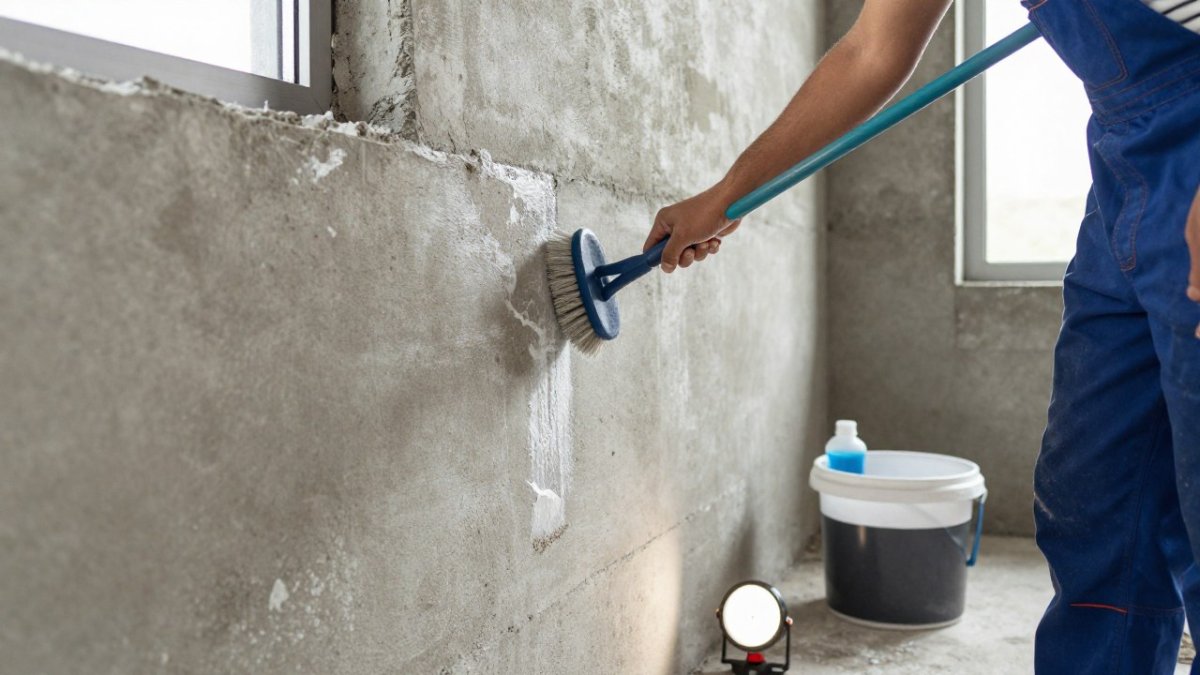
2. Remove existing mold and mildew before anything else. Scrub the growth with a stiff brush and a solution of one part household bleach to three parts water, or a commercial masonry cleaner labeled for mold. Wear an N95 respirator, eye protection, and rubber gloves, and ventilate the space with a fan pulling air out. Let the surface dry completely, 24 to 48 hours in a humid basement, before the next step.
3. Treat efflorescence as a symptom, not a stain. The white chalky powder is salt pushed to the surface by water moving through the masonry. Scrub it off with a dry stiff brush first, then wash with a masonry cleaner, and rinse thoroughly. If it returns within weeks, the moisture source is still active and paint will fail. Do not seal over efflorescence; the salt will push the coating off from behind.
4. Patch cracks and voids with the right material. Hairline cracks under 1/16 inch can be filled with a masonry patching compound. Wider cracks and tie-rod holes need hydraulic cement, which sets fast and expands as it cures to lock into the void. Chisel the crack into a slight V-shape first so the patch has something to key into, dampen the concrete, and press the cement in firmly.
5. Prime with a masonry-appropriate primer. On bare concrete, a masonry primer improves adhesion and evens out absorption so the topcoat does not dry unevenly. On walls with existing mold residue, Zinsser Mold Killing Primer is the water-based, EPA-registered fungicidal option, applied over the cleaned surface and topcoated within 24 hours. On dry but stained walls, a stain-blocking primer does the job for less.
6. Apply two coats under the right conditions. Cut in edges with a brush, then roll or spray the field. Two coats are commonly recommended for interior paints and waterproofing coatings. Keep the space between 50°F and 85°F, ventilate continuously, and wear a respirator rated for the product. Recoat within the window on the label, too soon and the first coat lifts, too late and the second coat will not bond.
7. Cure before you judge the job. Full cure takes about 7 days for most masonry coatings and up to 14 for some acrylic latexes. Do not wash the wall or move storage against it during that window. A faint sheen or slight tackiness in the first 48 hours is normal.
Watch out: painting over a wall that still has active water intrusion traps moisture inside the masonry and pushes it toward your framing and insulation, which is how a paint job turns into a rot repair. If the plastic test shows water coming through, stop and fix the source first.
For the full step-by-step process, read how to waterproof a damp basement, and for keeping mold from returning after the job, see preventing mold in finished basements.
When to Call Berry Basements for a Free Estimate
Call a professional when water is actively entering, when efflorescence keeps returning, or when mold covers more than a small patch. Those are signs the problem sits behind the wall, not on it.
Berry Basements is a licensed basement contractor serving the Grand Rapids area since 2017.
If you are hiring anyone for this work, verify them first. Our guide on verifying basement contractor references gives you a checklist to run before you sign.
Paint manages the surface. Water management protects the room. If your basement has had moisture problems for years, get the source fixed before you finish the space. Berry Basements brings licensed waterproofing, structural expertise, and a collaborative planning process to the same project, so the coating you choose sits on a wall that stays dry. Get started with Berry Basements and a free estimate on your basement.
Frequently Asked Questions
Can you paint over mold on basement walls?
You can paint over mold only after cleaning the surface and treating it with a fungicidal primer like Zinsser Mold Killing Primer. Painting directly over active mold traps spores and the paint will peel as the mold grows underneath. Fix the moisture source first, then clean the surface, dry it completely, and apply a mold-resistant paint or primer. For larger areas of mold, consider professional remediation.
Does mold resistant paint actually work?
Mold-resistant paint works as a preventive layer, not a cure. It contains additives that stop mold and mildew from growing on the paint film itself, which helps in damp basements. It cannot stop mold that starts behind the wall or inside the concrete. If water seepage or high humidity continues, mold will return regardless of the paint. Pair mold-resistant paint with moisture control, ventilation, and a waterproofing coating where water intrusion is present.
What is better than DRYLOK for basement walls?
It depends on the wall condition. DRYLOK Extreme is a waterproofing paint rated at 15 psi, suited to masonry walls with mild seepage. For walls with active water intrusion or hydrostatic pressure, a waterproofing system or exterior drainage addresses the cause more directly than paint. For finished interior walls where mold resistance matters more than blocking water, an interior acrylic latex is one option to consider. Diagnose the moisture source before choosing.
Should basement walls be sealed before painting?
Sealing is not always the right first step. If the walls are damp from exterior water pressure, a sealer can trap moisture and cause paint to peel. Test for moisture first with a plastic sheet taped to the wall for 24 hours. If condensation forms, fix ventilation and humidity. If the wall stays dry, clean it, patch cracks, treat efflorescence, and apply a masonry primer before the finish coat. For persistent seepage, call a licensed basement contractor to assess drainage.
Can you use regular paint on concrete basement walls?
Regular interior paint can work on dry, cured concrete after proper preparation, but it offers no moisture protection. Concrete is alkaline and porous, so an alkali-resistant masonry primer is needed for adhesion. In damp basements, standard paint traps moisture and peels within a season or two. Choose a mold-resistant paint or a masonry waterproofing coating instead, and only after confirming the wall is dry and the moisture source is controlled.
