

Last Updated: November 5, 2026
Quick Summary
Breathing construction dust at home can irritate your airways and trigger asthma, bronchitis, COPD, silicosis, lung cancer, and skin or eye problems. The fine particles in construction dust travel deep into your lungs, and repeated exposure over weeks or months is where the real danger builds.
- Silica dust from cutting concrete, brick, stone, and mortar is the most dangerous type of construction dust.
- Watch for a persistent cough, throat irritation, wheezing, and shortness of breath during or after dust work.
- Seal doorways and HVAC vents with plastic sheeting before the first cut to isolate the work zone.
- Wet-sand drywall and use a HEPA-rated vacuum instead of a shop broom or standard household vacuum.
- Pregnant people, young children, and anyone with asthma or lung disease should leave during heavy dust work.
Table of Contents
- Why Construction Dust at Home Is a Real Health Hazard
- Types of Dust in Construction and How Their Hazards Differ
- Construction Dust Inhalation Symptoms to Watch For
- 7 Health Risks of Repeated Dust Exposure
- How Much Exposure to Concrete Dust Is Dangerous?
- How to Control Drywall Sanding Dust and Other Dust at Home
- When to Leave the House or See a Doctor
- Planning a Dust-Safe Basement Renovation with Berry Basements
- Frequently Asked Questions
Why Construction Dust at Home Is a Real Health Hazard
Construction dust at home is a real health hazard because the fine particles it releases can travel deep into your lungs, and a home renovation gives those particles nowhere to escape.
A finished basement project can look clean on the surface while fine dust settles into carpet, ducts, and furniture for weeks. That slow buildup is what catches most homeowners off guard.
How Dust Becomes Airborne and Reaches Your Lungs
Dust becomes airborne when a tool breaks solid material into tiny pieces. Sanding, cutting, drilling, and demolition all throw fine particles into the air, and those particles can hang there for hours.
The smallest particles are the problem. Larger grit falls fast. Fine particles stay suspended and drift through doorways, up stairwells, and into heating and cooling systems. Once you breathe them in, they bypass your body’s first line of defense and settle in the deepest parts of the lungs.
Types of Dust in Construction and How Their Hazards Differ
Not all construction dust carries the same risk. The material being cut matters as much as the amount of dust in the air.
- Silica dust comes from cutting concrete, brick, stone, and mortar. It is the most dangerous type.
- Concrete dust and cement dust contain crystalline silica and are highly alkaline, which irritates skin and airways.
- Gypsum dust and drywall dust come from cutting and sanding drywall and joint compound. They are less toxic but very fine and irritating.
The Occupational Safety and Health Administration guidance on respirable crystalline silica treats silica as a serious lung hazard even at low exposure levels. That is why concrete and cement dust deserve more caution than drywall dust.
Construction Dust Inhalation Symptoms to Watch For
Construction dust inhalation symptoms usually show up as airway irritation first. Watch for a persistent cough, throat irritation, a scratchy feeling in the nose, and excess phlegm.
Other common signs include:
- Shortness of breath during light activity
- Wheezing or a tight chest
- Itchy, watery eyes
Most mild symptoms ease once exposure stops. If a cough lingers for weeks after the work ends, or you notice breathing difficulties getting worse, that is your signal to see a doctor.
7 Health Risks of Repeated Dust Exposure
Repeated exposure is where the real danger builds. One afternoon of sanding rarely causes lasting harm.
- Airway irritation. Fine particles inflame the nose, throat, and airways, causing chronic coughing and soreness.
- Asthma. Dust can trigger new asthma or make existing asthma much harder to control.
- Bronchitis. Ongoing exposure can cause persistent inflammation of the bronchial tubes.
- COPD. Long-term exposure to dust and silica raises the risk of chronic obstructive pulmonary disease.
- Silicosis. Breathing respirable crystalline silica causes lung scarring that never reverses (Learn About Silicosis).
- Lung cancer. Crystalline silica is linked to lung cancer in people with heavy cumulative exposure.
- Skin and eye problems. Cement dust burns skin, and airborne dust causes allergic reactions and eye irritation.
The American Lung Association’s overview of silica and lung disease notes that silicosis can develop years after exposure ends. That delay is exactly why prevention matters more than cleanup.
Here are the seven health risks the article links to repeated construction dust exposure at home.
| Health risk | What the article says |
|---|---|
| Airway irritation | Fine particles inflame nose, throat, and airways |
| Asthma | Dust can trigger new asthma or worsen existing asthma |
| Bronchitis | Ongoing exposure causes persistent bronchial tube inflammation |
| COPD | Long-term dust and silica exposure raises COPD risk |
| Silicosis | Breathing respirable crystalline silica causes irreversible lung scarring |
| Lung cancer | Crystalline silica linked to lung cancer with heavy cumulative exposure |
| Skin and eye problems | Cement dust burns skin; airborne dust irritates eyes |
How Much Exposure to Concrete Dust Is Dangerous?
There is no safe casual threshold for concrete dust at home. Any amount of respirable crystalline silica carries some risk, and the danger grows with dust concentration and exposure duration. That answer is accurate but not very useful when you are standing in a basement with a rented saw. The practical question is not whether a specific number is safe, but how to tell when your exposure has crossed from a nuisance into something worth acting on.
Why Concentration and Duration Matter More Than a Single Number
Occupational exposure limits are built around two variables: how much dust is in the air and how long a person breathes it. A short, intense burst of concrete cutting in a closed room can deliver a meaningful dose in minutes, while low-level sanding dust that lingers for weeks in carpet and ducts adds up through repeated small exposures.
That is why a homeowner who cuts a single concrete anchor once a year is in a different category from someone spending every weekend for three months finishing a basement. The first is a minor exposure; the second is a sustained one that deserves real controls.
What Visible Dust Does and Does Not Tell You
Visible haze in the air means concentrations are already high, and dust settling on surfaces hours later means fine particles are still circulating. But the most harmful particles are invisible.
A useful rule of thumb: if you can smell or taste the dust, or if a surface you wiped an hour ago is gritty again, fine particles are still in the air.
Practical Indicators That Your Exposure Is Too High
- Visible haze or a gritty taste in the air means concentrations are already elevated.
- Dust settling on surfaces hours after work stops means fine particles are still circulating through the home.
- Symptoms during or after work, coughing, wheezing, throat irritation, mean your protection is not working.
When Professional Assessment or Air Monitoring Makes Sense
Most home renovations do not require air monitoring. But a few situations justify bringing in a qualified indoor-air or industrial-hygiene professional:
- Large-scale demolition or concrete removal inside an occupied home
- Renovation of a home built before the mid-1980s, where dust may contain asbestos or lead in addition to silica
- A household member with asthma, COPD, or another chronic lung condition
A qualified indoor-air or industrial-hygiene professional can measure airborne particle concentrations and confirm whether containment is working. It is worth considering when the project is large or a vulnerable person shares the home.
Watch out: a clean-looking room is not evidence that the air is clean. Fine silica particles can remain suspended and settle into soft surfaces long after visible dust is gone, so do not let a tidy workspace talk you out of respiratory protection or HEPA cleanup.
How to Control Drywall Sanding Dust and Other Dust at Home
Dust control starts before the first cut. Sealing the work area is the single most effective step a homeowner can take, and the order you do things in matters as much as the tools you buy. The sequence below covers the main steps for keeping dust contained during a home renovation: isolate, ventilate, control at the source, then clean in the right order.
Step 1: Isolate the Work Zone
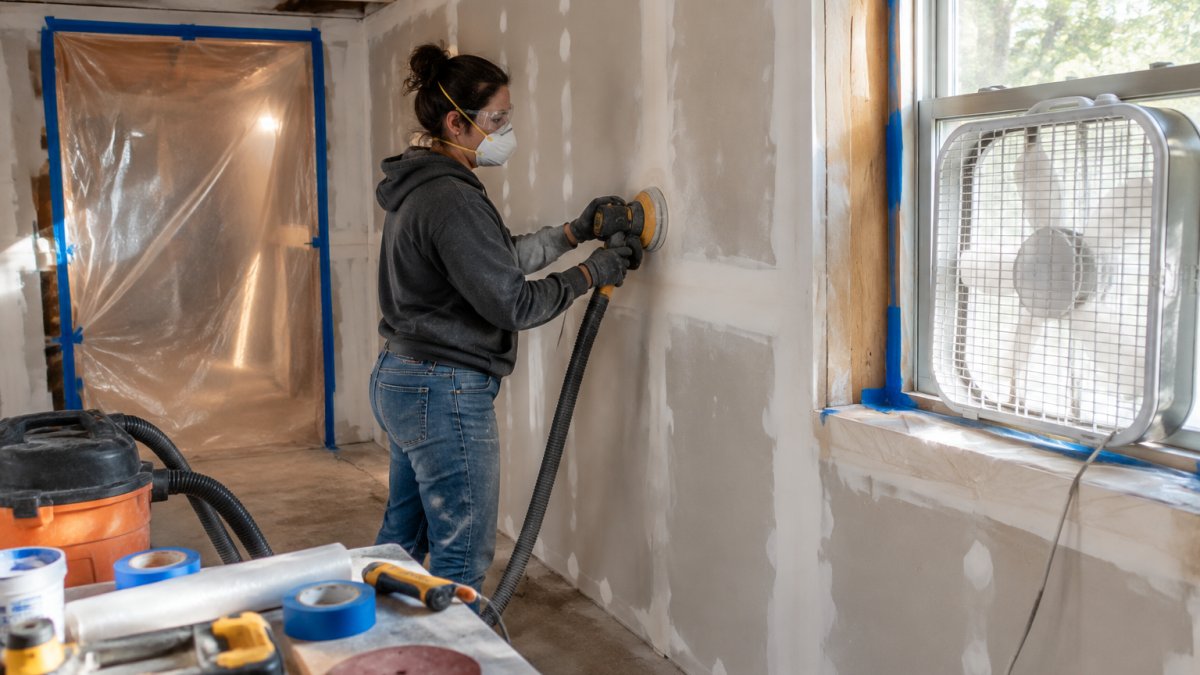
- Tape plastic sheeting over doorways and HVAC vents in the work area. Seal return-air grilles especially, because a running system will pull fine dust through the whole house.
- Use zippered plastic doorways rather than taping a flap, so you can pass through without breaking the seal.
- Cover furniture and flooring you cannot move, and remove rugs and textiles if possible, they trap fine dust and release it for weeks.
Step 2: Set Up Ventilation and Negative Pressure
- Place a box fan blowing outward through a window in the work zone. This creates slight negative pressure so air flows out of the work area rather than into the rest of the home.
- Seal the rest of that window opening around the fan so air does not short-circuit back in.
- Do not run the home’s central heating or cooling during heavy dust work. If you must, seal the work-zone vents first and change the filter afterward.
Step 3: Control Dust at the Source
- Wet-sand drywall with a damp sponge or use a sanding attachment with dust collection. Wet-sanding cuts airborne dust dramatically compared with dry sanding.
- Use a vacuum with a fine-particle filter, a HEPA-rated vacuum, not a shop broom or a standard household vacuum, which can blow fine particles back into the air.
- On concrete cutting or drilling, use a wet saw or a tool with a water feed, and keep the cut area damp.
Step 4: Clean in the Right Order
- Vacuum surfaces with the HEPA vacuum first, working from the ceiling down to the floor so you are not re-dirtying clean surfaces.
- Follow with a damp cloth or damp mop. Damp cleaning captures fine particles that dry dusting and sweeping just launch back into the air.
- Change the water and rinse the cloth often. A dirty cloth spreads dust rather than removing it.
Step 5: Dispose of Debris Without Re-Contaminating the Home
- Bag debris in heavy-duty plastic bags inside the work zone, seal them, and carry them out through the sealed path rather than through living areas.
- Do not shake out drop cloths indoors. Fold them dirty-side-in and take them outside.
- Change the HVAC filter after the project and consider having ducts cleaned if dust reached the system.
Drywall sanding is the worst offender in most basements because joint compound turns into a fine powder that coats everything. If your project also involves moisture, our guide on 7 steps to preventing mold in finished basements covers the related air-quality concerns.
Watch out: a standard shop vacuum without a HEPA filter can exhaust fine dust back into the room, so verify the filter rating before you rely on it for cleanup.
When to Leave the House or See a Doctor
Leave the house during heavy dust work, especially demolition, concrete cutting, or large-scale sanding. Pregnant people, young children, older adults, and anyone with asthma or lung disease should stay away entirely until the air clears.
See a doctor if you notice:
- A cough that lasts more than a few weeks
- Shortness of breath that is getting worse
- Chest pain or wheezing that does not settle
Watch out: ignoring a persistent cough after months of renovation dust is the most common mistake we see. Scarring from silica does not show up right away, so early symptoms are your only warning.
Planning a Dust-Safe Basement Renovation with Berry Basements
The safest renovation is one that contains dust from day one. That means sealed work zones, negative air pressure, filtered vacuums, and a schedule that keeps your family out of the worst of it.
Before you hire anyone, know what to look for. Our articles on what to include in a basement renovation contract and the signs of a bad basement renovation contractor help you ask the right questions up front.
Berry Basements is a licensed basement contractor serving the Grand Rapids area since 2017. If you are ready to plan, you can request a free estimate and get clear answers before work begins.
Frequently Asked Questions
Is breathing in construction dust bad for you?
Yes. Construction dust contains fine particles and crystalline silica that can reach deep into the lungs. Short-term exposure can cause coughing, throat irritation, and shortness of breath. Repeated or long-term exposure raises the risk of silicosis, asthma, bronchitis, COPD, and lung cancer. The risk grows with dust concentration and exposure duration, so even home renovations warrant respiratory protection and dust control.
How long can drywall dust affect your lungs?
Drywall dust and joint compound particles can stay airborne for hours and settle on surfaces for days after sanding stops. Symptoms like coughing and throat irritation may last a few days in healthy adults, but repeated exposure during a long renovation can cause persistent airway inflammation. Clean surfaces with wet methods and HEPA vacuums, and ventilate the work area to shorten how long dust lingers.
Can your lungs recover from concrete dust or silica exposure?
The lungs can clear some larger particles, but respirable crystalline silica is small enough to lodge deep in lung tissue, and the body cannot remove it efficiently. That is why silicosis is permanent and progressive. Avoiding further exposure is the main way to protect lung function once exposure has occurred. If you have breathed concrete dust and notice persistent cough or breathlessness, see a doctor.
What should you do after breathing construction dust at home?
Leave the dusty area, get fresh air, and rinse your nose and mouth with water. Watch for coughing, wheezing, or shortness of breath over the next 24 to 48 hours. Seek medical care if symptoms persist or worsen, especially if you have asthma or another lung condition. For the rest of the project, use an N95 respirator, seal off work zones with plastic sheeting, and run a HEPA air scrubber to lower dust concentration.
Breathing construction dust is a manageable risk when you plan for it, and a serious one when you don’t. If your basement project involves demolition, concrete work, or weeks of sanding, get a professional plan in place first. Berry Basements offers licensed contractors, a collaborative planning process, and expert management of complex tasks so your renovation protects your home and your health. Get started with Berry Basements and build a basement your family can enjoy safely.
