

Last Updated: November 14, 2026
Quick Summary
Basement window treatments are installed by first choosing a treatment that fits the room’s purpose and the window’s frame depth, then measuring the opening in three places, mounting hardware into masonry with proper anchors, and testing that the window still opens fully. Tension rods suit shallow frames, while hopper windows need the sash swing checked before mounting blinds.
- Measure the opening at top, middle, and bottom, and use the smallest number.
- Use masonry bits and masonry anchors for concrete or block walls, not standard plastic plugs.
- Tension rods suit shallow frames but not heavy drapes or very wide windows.
- Open hopper sashes through their full swing with the blind installed to confirm clearance.
- Do not hang heavy fabric over a window that serves as an emergency exit.
Table of Contents
- Choosing the Right Basement Window Treatment for Your Conditions
- Tools, Hardware, and Materials Checklist
- Measuring Shallow, Irregular, or Obstructed Basement Windows
- Installing Basement Window Curtains with Tension Rods
- Mounting Basement Hopper Window Blinds
- How to Cover Basement Windows from Outside
- Planning Your First Basement Window Project and Calling for Help
- Frequently Asked Questions
Choosing the Right Basement Window Treatment for Your Conditions
Basement windows are small, often low to the ground, and they get less daylight than any window upstairs.
Basements also have their own problems. Compare the best basement window treatments for privacy and light before settling on one method.
- Privacy at street level: Fabric curtains or cellular shades work well when neighbors or passersby can look in.
- Light control in a home theater or bedroom: Blackout shades or lined curtains block most outside light.
- Moisture-prone rooms: Vinyl, aluminum, or faux wood blinds hold up better than real wood or paper-based products.
If your basement sits near the ground, outside covers may matter more than interior coverings.
Watch out: Do not hang heavy fabric over a window that serves as an emergency exit.
The best option depends on the room’s use and the window’s location. For more on choosing basement window treatments that still let in the light you already have, read how to maximize natural light in a dark basement.
Tools, Hardware, and Materials Checklist
Gather everything before you start. Most installations take less time when the tools are on hand.
- Tape measure (metal, at least 25 feet)
- Pencil or painter’s tape for marking
- Level (torpedo or 24-inch)
Concrete and block walls are common in basements. Use masonry bits and anchors made for them, not standard plastic wall plugs. Standard anchors can pull out of masonry under the weight of a curtain rod or blind.
Measuring Shallow, Irregular, or Obstructed Basement Windows
Measure twice before you order anything. Basement windows often sit at odd heights, and the frame may not be square.
- Measure the width of the window opening at the top, middle, and bottom. Use the smallest number.
- Measure the height at the left, center, and right. Use the smallest number again.
- Check the depth of the window recess. Shallow frames need a different bracket than deep ones.
- Note any pipes, vents, or window well walls that block the mounting area.
- Decide whether you want an inside mount (fits within the frame) or an outside mount (covers the frame and wall).
Shallow windows usually need an outside mount or a tension rod.
Installing Basement Window Curtains with Tension Rods
Tension rods offer the simplest installation. They need no drilling and work well in shallow frames. They are not suited to heavy drapes or very wide windows.
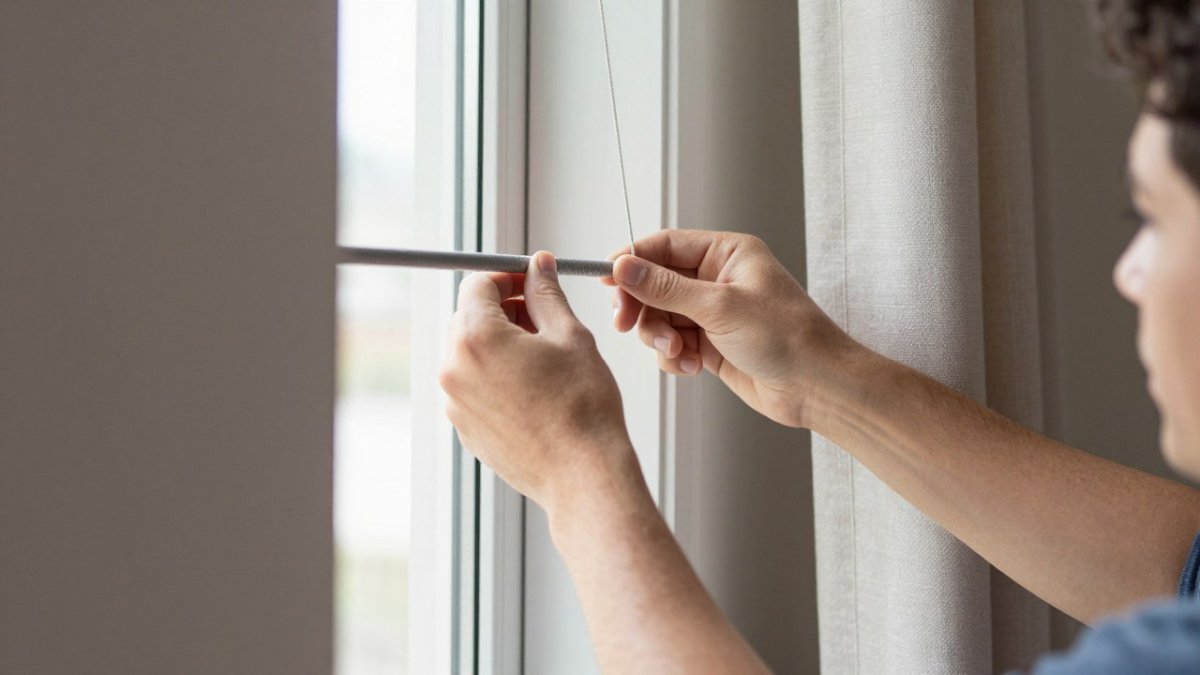
- Measure the inside width of the frame at the spot where the rod will sit.
- Choose a rod that is about 1 inch wider than that measurement, then compress it to fit snugly.
- Set the rod inside the frame, then twist or push it until it locks in place.
- Hang the curtain panels on the rod using the grommets or clips.
- Check that the rod stays level and does not slip.
Expected result: The curtain should hang straight, without sagging, and stay in place when you open or close the window.
Watch out: Tension rods can slip or fall if the frame is too wide or too smooth.
Mounting Basement Hopper Window Blinds
Hopper windows tilt inward from the bottom, so the blind has to clear the sash through its full swing, not just when it is closed.
Measure the swing before you buy. Open the sash to its widest point and measure how far the bottom edge travels into the room.
Choose the mount type based on that number:
- Inside mount with a short headrail: Best when the recess is at least 1 1/2 inches deep and the sash swing stays below the headrail. The blind sits inside the frame and the sash tilts past it.
- Outside mount above the frame: Use when the recess is too shallow for an inside mount or when a pipe or vent crosses the frame. Mount the brackets on the wall or trim above the window so the raised blind clears the sash entirely.
- Cordless cellular or pleated shade: Folds flat against the headrail, which gives the most sash clearance of any interior option.
Installation steps:
- Mark the bracket centers with a pencil. For an inside mount, set them 1/8 inch in from each side of the frame so the headrail does not bind. For an outside mount, center the brackets over the window and extend them 1 to 2 inches past each side of the frame.
- Hold a torpedo level against the marks and confirm they are level before drilling. A blind mounted 1/4 inch out of level will drift to one side every time it is raised.
- Pre-drill pilot holes. Use a masonry bit and masonry anchors if the frame or wall is concrete or block; use a wood bit and the screws that came with the bracket if the frame is wood.
- Attach the brackets, then snap or screw the headrail into place per the manufacturer’s instructions.
- Open and close the sash through its full swing with the blind raised. If the sash contacts the blind, lower the headrail, switch to an outside mount, or swap to a folding shade.
- Raise and lower the blind several times and check that it stays level and that the cords or lift mechanism do not catch on the sash hardware.
Troubleshooting common problems:
- Sash hits the headrail: Move to an outside mount or a folding shade; do not trim the sash or remove the restrictor.
- Brackets pull loose from block: Standard plastic wall plugs are not rated for masonry. Switch to sleeve or wedge anchors sized for the block.
- Blind hangs crooked: Recheck the bracket marks with a level; a 1/8 inch difference at the brackets shows up as a visible tilt at the bottom rail.
The table below summarises the main hopper blind mount choices, based on the sash swing and recess depth.
| Mount type | Best when | Key constraint |
|---|---|---|
| Inside mount, short headrail | Recess at least 1 1/2 inches deep | Sash swing must stay below headrail |
| Outside mount above frame | Recess too shallow or pipe/vent crosses frame | Brackets extend 1 to 2 inches past frame |
| Cordless cellular or pleated shade | Need maximum sash clearance | Folds flat against headrail |
How to Cover Basement Windows from Outside
Outside covers do two jobs: they keep rain, leaves, and cold air out of the window well, and they add a layer of privacy and security at grade. They also sit directly over an opening that may be an emergency exit, so the installation has to preserve both drainage and sash clearance. Most how-to guides skip that trade-off; this section treats it as the main design constraint.
Start with the well, not the cover. A cover that traps water causes more damage than no cover at all.
Measure for fit:
- Measure the well’s width at the top and at the bottom. Use the smaller number.
- Measure the depth from the back wall of the well to the outer edge.
- Measure the height from the well floor to the top of the foundation wall.
- Note the sash swing of the window itself. A hopper or casement sash needs room to open inward, and a cover that sits too low over the well can block a slider or awning sash from opening outward.
Choose a cover type that matches the well:
- Flat polycarbonate or acrylic cover: Clear or tinted panels that let light in and shed water. They work on rectangular wells with a flat top edge and are the most common choice for egress wells because they lift or hinge for access.
- Hinged or lift-off cover: Hinges at the back so the front lifts for window access and cleaning. Best when the window is used or must remain openable as an exit.
- Sloped cover: Sheds water and debris away from the well. Suited to wells with a raised outer edge.
Installation steps:
- Set the cover in place dry and check that it sits level and does not rock.
- Mark the bracket or clip positions on the foundation wall or well edge.
- Drill pilot holes with a masonry bit if mounting into concrete or block, and use masonry anchors rated for the cover’s weight.
- Attach the brackets or clips, then set the cover and secure it per the manufacturer’s instructions.
- Confirm the cover does not block the sash from opening through its full swing, and that any hinge or lift hardware clears the window frame.
- Pour a bucket of water on the cover and watch where it runs. Water should shed away from the well, not pool at the edges or drip back inside.
Watch out: A cover that blocks an egress window from opening fully can turn a legal bedroom into a safety hazard.
Maintenance: Clear debris from the cover and well twice a year, and after any major storm.
Our guide on how to choose basement window well covers covers sizing and material comparisons in more detail.
Planning Your First Basement Window Project and Calling for Help
Start with one window. Choose a simple treatment, such as tension rod curtains, and install it. That will show you how your basement’s walls, frames, and light behave before you tackle larger projects.
Call a professional when you see any of these problems:
- Water stains, mold, or active leaks around the window
- Cracked or crumbling masonry near the frame
- A window that you must keep as an emergency exit
- Electrical wiring or gas lines in the mounting area
For larger jobs, such as replacing a window or altering an egress opening, compare DIY and professional egress window installation before you decide.
Berry Basements has served the Grand Rapids area since 2017. Contact us for a free estimate.
Frequently Asked Questions
What are the best window treatments for basement windows?
Blinds, shades, and curtains on tension rods are the most common choices for basement windows because they are easy to install and control light. Hopper windows that open inward often suit lightweight blinds or cellular shades, while small or shallow openings usually work best with tension-rod curtains. Choose moisture-resistant materials such as vinyl or faux wood blinds if the window is near a damp wall, and avoid fabrics that stain or mildew easily. Measure the depth of the frame before buying so the treatment clears the sill and any crank mechanism.
Can you hang basement curtains with a tension rod?
Yes, tension rods work well in most basement windows as long as the frame is inside the window opening and has a consistent width. Measure the inside width at the top, middle, and bottom, then buy a rod slightly wider than the narrowest measurement. Tighten the rod until it is snug, but not so tight that it bows or slips. Tension rods are best for lightweight curtains, since heavy drapes can cause the rod to fall. Check the rod every few weeks, especially in humid months when the frame may shift slightly.
How do you install blinds on a basement hopper window?
Hopper windows open inward from the bottom, so inside-mount blinds need enough clearance so the sash can swing without hitting the slats. Measure the inside depth and width, then choose a blind that clears the open sash. Mark the bracket locations level with a pencil and a small torpedo level, pre-drill pilot holes, and screw the brackets into the frame or wood trim. Test the blind by opening and closing the window several times before you finish mounting the hardware.
How do you cover basement windows from the outside?
Exterior coverings are most useful for window wells, privacy, and insulation. Use a removable window-well cover or a clear polycarbonate panel sized to sit above the well without blocking emergency exit clearance. Secure the cover with brackets or clips that allow quick removal in case of a fire. Keep the well free of leaves and standing water, and check that the cover does not trap moisture against the foundation. Local building codes often set minimum well dimensions for egress windows, so confirm those rules before installing anything permanent.
