

Table of Contents
- What Drives Basement Renovation Costs for Home Theater
- Average Cost Breakdown by Project Scope
- Basement Home Theater Soundproofing Costs and ROI
- Home Theater Equipment Budget Essentials
- Modern Basement Layout Design Ideas for Theater Spaces
- Hidden Costs and Structural Considerations
- Labor vs. Material Cost Allocation
- Return on Investment for Basement Theater Renovations
Last Updated: August 19, 2026
What Drives Basement Renovation Costs for Home Theater
A basement renovation cost for home theater can range dramatically depending on scope. The difference between a basic media room and a dedicated theater with acoustic treatment, custom seating, and professional AV integration is substantial.
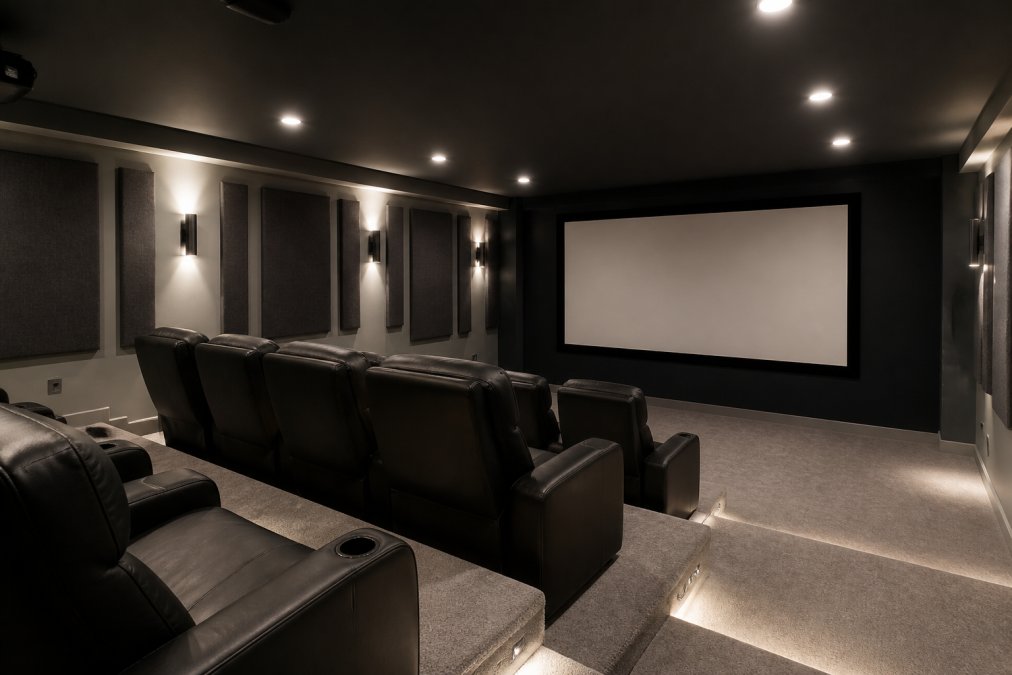
At Berry Basements, we’ve helped homeowners in the Grand Rapids area understand that basement renovation costs break down into predictable categories: structural work, HVAC, electrical, soundproofing, finishes, and equipment. Each category compounds the others. Add acoustic insulation, and suddenly you need to rethink your wall framing. Install a projector, and your electrical load changes. This is why a generic "cost per square foot" estimate falls apart fast.
The real cost drivers are scope, complexity, and whether you’re addressing existing basement issues. A finished basement in dry, structurally sound condition costs far less than one requiring waterproofing, egress windows, and structural modifications. Most homeowners underestimate hidden costs because they focus on visible elements, the screen, the seating, the lighting, while overlooking the infrastructure that makes it all work.
Average Cost Breakdown by Project Scope
Understanding what you’re actually paying for helps separate realistic budgets from wishful thinking. The basement renovation cost for home theater divides cleanly into three tiers, each with distinct trade-offs.
Basic Media Room Setup
A basic media room is a finished basement space with standard drywall, basic lighting, a TV or small projector, and comfortable seating. Standard finishes include recessed lighting with dimmer controls, a single projector or large TV, basic surround sound (5.1 system), and sectional or theater seating. Structural work is minimal, electrical upgrades are straightforward, and moisture barriers are standard but not extensive. HVAC adjustments are usually limited to extending existing ductwork.
You’re not doing acoustic treatment beyond basic absorption, custom cabinetry, dedicated power conditioning, or structural changes. The space remains flexible for future repurposing.
Mid-Range Home Theater Installation
Mid-range installations treat the basement as a dedicated entertainment space with intentional acoustic design, proper equipment layout, and semi-custom finishes. Projects include acoustic insulation in walls and ceilings, custom-built seating risers, a quality projector with motorized screen, 7.1 or Atmos surround sound, custom cabinetry for equipment and storage, dimmer-controlled accent lighting, and proper moisture barriers. Electrical work becomes more complex with dedicated circuits for AV equipment. HVAC adjustments are more involved because acoustic treatment affects air flow. Structural modifications may include reinforcing ceilings for projector mounts or seating platforms.
This is where the basement renovation cost for home theater becomes substantial. You’re engineering the space for performance, not just finishing it.
Premium Dedicated Theater Build
Premium builds are bespoke installations with professional-grade acoustics, high-end equipment, custom architecture, and integrated smart home controls. Projects include professional acoustic design with bass traps and diffusion, custom-built seating with motorized recliners, high-end projector systems with laser light sources, immersive audio (Atmos, object-based surround), professional-grade AV receivers, motorized blackout systems, integrated smart home automation, and luxury finishes. Electrical work is substantial with dedicated circuits and isolated ground systems. HVAC becomes critical because high-end equipment generates heat. Building permits may be required for structural changes.
Basement Home Theater Soundproofing Costs and ROI
Acoustic treatment separates a room with a screen from an actual theater. Sound control determines whether neighbors hear explosions at midnight and whether your dialogue is intelligible.
Soundproofing addresses two problems: preventing sound from leaving the room and controlling reflections inside it. Isolation, decoupling walls and ceilings so vibrations don’t transfer, is expensive but necessary for true soundproofing. Absorption, using materials to dampen sound reflections, is less costly but doesn’t prevent sound transmission to adjacent spaces.
Standard fiberglass insulation is transparent to low frequencies. Effective soundproofing requires decoupling layers: resilient channels, acoustic caulk, isolated rim joists, and sometimes floating floors. A hybrid approach works for most basements: invest in isolation where it matters most (shared walls, ceilings near bedrooms) and use absorption for interior acoustic control.
The ROI on soundproofing is functional. You can use the space without complaints and turn up the volume without disturbing the rest of the house. For many homeowners, that freedom justifies the investment.
Home Theater Equipment Budget Essentials
Equipment costs are visible and easy to compare. They’re also where many people overspend on specs that don’t match their actual use.
Projector and Screen Systems
A projector is the centerpiece. For a dedicated basement theater with light control, a mid-range 4K projector performs better than an overpowered projector in a bright room. Brightness matters less in a dark theater; contrast and color accuracy matter more.
Throw distance, how far the projector sits from the screen, determines where you can mount it and affects your room layout significantly. Most mid-range home theater setups use projectors in the $2,000-$4,000 range with screens in the $1,500-$3,000 range. Motorized screens add complexity but improve aesthetics when the system isn’t in use. A fixed screen is cheaper and performs better optically.
Audio and Surround Sound Setup
A quality 5.1 system (front left, center, right, two surrounds, subwoofer) outperforms a cheaper 7.1 system. Speaker placement and room acoustics matter more than speaker count.
Surround speakers need positioning at ear level, 90-110 degrees from center listening position. The subwoofer location is critical; bass is directional at lower frequencies, and poor placement creates dead spots. Atmos (height channels) adds immersion but requires ceiling-mounted speakers or upward-firing drivers and works best in dedicated theaters with proper ceiling height.
Quality matters: a well-tuned 5.1 system with mid-range speakers and proper placement beats a poorly positioned 7.1 system. Prioritize placement and calibration over speaker count.
Seating and Custom Cabinetry
Seating comfort determines whether the room actually gets used. Quality seating lasts decades; cheap theater recliners fail within years. Custom cabinetry for equipment, media storage, and snack bars improves functionality and aesthetics. Equipment cabinets need ventilation, cable management, and proper power distribution.
Tiered or riser seating improves sightlines in smaller basements. A simple riser platform is cheaper than custom theater seating risers but limits flexibility.
Modern Basement Layout Design Ideas for Theater Spaces
Layout determines whether the space functions as intended. A poorly designed basement theater creates acoustic problems, sightline issues, and wasted space.
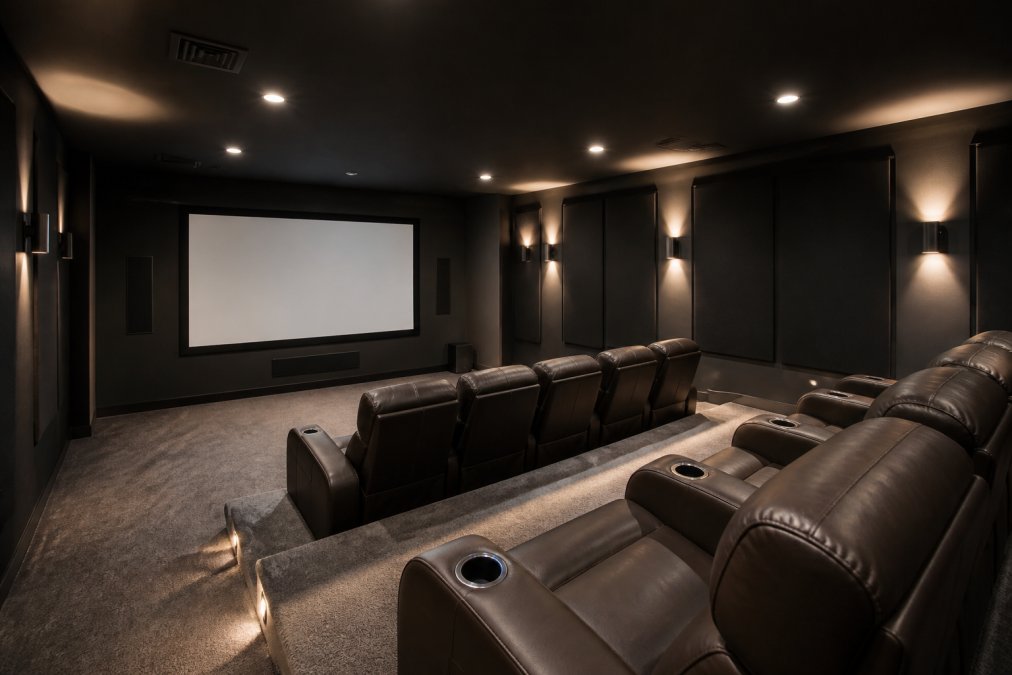
Seating arrangement is the first decision. Tiered seating (raised back rows) improves sightlines without consuming excessive space. The viewing distance from screen to seating should be 1.5 to 2.5 times the screen width.
Acoustic layout affects sound quality. Parallel walls create flutter echo. Angled or asymmetrical room shapes improve acoustics. The projection booth should be isolated from the seating area to reduce equipment noise. A small closet or equipment alcove works well.
Equipment placement drives cable runs and electrical needs. Plan these details before drywall goes up to avoid costly rework. Lighting design is critical: recessed lights with separate dimmer zones control ambiance, and indirect lighting reduces glare on the screen. Accent lighting adds depth without interfering with viewing.
Storage and accessibility matter. Equipment needs ventilation; cable management should allow future equipment changes without ripping out walls.
Hidden Costs and Structural Considerations
This is where most basement renovation cost estimates fall apart. Visible costs are easy to budget; hidden costs surprise you mid-project.
Moisture Barriers and Waterproofing
Basements are inherently damp. Concrete wicks moisture from the ground. Standard poly sheeting is insufficient for long-term moisture control. Proper waterproofing requires a vapor barrier, drainage plane, and often exterior waterproofing if the basement has had moisture issues.
Many homeowners discover existing moisture problems during renovation. If your basement has had water intrusion, solve that before finishing. This might require interior or exterior French drains, sump pump upgrades, or foundation repairs. A moisture barrier under flooring is non-negotiable. Carpet over concrete is a mold risk in most basements.
Electrical Wiring and HVAC Requirements
A home theater setup requires multiple dedicated circuits: one for the projector and receiver, separate circuits for lighting, and ideally isolated ground systems for sensitive AV equipment. Running new circuits from your main panel might require panel upgrades if your home’s electrical service is maxed out.
HVAC is critical but often overlooked. AV equipment generates heat. A sealed, insulated basement without proper ventilation becomes an oven. You need to extend ductwork from your main system or install a separate mini-split system. Humidity control is part of HVAC; a small dehumidifier helps, but proper HVAC design prevents expensive equipment failures.
Egress Windows and Building Permits
If your basement renovation includes converting space to a bedroom, local building codes require egress windows. These are expensive to install (often $1,500-$3,000 per window) and non-negotiable legally.
Building permits are required for most basement finishing work. Unpermitted work creates liability and complicates future home sales. Most lenders won’t finance homes with unpermitted work. A licensed contractor like Berry Basements knows local requirements and handles permit coordination.
Labor vs. Material Cost Allocation
The basement renovation cost for home theater splits between labor and materials. For basic media rooms, materials typically represent 50-60% of total cost and labor 40-50%. For mid-range installations, the split is more balanced. For premium builds, labor often exceeds materials because of complexity.
Labor-intensive work includes framing, electrical, HVAC, acoustic treatment installation, and custom cabinetry. Cutting corners on labor creates problems that cost far more to fix. A licensed contractor manages complexity, coordinates trades, ensures code compliance, and prevents costly mistakes.
Cutting corners on materials degrades the space over time. The sweet spot is investing in materials that matter (acoustic treatment, quality equipment, durable finishes) and labor expertise that prevents mistakes.
Return on Investment for Basement Theater Renovations
ROI for basement finishing is complicated. A finished basement adds resale value, but not dollar-for-dollar. A $50,000 renovation might add $30,000-$40,000 to home value. A $150,000 premium build might add $80,000-$100,000.
The functional ROI is immediate. A finished basement with a home theater expands your living space and improves daily quality of life. Your family uses it, you host gatherings, and the space becomes valuable immediately.
For most homeowners, the decision isn’t primarily financial. It’s about whether you’ll use the space and whether the investment aligns with your budget. Berry Basements helps homeowners in the Grand Rapids area understand their actual ROI by clarifying what they’re paying for and what they’ll get in return. A transparent basement renovation cost for home theater estimate, broken down by category, lets you make an informed decision about where to invest and where to be conservative.
Frequently Asked Questions
How much does it cost to build a basement home theater?
Basement renovation costs for home theater vary widely based on square footage, finishes, and equipment quality. A basic media room might cost less, while a dedicated theater with premium soundproofing, custom seating, and high-end AV equipment typically represents a larger investment. For an accurate estimate tailored to your specific project scope, contact a licensed contractor for a detailed quote that accounts for your basement's unique conditions and your entertainment goals.
What are the biggest expenses when installing a home theater in a basement?
The largest costs typically include structural modifications (subfloor installation, drywall, HVAC adjustments), acoustic treatment and soundproofing materials, AV equipment (projector, receiver, speakers), custom seating, and labor. Hidden expenses like moisture barriers, electrical upgrades, egress windows, and building permits often catch homeowners off guard. Soundproofing alone can represent 15-25% of your total project budget depending on your acoustic goals and existing basement conditions.
Do I need to address moisture issues before starting a basement home theater renovation?
Yes, addressing moisture is critical before any renovation. A wet basement can damage electronics, drywall, flooring, and custom cabinetry, making it a poor foundation for expensive AV equipment and seating. Moisture barriers, waterproofing, and proper drainage should be installed first. A professional assessment identifies whether your basement needs full waterproofing or targeted solutions, ensuring your theater investment is protected long-term.
What return on investment can I expect from a basement home theater renovation?
Home theaters typically return 50-70% of renovation costs in resale value, depending on market conditions and quality of finishes. The real ROI often comes from increased family enjoyment and entertainment functionality while you own the home. A well-designed theater with quality soundproofing, durable finishes, and integrated smart home features appeals to buyers and justifies higher asking prices, particularly in competitive markets where finished basements add significant square footage value.
A basement renovation cost for home theater is substantial, but it’s also an investment in how your family uses your home. The real cost isn’t just the price tag; it’s understanding what you’re paying for and whether it matches your priorities. Berry Basements works with homeowners to build spaces that deliver on that promise. Get a free estimate and see how we can transform your basement into the space you actually want to use.
This article was written using GrandRanker