

Table of Contents
- Why Traditional Basement Wall Paneling Falls Short
- Basement Drywall Alternatives That Handle Moisture
- Moisture-Resistant Basement Wall Materials Compared
- Basement Concrete Wall Ideas Beyond Covering Them Up
- Painted Basement Walls: When Paint Is Enough
- Matching Wall Materials to Your Basement’s Use Case
- Frequently Asked Questions
Last Updated: October 6, 2026
Why Traditional Basement Wall Paneling Falls Short
Traditional basement wall paneling fails because it traps moisture against concrete, hides active leaks, and warps within a few seasons.
Wood paneling, the classic 1970s basement finish, was never designed for a damp environment.
At Berry Basements, we have walked into finished basements where the paneling looked fine from the couch and terrible from behind.
The alternatives to traditional basement wall paneling below solve that problem in different ways. Some prioritize moisture resistance. Some prioritize looks.
Never install any wall covering over concrete that has active seepage or a history of flooding. Covering a wet wall traps the problem and guarantees mold growth. Fix drainage and waterproofing first, then finish.
Basement Drywall Alternatives That Handle Moisture
Moisture-resistant materials fall into two families: plastic-based panel systems and mineral or engineered boards. Each handles damp concrete differently, with a trade-off worth knowing.
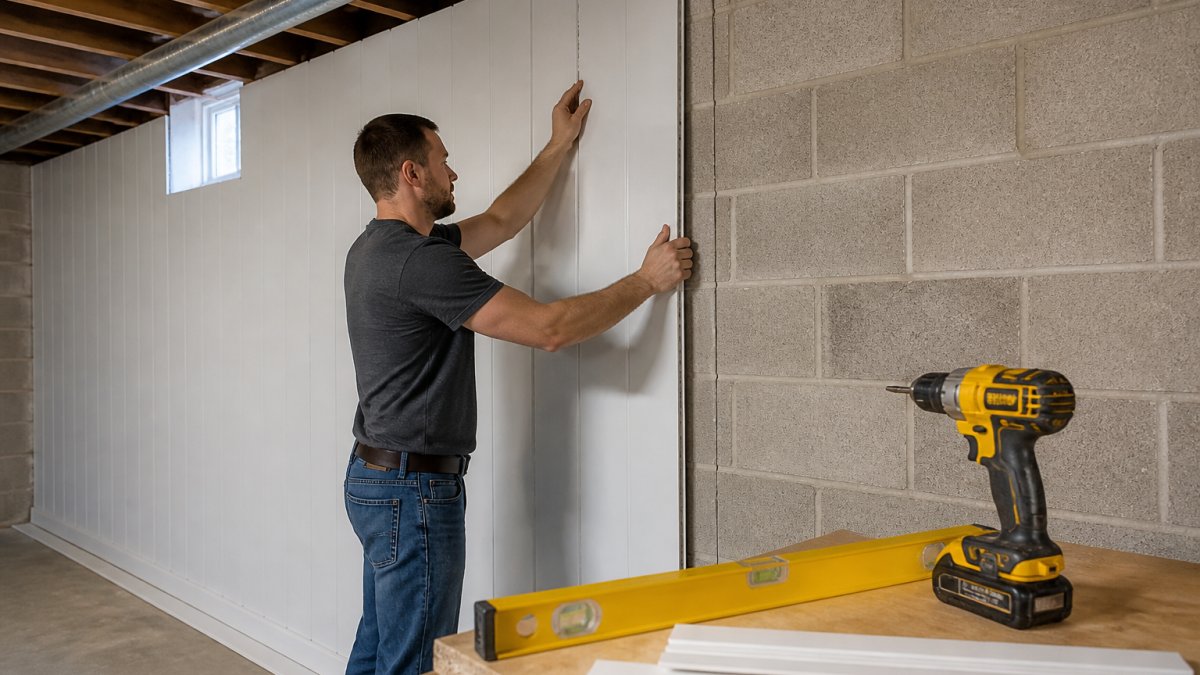
PVC and Fiberglass Panel Systems
PVC and fiberglass panels are the most moisture-proof option available, because they contain no organic material for mold to feed on.
Fiberglass reinforced plastic panels, often called FRP, are non-porous, impact-resistant, and common in utility rooms and workshops.
For partial coverage, PVC wainscoting products such as Plastpro protect the lower half of the wall where moisture and scuffs hit hardest, at a fraction of the cost of full-wall systems.
Magnesium Oxide and Engineered Wood Boards
Magnesium oxide board is a mineral-based sheet that resists fire, mold, and moisture while installing on standard framing.
Engineered wood sheathing takes the opposite route. Products like Advantech and Zip System use moisture-resistant resins and integrated barriers to resist warping and swelling.
The trade-off is weight. Magnesium oxide boards are heavier than standard drywall and harder to cut, which slows installation and raises labor time.
Moisture-Resistant Basement Wall Materials Compared
Here is how the main options stack up on the factors that matter most below grade, moisture resistance, finish requirements, and acoustic behavior.
| Material | Moisture Resistance | Finish Required | Acoustic Behavior | Best For | Main Drawback |
|---|---|---|---|---|---|
| PVC panel systems | Excellent | None | Hard, reflective, echoes without treatment | Wet-prone rooms, fast installs | Higher upfront cost |
| FRP fiberglass panels | Excellent | None | Reflective, industrial | Utility rooms, workshops | Industrial look |
| Magnesium oxide board | Very good | Paint or texture | Dense, absorbs some mid-range | Fire safety, standard framing | Heavy, hard to cut |
| Engineered wood sheathing | Good | Paint or stain | Moderate absorption | Structural walls | Needs a finish layer |
| Decorative panels | Varies by type | None | Varies by substrate | Feature walls, texture | Not for wet zones |
| Peel-and-stick foam | Basic | None | Slight absorption | Quick budget refreshes | Low durability |
The pattern is clear: the more moisture-proof the material, the less it looks like a traditional finished wall and the more it reflects sound. The more it looks like drywall, the more finishing work it needs.
Budget Tiers and Phased Upgrades
Most homeowners do not finish a basement in one weekend, so the smartest projects are phased into three tiers:
- Entry tier: Seal and insulate the concrete, then paint with a masonry-specific coating. This is the lowest-cost path and keeps the space usable while you save for the next stage.
- Mid tier: PVC or FRP panel systems on the wet walls, magnesium oxide board finished like drywall on the dry walls. This is where a basement starts to feel like a real room, and it is the most common stopping point for homeowners who want durability without a full build-out.
- Higher tier: Full-wall engineered systems, a dedicated feature wall, acoustic treatment, and integrated AV planning, where the room becomes a destination rather than storage.
Phasing matters because the moisture strategy comes first in every tier. If you paint now and panel later, the entry-tier sealer and insulation work carries forward; skip it and every later upgrade starts from a wet wall.
Match the material to the moisture risk, not to the photo you saw online. A dry, well-drained basement can handle finishes that a damp one cannot, and a phased plan lets you upgrade without redoing the prep.
Basement Concrete Wall Ideas Beyond Covering Them Up
Not every basement wall needs to be hidden. Sometimes the better move is to seal, insulate, and let the concrete show, or use it as a design feature.
Sealing and Insulating Before You Finish
Sealing and insulating is the step most homeowners skip, and it determines whether any finish lasts. A masonry sealer on the interior face slows vapor movement, while rigid foam insulation creates a thermal break so the concrete stays warmer and condensation drops.
Get this wrong and you will replace whatever you installed in a few years; get it right and almost any material on this list will hold up.
Textured Panels and Feature Walls
Concrete does not have to stay gray. Decorative panels from suppliers like Decorative Ceiling Tiles come in faux stone, brick, and 3D textures that mount directly over block or poured walls and cover uneven surfaces well.
Woody Walls takes the opposite approach, adding real wood texture and warmth. It looks excellent on a feature wall behind a bar or media setup, but it is a poor choice for a wall with any humidity.
Use a textured or wood feature wall on one accent wall only, and keep the other three walls in a moisture-proof material. You get the look without the risk.
Painted Basement Walls: When Paint Is Enough
Paint is enough when the basement is dry, the concrete is sound, and you want a finished look at the lowest possible cost.
The key is surface prep. Clean the walls, patch cracks, and use a masonry-specific paint that resists moisture and mildew.
Where paint falls short is comfort. Bare painted concrete is cold, hard, and echoes. It does nothing for insulation or sound.
Matching Wall Materials to Your Basement’s Use Case
The right wall material depends on what the room actually does. A home theater, a gym, and a playroom have different demands, and picking one material for the whole basement usually means compromising somewhere. Entertainment use cases deserve their own planning, because the wall finish, the screen, and the seating all interact.
Ten Entertainment Concepts and How Each One Changes the Walls
Most basement entertainment guides stop at the movie theater. Here are ten distinct concepts, each with the wall and screen implications that matter.
- Conventional movie theater. Dark, matte walls, engineered wood or magnesium oxide board finished in flat dark paint. A fixed-frame or retractable screen mounts on the front wall, which should be solid enough to anchor a screen frame. PVC panels reflect sound and create echo, so avoid them here.
- Sports viewing room. Wider seating arc and a larger screen than a movie room. Walls benefit from acoustic treatment because crowd noise and announcers fill the space. A feature wall behind the screen in a team color works well with a painted or paneled finish.
- Gaming room. Multiple screens or a single large display, often with a desk or console setup. Walls need cable management and equipment storage, so built-in cabinetry or a paneled wall with concealed conduit is the practical choice.
- Karaoke and music room. Sound isolation matters more here than in any other concept. Dense wall materials plus acoustic panels reduce transmission to the floor above. A feature wall behind the performance area gives the room a stage feel.
- Multi-use lounge. A bar, a seating area, and a screen that retracts when not in use. This is where a retractable screen earns its cost, because the wall behind it stays usable for shelving or art.
- Wine and tasting room. Cooler, drier conditions than a typical basement, so moisture-resistant materials are non-negotiable. A textured or wood-look feature wall reads well, but only on a wall with no humidity risk.
- Home gym. FRP or PVC panels take impact and wipe clean. A wall-mounted screen or TV for workout classes sits well on a paneled wall with a simple mount.
- Playroom and family zone. Durable, cleanable walls and a low-mounted screen or projector kids can reach safely. Rounded or soft-edged feature elements reduce injury risk.
- Craft and hobby studio. Task lighting and storage dominate. Painted or paneled walls with a pegboard or slatwall section give flexibility without a full build-out.
- Guest suite with entertainment. Magnesium oxide board finished like drywall so the room reads as a normal bedroom, with a small wall-mounted display rather than a projector.
Projector-Screen Integration for Each Concept
The projector is not a generic feature. Where it goes depends on the room concept and the wall finish you chose.
- Fixed-frame screens mount permanently on a solid front wall. They give the best image and cleanest look, but commit the wall to the theater concept. Use them in dedicated movie and sports rooms.
- Retractable screens drop from a ceiling or wall housing and disappear when not in use. They suit multi-use lounges, karaoke rooms, and any space where the wall does double duty. The housing adds depth, so plan for it during framing.
- Ultra-short-throw projectors sit inches from the wall and throw a large image without a long room. They work well in small basements and gaming rooms, but need a perfectly flat screen surface, a textured or paneled wall will show every imperfection.
Practical Projector Setup Constraints
Before committing to a projector, check these constraints against your actual room:
- Throw distance. A standard projector needs a specific distance from the screen to hit a given image size. Measure the room before buying, because a short room may force an ultra-short-throw model.
- Ceiling height. A ceiling-mounted projector needs clearance above the seating area and a clear line to the screen. Low basements often rule out ceiling mounts entirely.
- Ambient light. Basements are naturally dark, which is an advantage, but any window or stairwell light will wash out the image. Light control is part of the wall and window plan, not an afterthought.
Basement-Specific Safety and Comfort
Entertainment rooms add load to a basement that storage never did. Plan for these before the walls go up:
- Moisture. The same rule applies here as everywhere else: fix water first. A damp wall behind a screen or cabinet will damage both.
- Ventilation. A crowded theater or gaming room generates heat and humidity. Make sure the HVAC plan accounts for the occupancy load.
- Egress. Any sleeping area, including a guest suite with entertainment, needs a compliant egress window. Check local requirements before framing.
Homeowners who want a finished look without gambling on moisture: PVC panel systems on the wet walls, finished drywall alternatives on the dry ones, and a retractable screen on the wall that needs to do double duty.
If the project involves waterproofing, structural work, or running new HVAC and plumbing around existing pipes, that complexity is where a licensed contractor earns their keep. Berry Basements has handled those basement-specific challenges since 2017, and we plan the moisture strategy before a single panel goes up.
Frequently Asked Questions
What can I use instead of traditional basement wall paneling?
Several materials work well: interlocking PVC panels resist moisture and mold completely, magnesium oxide board offers fire resistance and durability, fiberglass reinforced plastic panels handle high-moisture utility areas, and engineered wood sheathing provides structural strength. For budget projects, painted concrete walls or PVC wainscoting deliver a finished look without full-wall coverage. The right choice depends on your basement’s moisture level and how you plan to use the space.
Are basement wall panels better than drywall?
It depends on moisture conditions. Standard drywall absorbs water and supports mold growth, making it risky in damp basements. Moisture-resistant alternatives like PVC panels, magnesium oxide board, or fiberglass reinforced plastic resist water damage and clean up easily. Drywall still works in basements with proven waterproofing and controlled humidity. If your basement has had repeated moisture issues, panel systems designed for wet environments are the safer investment.
Can you paint basement concrete walls?
Yes, but preparation determines how long the paint lasts. Clean the walls, patch cracks, and apply a masonry primer before painting. Use a breathable acrylic or silicate masonry paint rather than standard interior paint, which traps moisture and peels. Painted basement walls work best when the concrete is dry and the space has good ventilation. If you see efflorescence or active seepage, address the water source first.
What is the best material for basement walls in a damp space?
PVC panel systems and fiberglass reinforced plastic panels perform best in consistently damp basements because they are non-porous and do not support mold. Magnesium oxide board also resists moisture while adding fire resistance. Before installing any wall material, fix the underlying water problem with proper drainage, sump systems, or waterproofing. No wall finish survives ongoing moisture intrusion, so waterproofing comes first.
How do you make basement walls look modern without drywall?
Decorative panels with faux stone, brick, or 3D textures create visual interest without drywall. Peel-and-stick wood panels add warmth and install quickly. For a cleaner look, interlocking PVC panels come in smooth finishes that resemble painted drywall but resist moisture. Feature walls combining textured panels with painted concrete on adjacent walls create contrast. Lighting also matters: wall-washing sconces or LED strips highlight texture and make any finish look intentional.