

Table of Contents
- Why Basement Project Management Changes the Outcome
- Budget Transparency and Change-Order Control
- Schedule Control and Milestone Planning: The Basement Renovation Project Timeline
- Permits, Code Compliance, and Inspections Handled for You
- How to Choose a Basement Contractor With Real Management Depth
- Your Basement Renovation Contractor Checklist
- Basement Remodeling Cost Management: Where the Savings Actually Come From
- Conclusion
- Frequently Asked Questions
Last Updated: October 17, 2026
Why Basement Project Management Changes the Outcome
Basement project management is the discipline of coordinating design, trades, budget, schedule, permits, and quality control through a single accountable process. It changes the outcome because a basement renovation is not one job. It is a stack of connected jobs, and the order they happen in decides whether the room works.
Here is what most guides get wrong: they treat management as paperwork that arrives after the decisions. In practice, the decisions that cost the most are made in the first two weeks, long before a single stud goes up.
At Berry Basements, we have run basement renovations since 2017, and the pattern is consistent. Homeowners who lock in scope, moisture strategy, and inspection sequence early spend their energy choosing finishes. Homeowners who don’t spend it chasing surprises.
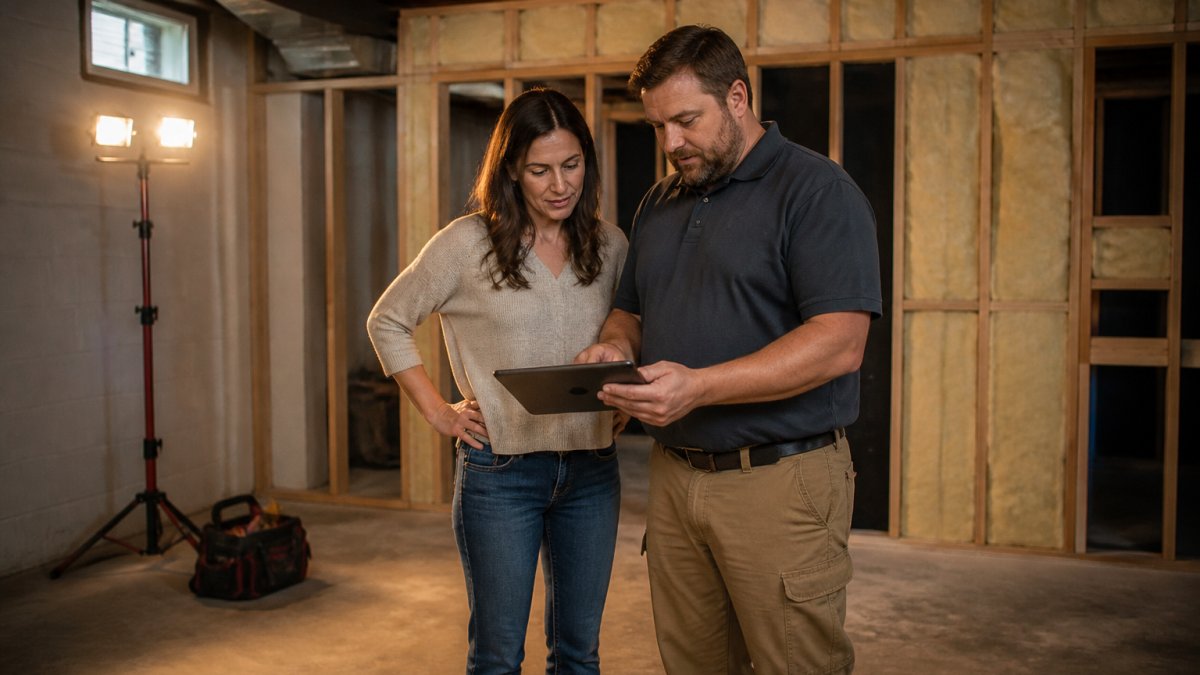
A finished basement adds usable square footage without touching the footprint. That is the appeal. Delivering it without a mid-project crisis is the management problem, and it is the one we solve.
Good basement project management front-loads the expensive decisions. Moisture, layout, and code come before finishes, not after.
Budget Transparency and Change-Order Control
A transparent budget lists allowances, exclusions, and a contingency line in writing before work starts. Change-order control means no added cost gets approved without a written scope description and a signed price. Together they turn a renovation budget from a guess into a tracked number.
The real difference between a calm project and a stressful one comes down to how change orders are handled. A common mistake is accepting verbal adjustments. “We’ll sort it out at the end” is how budgets drift.
We build a written contingency into every proposal and require a signature on any change before material is ordered. That single rule removes most end-of-project disputes.
- Every allowance labeled with what it covers
- Exclusions spelled out in plain language
- Contingency held for unknowns, not spent on upgrades
- Written change orders with price and schedule impact
Schedule Control and Milestone Planning: The Basement Renovation Project Timeline
A basement renovation project timeline runs through a fixed sequence: design and permits, demolition, waterproofing and rough-ins, framing and insulation, inspections, finishes, and final walkthrough. Milestone planning assigns a completion date to each phase so slippage shows up early instead of at the end.
Trade coordination is where schedules break. Electrical, plumbing, and HVAC rough-ins have to be sequenced around inspections, and a missed inspection window can stall every trade behind it.
What most guides miss is that the calendar is a management tool, not a promise. We publish milestones weekly so homeowners can see what is happening and what comes next.
Ask for the inspection dates, not just the finish date. Inspections are fixed appointments, and every trade in the basement queues behind them.
Permits, Code Compliance, and Inspections Handled for You
Permits and inspections are the part of a basement renovation that homeowners cannot manage alone. Building permits, building codes, and inspection scheduling belong to the contractor’s scope, and a finished basement that fails inspection is not a finished basement.
Many municipalities require permits for finishing work, and requirements vary by jurisdiction. Rather than guess, we confirm local requirements with the authority having jurisdiction before demolition begins. The International Code Council’s building code resources explain how model codes are adopted locally, and the U.S. Department of Energy guidance on basement insulation covers insulation and moisture details that inspections often touch.
Compliance is not a formality. It is the record that the work was done correctly.
How to Choose a Basement Contractor With Real Management Depth
Choosing a basement contractor comes down to one question: can they show you how they manage, not just what they build? Management depth shows up in written schedules, named responsibilities, and a documented process for changes, not in a polished portfolio.
Most homeowners evaluate contractors on price and photos. The better test is to ask what the project manager actually does. On a basement renovation, a dedicated project manager typically owns six things: the scope document, the permit and inspection sequence, the trade schedule, the budget and change-order log, the communication cadence, and quality checks at each milestone. If a contractor cannot describe who fills that role and what they are accountable for, the management is informal, and informal management is where delays and overruns start.
When you evaluate a contractor, ask for the project manager’s responsibilities in writing. Ask who answers the phone during construction and how often you will receive updates. Ask for references from projects with the same complexity as yours, finished basements with waterproofing, egress, and multiple trades, not just cosmetic remodels.
- Scope clarity: Is the proposal specific about what is included and excluded, with allowances labeled?
- Schedule: Do you receive dated milestones per phase, and who updates them?
- Change process: Is there a written change-order procedure with pricing rules and approval steps?
- Compliance: Who pulls permits, schedules inspections, and confirms egress and ceiling-height requirements?
- Communication: How often do you get updates, in what format, and who is the single point of contact?
- Risk and quality: How are hidden conditions, water issues, and workmanship problems documented and resolved?
That last pair matters more than most homeowners expect. Communication and homeowner decision support are what keep a project moving when a choice has to be made quickly. A manager who maintains a decision log, recording what was chosen, when, and what it cost, prevents the “I thought we agreed” conversation that stalls a schedule. Likewise, a manager who walks the site before each inspection and documents corrections is doing quality assurance, not just supervision.
Ask for a sample weekly status report. A manager who can show you a real one, with milestone status, open decisions, and change-order log, is managing. A manager who cannot is improvising.
Your Basement Renovation Contractor Checklist
Use this basement renovation contractor checklist before signing anything. It converts a vague impression of competence into verifiable answers.
- License and insurance certificates provided without being asked
- Written proposal with allowances, exclusions, and contingency line
- Dated milestone schedule by phase
- Named project manager and contact method
- Written change-order procedure with pricing rules
- Permit and inspection responsibility stated in the contract
- Moisture and waterproofing approach described in detail
- References from comparable projects, with photos
- Warranty terms in writing
- Payment schedule tied to completed milestones
Skipping the moisture question is the most expensive shortcut in a basement. Water damage and mold prevention have to be designed in before framing, not patched after finishes go up.
| Problem | Management Fix | Impact |
|---|---|---|
| Budget drift | Written change orders, held contingency | Predictable final cost |
| Missed dates | Dated phase milestones | Early warning on slippage |
| Failed inspection | Permit and inspection sequence planned upfront | No rework |
| Moisture returns | Waterproofing before framing | Dry, usable space |
| Decision delays | Single point of contact | Fewer work stoppages |
Basement Remodeling Cost Management: Where the Savings Actually Come From
Basement remodeling cost management is less about finding a cheaper bid and more about controlling how the number moves. The largest savings come from sequencing correctly, holding a real contingency, and deciding finishes before installation starts, but those savings only materialize if the budget is structured to track them.
A cost-effective renovation is not the lowest quote. It is the project that finishes once. Rework, torn-out drywall, and re-inspections cost far more than the line items homeowners usually negotiate. The management fix is a budget built in four layers:
- Detailed estimate: Line items for labor and materials, not lump sums, so you can see what each phase costs.
- Allowances: A stated dollar figure for items not yet selected (tile, fixtures, flooring), labeled with what it covers and what happens if you exceed it.
- Contingency: A separate reserve for unknowns, hidden moisture, framing surprises, code corrections, held apart from upgrades and released only with your approval.
- Payment milestones: Payments tied to completed and inspected work, not to calendar dates, so cash flow follows progress.
Change-order management is the other half. A written change order should state the scope change, the price, and the schedule impact, and it should require a signature before material is ordered or work proceeds. Verbal adjustments, “we’ll sort it out at the end”, are how budgets drift. A manager who logs every change order and reviews the budget against actuals at each milestone lets you see the number move before it becomes a problem.
We manage cost by locking scope early, keeping contingency separate from upgrades, and reviewing the budget against actuals at each milestone. Homeowners see where the money is going while there is still time to adjust.
A contingency that gets spent on upgrades is not a contingency. Ask how the reserve is tracked and who approves drawing from it.
Homeowners planning a finished basement with a home theater, gym, or extra bedroom who want one accountable team handling waterproofing, structure, and trades, and a budget they can track milestone by milestone.
Conclusion
The hardest part of a basement renovation is not the construction. It is keeping scope, schedule, budget, and compliance aligned while a dozen trades move through one room.
That is what we do. Berry Basements brings licensed basement contractors, a collaborative process built around your priorities, and expert management of complex tasks like waterproofing and structural changes. We have served homeowners since 2017, and we do not cut corners to hit a date.
Request a free estimate and get a written scope, schedule, and budget before you commit.
Frequently Asked Questions
What are the benefits of hiring a professional basement project manager?
A basement project manager coordinates trades, controls the schedule, tracks the budget, and handles permits and inspections so you are not managing those moving parts yourself. They catch problems like moisture intrusion or duct conflicts before they become change orders. The practical payoff is fewer surprises, a documented decision trail, and one accountable point of contact from demolition through final walkthrough.
How does basement project management keep a renovation on schedule?
Milestone planning breaks the build into sequenced phases: design and permits, framing and rough-ins, insulation and drywall, finishes, and inspection. The manager books trades in that order, confirms material lead times before crews arrive, and flags slippage early. When one trade runs late, the next is rescheduled rather than stacking crews into a crowded basement, which is how most delays compound.
Can professional project management help control basement remodeling costs?
Yes, mainly through prevention. A written scope, a contingency budget, and a change-order process that requires your signature before work proceeds stop small requests from quietly inflating the total. Managers also catch rework triggers, such as insufficient waterproofing or misplaced plumbing, while they are still cheap to fix. Ask for a line-item budget and a stated contingency percentage before signing.
What should a basement renovation contractor checklist include?
Verify the license and insurance certificate, ask for references from projects similar to yours, and confirm who manages the schedule day to day. Get a written scope with allowances, a payment schedule tied to milestones, a change-order procedure, and a warranty in writing. Ask how moisture and waterproofing are handled and whether permits and inspections are included in the contract price.