

Table of Contents
- Basement Value at a Glance: Finished vs Unfinished
- What Finished Square Footage Actually Adds to Resale Value
- Basement Renovation Cost Per Square Foot: What Drives the Number
- Average ROI for Basement Finishing: What the Data Shows
- Finished Basement Property Tax Impact: What Homeowners Should Expect
- Maintenance and Flexibility: The Unfinished Basement Case
- Which Option Fits Your Home? A Decision Framework
- Frequently Asked Questions
Last Updated: October 1, 2026
Basement Value at a Glance: Finished vs Unfinished
The finished basement vs unfinished storage space value question comes down to one number: finished square footage counts toward your home’s living area and appraised value, while unfinished storage generally does not. This guide from Berry Basements breaks down what moves the needle, where costs come from, and how to decide which path fits your home.
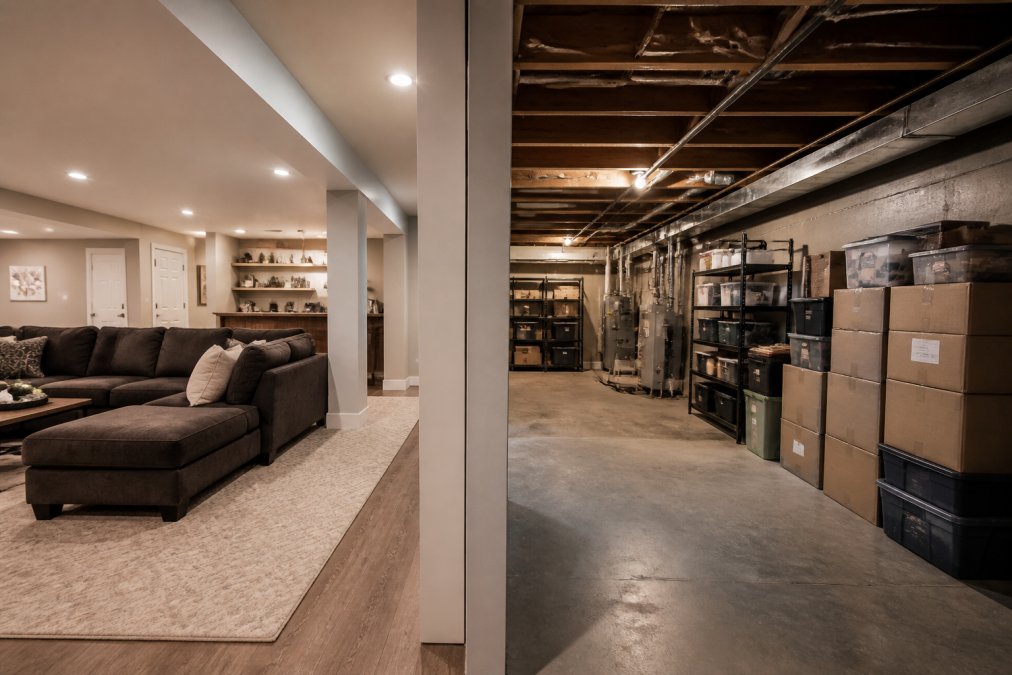
| Factor | Finished Basement | Unfinished Storage |
|---|---|---|
| Counts in living area | Yes | No |
| Buyer appeal | High | Low |
| Upfront cost | High | Minimal |
| Maintenance needs | Moderate | Low |
| Flexibility of use | Fixed rooms | Raw storage |
| Insurance impact | Higher coverage | Basic coverage |
What Finished Square Footage Actually Adds to Resale Value
Finished square footage adds measurable value because it converts below-grade space into above-grade-equivalent living area. Appraisers and buyers treat a permitted, finished basement as usable living space, not raw storage, which changes how your home is priced.
How Appraisers Count Below-Grade Space
Appraisers typically value below-grade finished space at a lower rate per square foot than above-grade living space, usually as a separate line item on the report. Proper ceiling height, egress windows, and code-compliant work appraise higher than partially finished or unpermitted space.
Living Space vs. Storage Utility: The Trade-Off
Living space wins on resale value. Storage utility wins on cost and flexibility. A homeowner who needs a gym, playroom, or extra bedroom gets more use from finished square footage. A homeowner who mainly needs overflow storage may not recover the renovation cost through resale. The Appraisal Institute guidance on below-grade space notes that below-grade areas are valued differently from above-grade space, which is why the finished vs unfinished comparison is not a simple dollar-for-dollar trade.
Basement Renovation Cost Per Square Foot: What Drives the Number
Basement renovation cost per square foot depends on scope, code requirements, and how much of the existing structure you can keep. A simple open room costs far less per square foot than a build-out with a bathroom, kitchenette, or bedroom. The NerdWallet cost breakdown for finishing a basement outlines typical ranges, but your final number depends on local labor, permits, and site conditions.
Where Costs Come From: Permits, Egress Windows, and Moisture Control
The big cost drivers are rarely the drywall and paint. They are the items you cannot see:
- Building permits and inspections for any structural modifications or new living area
- Egress windows for any bedroom, required by most building codes for safety
- Moisture control, including a vapor barrier, sump pump, and drainage corrections
- HVAC requirements, since extending ductwork or adding a dedicated system adds cost
- Ceiling height adjustments if the existing clearance is below code minimum
- Subfloor and insulation upgrades to meet energy and comfort standards
Skipping the permit process to save money is the most expensive mistake homeowners make. Unpermitted finished space can fail a foundation inspection during a sale, and lenders may refuse to count it toward appraised value.
Average ROI for Basement Finishing: What the Data Shows
Average ROI for basement finishing is not a single national number, and any guide that hands you one is oversimplifying. What the data consistently shows is a spread: projects that add a legal bedroom, a full bathroom, or a kitchenette cluster near the top of the range, while open recreation rooms with no plumbing or egress cluster near the bottom.
What Separates a High-Return Project From a Low-Return One
The variables that actually move ROI, in rough order of impact:
- Whether the space is permitted and code-compliant. Unpermitted finished area is routinely excluded from appraised living area and can complicate financing. This alone can erase the entire return.
- Whether it adds a legal bedroom or full bath. These are the features buyers and appraisers price. A rec room is nice; a fourth bedroom is a line item.
- Ceiling height and egress. Below-code ceiling height caps how the space can be classified. Missing egress in a bedroom is a safety and legal problem, not a design preference.
- Moisture history. A basement with a known water problem will not appraise like a dry one, no matter how nice the finishes are.
- How common finished basements are in your comparable set. This is the factor most guides skip, and it is covered below.
Regional Market Variance: Why Two Homes Get Different Returns
Regional market variance often separates a project that pays for itself from one that does not. Appraised value comes from comparable sales, and comparables are local.
The Insurance Angle Most Homeowners Miss
Finishing a basement changes your insurance picture in ways easy to overlook.
- Dwelling coverage limits. Finished living space carries a higher rebuild cost per square foot than raw storage, so your Coverage A limit may need to increase to reflect new finishes, flooring, and fixtures.
- Contents coverage. A finished basement holds furniture, electronics, and sometimes appliances. Your personal property limit should reflect what is actually down there.
- Water damage and sump pump coverage. Standard policies often exclude or limit water damage from sump pump failure, sewer backup, and surface water. If you finish a basement, these endorsements become far more important, because the loss is no longer a mop job.
- Liability exposure. A finished basement used as a bedroom, gym, or entertaining space increases foot traffic and the chance of a claim.
The Energy Efficiency Angle
Finishing a basement changes your home’s thermal and moisture profile, and the effect can go either way.
Before you sign a renovation contract, ask your contractor how they will handle rim joist sealing, foundation wall insulation, and vapor management. If those items are not in the scope, the ROI math is incomplete.
Putting the Numbers Together
A defensible ROI estimate combines four inputs: all-in project cost (permits, egress, moisture work, HVAC), incremental appraised value supported by local comparables, the change in annual carrying costs (insurance, taxes, utilities), and a maintenance reserve. The strongest returns come from projects adding a legal bedroom or full bath in a market where those features are scarce, not the largest or most elaborate builds.
Finished Basement Property Tax Impact: What Homeowners Should Expect
Finished basement property tax impact depends on your local assessor. Many jurisdictions reassess after a permitted renovation and raise assessed value to reflect the new finished area, meaning a higher tax bill alongside higher equity. The increase is usually a fraction of the value added, but plan for it before you start.
Ask your local assessor’s office how they treat below-grade finished area before you build. Some jurisdictions count it at a reduced rate, and knowing the formula helps you forecast the tax change accurately.
Maintenance and Flexibility: The Unfinished Basement Case
Maintenance and flexibility favor the unfinished basement, but the gap is narrower than most homeowners assume once you price out what each space demands over ten years. The right comparison is the annual and episodic cost of keeping each space dry, safe, and usable.
What Unfinished Storage Actually Costs to Maintain
An unfinished basement is not maintenance-free. It is low-finish, which is different. The recurring items most homeowners track:
- Sump pump testing and replacement. A primary sump pump is typically tested seasonally and replaced on a five-to-ten-year cycle, with a battery backup unit needing its own battery swap every few years. A failed pump during a spring thaw is the most common cause of a flooded unfinished basement.
- Dehumidification. Unfinished concrete and block walls wick moisture. Running a stand-alone dehumidifier through humid months adds to the electric bill and requires filter cleaning and condensate management.
- Foundation and drainage inspection. Grading, downspout extensions, and window wells need annual attention. Small drainage failures become slab and wall problems fast.
- Pest and rodent control. Open joist bays, rim areas, and stored cardboard give rodents and insects cover that finished drywall does not.
- Mold and mildew monitoring. Without a vapor barrier or conditioned air, unfinished spaces are more prone to surface mold on stored boxes, paper, fabric, and wood furniture.
What Finished Space Adds to the Maintenance Ledger
Finishing a basement does not eliminate those conditions, it hides them. A finished basement still needs:
- The same sump pump and drainage upkeep, because the water table and soil conditions did not change when you hung drywall.
- HVAC filter changes and system service for whatever conditioning you extended into the space.
- Humidity control, often via a dedicated dehumidifier or a ducted supply.
- Periodic inspection of below-grade finishes, baseboards, carpet, and drywall near the slab, for signs of wicking or slow leaks that would have been visible on bare concrete.
- Higher-stakes remediation if something fails. A slow leak in an unfinished basement is a mop job; the same leak behind finished drywall and under carpet is a demolition and rebuild.
Flexibility: Where Unfinished Wins and Where It Loses
Unfinished space is more flexible in the raw sense: you can store, workshop, or reconfigure it without permits and change its use seasonally. But that flexibility has a ceiling, it is not counted as living area, does not support a legal bedroom or bathroom, and does not change your appraisal.
The honest maintenance comparison is not finished versus unfinished, it is cheap-to-repair versus expensive-to-repair. Budget for the same water management in both cases, and add a contingency for finish damage only in the finished scenario.
A Simple Way to Frame the Decision
If your basement is dry, well-drained, and you mainly need storage and project space, unfinished is the lower-cost, lower-risk answer over a ten-year hold. If it is dry and you need living area, a legal bedroom, or appraisal credit, finished is the only path, but carry the same water-management costs plus a finish-repair reserve.
Which Option Fits Your Home? A Decision Framework
Use this framework to decide between a finished basement vs unfinished storage space value strategy for your situation:
- Is resale within 5 years? If yes, lean finished, but only with permitted, code-compliant work.
- Do you need a legal bedroom or bathroom? If yes, finishing is the only path that adds that value.
- Is your basement dry? If not, fix moisture control first. Finishing a wet basement wastes money.
- Is your budget tight? Consider partial finishing: one finished room, the rest left as storage.
- Do comparable homes nearby have finished basements? If most do, finishing keeps you competitive.
- Will the tax increase fit your budget? Factor the reassessment into your decision.
Frequently Asked Questions
How much value will a finished basement add to my home?
A finished basement adds value based on condition, layout, and local demand. The value comes from usable square footage, extra bedrooms or bathrooms, and added marketability. Appraisers weigh finished square footage less than above-grade living space, so returns vary by neighborhood and buyer preferences.
Does a finished basement increase property tax?
A finished basement can increase property tax because many assessors count finished below-grade square footage when determining assessed value. The finished basement property tax impact depends on your local assessment cycle and how your jurisdiction classifies below-grade space. Some assessors add the full finished area, others apply a discount. Check with your county assessor before starting work so you can factor any tax change into your budget.
What is the average ROI for basement finishing?
The average ROI for basement finishing depends on project scope and market. Projects that add a bathroom, bedroom, or full kitchen tend to recover more because they increase functional square footage. High-end finishes usually return less than their cost. An appraiser or real estate professional familiar with your local market can give you a more specific estimate before you commit to a renovation.
What are the primary benefits of keeping a basement unfinished?
An unfinished basement preserves storage utility for seasonal items, tools, and mechanical systems. It costs nothing to maintain beyond moisture control, keeps your renovation budget intact, and gives future owners flexibility to finish it their own way. If your home already meets your space needs, the higher resale value from finishing may not justify the cost. Unfinished space also makes it easier to access pipes, wiring, and HVAC equipment for repairs.
How does square footage impact basement valuation?
Square footage impacts basement valuation, but finished below-grade space is not valued the same as above-grade living space. Appraisers often count finished basement square footage at a lower rate per square foot than main-floor area. A 500-square-foot finished basement might add less value than a 500-square-foot addition. The gap widens when the basement lacks egress windows, proper ceiling height, or a dedicated HVAC zone, since those features affect whether the space qualifies as living area.
The hardest part of this decision is not the budget. It is knowing which upgrades will actually pay you back and which ones will not. Berry Basements handles that analysis for you, from waterproofing and structural modifications to custom living spaces, with a collaborative process and a commitment to quality without cutting corners. Get started with Berry Basements and turn your lower level into space your family uses every day.