

Table of Contents
- Remodeling vs. Custom Contractors: Core Differences
- Project Scope and Complexity
- How to Choose a Basement Contractor
- Questions to Ask Basement Contractors
- Basement Finishing Timeline and Process
- Budget Planning and Cost Estimation
- Licensing, Permits, and Local Requirements
- Conclusion
- Frequently Asked Questions
Last Updated: September 24, 2026
Remodeling vs. Custom Contractors: Core Differences
When you’re planning a basement transformation, understanding remodeling vs custom contractors shapes everything that follows. The difference isn’t just semantics. Remodeling contractors focus on updating existing spaces within their current footprint and structure, while custom contractors build or significantly alter spaces from the ground up. Understanding this distinction is essential because it determines your timeline, budget flexibility, design options, and the complexity of work your team will manage.
At Berry Basements, we’ve guided countless homeowners through this decision. The core tension is this: remodeling works when your basement’s bones are solid and you’re optimizing what exists. Custom work becomes necessary when structural changes, major system relocations, or entirely new layouts are required. This guide walks you through how to choose between them, what questions to ask, and how to budget realistically for either path.
Remodeling contractors specialize in finishing and updating existing basement spaces. Custom contractors handle structural modifications, complex system work, and custom builds. Choose remodeling if your space needs finishing touches; choose custom if you need walls moved, new egress windows, or significant HVAC and plumbing rework.
Project Scope and Complexity
The scope of your project determines which contractor type you actually need. A remodeling contractor excels at taking a raw basement and turning it into a finished living space with paint, flooring, cabinetry, and lighting. They work within the existing structural constraints and utility locations. A custom contractor, by contrast, handles the heavy structural work first: moving walls, installing new support beams, relocating HVAC ducts, running new plumbing lines, and creating custom layouts that don’t fit the original footprint.
Here’s where it gets practical. If your basement has moisture issues, a remodeling contractor can apply waterproofing solutions and then finish the space. But if you need to relocate a load-bearing wall to create an open entertainment area, or install a new egress window for a bedroom addition, that’s custom work. The contractor must understand structural engineering, building codes, and how systems interact. A remodeling contractor working on a simple finishing project operates within known parameters. A custom contractor managing structural renovation services must coordinate multiple trades and navigate permit requirements that remodeling alone doesn’t trigger.
Project complexity also affects timeline and cost. Project complexity also affects timeline and cost. Custom work, particularly when it involves structural renovation, often takes longer because of the sequencing required: structural work first, then systems, then finishes. Budget planning differs too. Remodeling costs are relatively predictable because you’re not discovering surprises behind walls. Custom work carries more unknowns because existing conditions may require modifications to your original plan.
Starting a custom project with a remodeling contractor is a common mistake. They’ll finish the visible surfaces beautifully, but if structural or system work is needed later, you’re back to square one with a new contractor. Get the scope right upfront.
How to Choose a Basement Contractor
Choosing the right contractor starts with honest assessment of what your basement needs. Begin by determining whether your project is primarily finishing work (remodeling) or includes structural changes (custom). Walk your basement with a critical eye. Are the walls straight and dry? Is the ceiling height adequate? Are utilities accessible or will they need relocation? Do you need to add windows for egress? These answers point you toward either a remodeling specialist or a custom contractor.
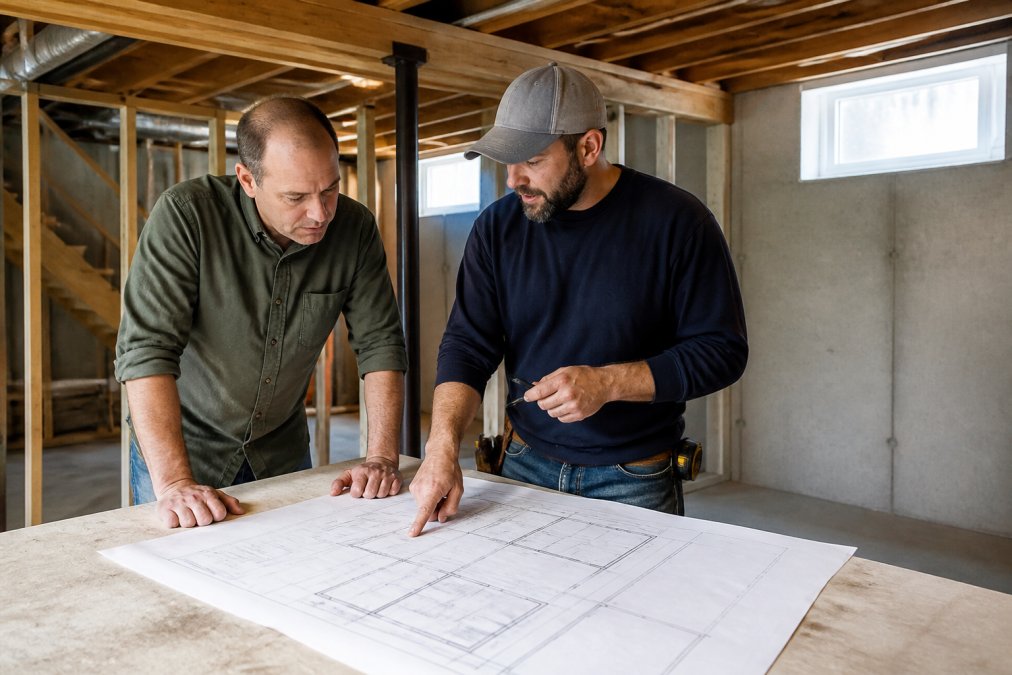
Once you’ve identified the project type, evaluate contractors based on their specific experience with that work. For remodeling, look for portfolios showing finished basements with quality finishes, proper waterproofing, and attention to detail. For custom work, you need evidence of structural projects, permit navigation, and coordination of complex trades. Ask to visit completed projects in person. A finished basement that looks good in photos but has moisture problems or poor workmanship becomes obvious when you see it.
Licensing and insurance are non-negotiable. A licensed contractor in your state has met training and testing requirements. Verify their license through your state’s licensing board. Confirm they carry liability insurance and workers’ compensation. This protects you if someone is injured or property is damaged during the project. Ask for references and actually call them. Ask specifically about timeline adherence, budget management, and how the contractor handled problems that arose.
Berry Basements brings 2017 forward as our foundation. We prioritize a collaborative process, working closely with clients to ensure every professional renovation reflects your unique vision. Our commitment to quality without cutting corners means we manage complex tasks like waterproofing and structural changes with the expertise they demand. When you’re choosing a contractor, look for that same combination: proven experience, transparent communication, and a track record of delivering what was promised.
Questions to Ask Basement Contractors
Before signing a contract, ask these specific questions to assess whether a contractor is right for your project. The answers reveal their competence and communication style.
Start with scope and timeline. “Can you walk me through your process from start to finish?” A clear answer shows they’ve done this work before. “What’s your typical timeline for a project like mine?” Listen for realistic estimates. “How do you handle changes once the project starts?” This matters because discoveries happen during renovation. A contractor who explains their change-order process transparently is better than one who brushes past the question.
Move to budget and risk. “What’s included in your estimate, and what isn’t?” A detailed estimate listing materials, labor, permits, and contingencies is professional. A vague number is a red flag. “What happens if we discover unexpected conditions during the work?” This is crucial for remodeling vs. custom contractors alike. Water damage, structural issues, or code violations discovered mid-project can derail budgets. A contractor who explains their process for handling discoveries is one you can trust.
Ask about their team and subcontractors. “Who does the work, your employees or subcontractors?” “How do you ensure quality control with your subs?” “Can I meet the people who’ll be working on my project?” Knowing who’s actually doing the work matters. For complex projects involving structural, HVAC, plumbing, and electrical work, understanding how the general contractor coordinates these trades is essential.
Finally, ask about guarantees and communication. “What warranty do you offer on your work?” “How will you keep me updated on progress?” “Who do I contact if something isn’t right after completion?” A contractor who stands behind their work and maintains clear communication reduces friction throughout the project.
Basement Finishing Timeline and Process
Understanding the timeline helps you plan for disruption and set realistic expectations. A typical basement finishing project follows a predictable sequence. For a straightforward remodeling project, waterproofing, framing, electrical, plumbing rough-in, drywall, flooring, and finishing, the timeline depends on square footage and complexity.
The first phase is assessment and planning.
Ask your contractor for a detailed timeline broken into phases with start and end dates for each. This lets you plan around the work and gives you a baseline to assess whether the project is on track.
Budget Planning and Cost Estimation
Budget planning requires understanding what drives costs and where contingency matters. For a remodeling project, costs depend on square footage, finish quality, and existing conditions. A basic basement finishing might run one price range, while adding custom cabinetry, premium flooring, or specialized spaces like home theaters increases cost. The contractor should provide a detailed estimate breaking down materials, labor, permits, and contingency.
Licensing, Permits, and Local Requirements
Licensing requirements vary by state, but all contractors should carry a license demonstrating they’ve met training and competency standards. In most states, general contractors and specialty contractors like electricians and plumbers must be licensed. Verify your contractor’s license through your state’s licensing board before signing a contract.
Conclusion
The choice between remodeling vs custom contractors determines how your basement transformation unfolds. Remodeling contractors excel at finishing spaces efficiently and affordably. Custom contractors handle structural changes, system relocations, and complex layouts that remodeling alone cannot address. Honest assessment of your project scope, whether you’re finishing an existing space or fundamentally changing its layout and systems, points you toward the right contractor type.
Frequently Asked Questions
What is the difference between a general remodeling company and a custom contractor?
General remodeling companies handle standard renovation projects using proven methods and established timelines. Custom contractors specialize in unique, design-build projects where the homeowner’s vision drives the scope. Remodeling contractors work within existing structures; custom contractors often handle complex structural modifications, site development, and architectural design integration. For basement work, remodeling works well for finishing existing spaces, while custom contractors excel at transforming basements into specialized areas like home theaters or gyms with unique layouts.
How do I verify a contractor’s license in Michigan?
Michigan requires general contractors to hold a valid license issued by the state. You can verify licensing status through the Michigan Department of Licensing and Regulatory Affairs (LARA) online database. Request the contractor’s license number and confirm it matches their business name. Ask for proof of liability insurance and workers’ compensation coverage. Licensed contractors demonstrate compliance with building codes, safety standards, and professional accountability, critical protections for your basement finishing project.
Do I need a licensed contractor for a basement renovation?
Yes. Basement renovations involve building permits, electrical work, plumbing, HVAC modifications, and structural changes that require licensed professionals. Unlicensed contractors expose you to code violations, failed inspections, liability issues, and voided warranties. A licensed contractor ensures compliance with local zoning and building codes, manages subcontractor coordination, and provides recourse if problems arise. This is especially important for complex work like waterproofing and structural renovation.
What should I expect during a basement finishing timeline?
A typical basement finishing project’s timeline depends on scope. Initial phases include site assessment, design consultation, and permit acquisition. Structural work, waterproofing, and HVAC/plumbing installation follow. Final phases include framing, electrical, drywall, flooring, and finish carpentry. Your contractor should provide a detailed construction timeline upfront and communicate any delays. Complex projects involving custom cabinetry or home theater integration may extend timelines. Weather, permit delays, and structural discoveries can affect scheduling.
What questions should I ask before hiring a basement contractor?
Ask about their experience with projects similar to yours, licensing and insurance details, subcontractor coordination practices, warranty coverage, and how they handle budget overruns. Request references from completed projects and ask about their approach to managing moisture issues and structural challenges. Clarify communication frequency, site management during construction, and whether they offer design-build services. Ask about their experience with local permitting and zoning compliance. Understanding their project management approach and quality standards helps you choose a contractor aligned with your needs.