

Quick Summary
A safe basement play area for toddlers starts with a room-by-room hazard check, covering choking hazards, outlets, furnace and sump pit access, moisture, and radon, before any design work. Next, keep active play away from the stairs, install gates at both ends, and store chemicals and small objects out of reach.
- Check every zone at toddler height for choking hazards, sharp edges, and pinch points.
- Use tamper-resistant outlet covers on every receptacle within a toddler’s reach.
- Install a hardware-mounted gate at the top of the stairs that swings away from them.
- Keep a clear line of sight from the stairs and place the play zone where you can see it.
- Run a dehumidifier to keep indoor humidity below about 50 percent.
Table of Contents
- Check Whether Your Basement Is Ready for Toddlers
- Plan the Layout of Your Basement Play Area
- Choose Safe Flooring for a Basement Playroom
- Secure the Basement Stairs With a Stair Safety Gate
- Select Age-Appropriate Play Equipment and Fall Protection
- Store Toys and Hazards Out of Toddler Reach
- Schedule Your Basement Safety Inspection and Next Steps
- Frequently Asked Questions
Last Updated: October 27, 2026
Keeping a toddler safe in a basement takes more than picking cute rugs and colorful bins, because building a safe basement play area starts with the hazards already in the room. Basements often have damp floors, exposed utility lines, steep stairs, and low light, and those conditions matter a lot once a child starts crawling and climbing. This guide walks through seven steps to building a safe basement play area for toddlers, from checking the space itself to securing the stairs and storing the hazards out of reach. Berry Basements is a licensed basement contractor serving the Grand Rapids area since 2017.
Check Whether Your Basement Is Ready for Toddlers
Before you buy a single toy, treat the basement as a hazard assessment, not a decorating project. Toddlers explore at floor level, mouth objects, pull on anything within reach, and climb before they can balance, so the readiness check has to be room-by-room and specific. Most ranking articles jump straight to design inspiration; this section is the toddler-specific inspection that those galleries skip.
Walk the full space with a clipboard and score each item pass or fail. For a broader look at preventing damp and mold, see guidance on preventing mold in a finished basement.
Toddler Hazard Checklist by Zone
Floor and low surfaces (0-36 inches):
- Choking hazards: small toy parts, loose hardware, dropped screws, pet kibble, coins, and button batteries. Get on your hands and knees at toddler eye level and sweep the entire perimeter.
- Sharp edges: exposed concrete corners, metal shelving brackets, window wells, and the bottom of stair stringers. Cover or pad anything at head height for a crawling or early-walking child.
- Pinch points: door hinges, folding tables, radiator fins, and the gap between a door and its frame. Check every hinge and folding mechanism.
- Unstable furniture: bookshelves, storage racks, and TVs that a toddler could pull over. Anchor tall furniture to wall studs with anti-tip straps.
Walls and openings:
- Outlet covers: every receptacle within a toddler’s reach needs tamper-resistant covers or a tamper-resistant receptacle (TRR). The National Electrical Code has required TRRs in many residential locations since the 2008 cycle, but older basements often predate that.
- Cords and cables: lamp cords, extension cords, and charging cables should be routed behind furniture or in cord channels, never across walking paths.
- Window wells and egress windows: check for sharp frames, loose gravel, and any gap a toddler could squeeze through.
Mechanical and utility zone:
- Furnace and water heater clearance: keep the play zone outside the manufacturer’s required clearance area, and install a physical barrier such as a latching gate or rigid panel so a toddler cannot wander into the utility corner.
- Sump pump pit: cover it with a secured, child-resistant lid; an open pit is a drowning and fall hazard.
- Electrical panel: keep a clear working space in front of it and lock or block access.
Assess Moisture, Mold, and Air Quality
Look for water stains on walls, a musty smell, white or green patches on concrete, efflorescence (the white powder that signals moisture moving through masonry), and condensation on pipes.
Run a dehumidifier to keep indoor humidity below about 50 percent. If you are weighing options that stand up to damp conditions, compare basement flooring options for moisture. Check for leaks after heavy rain. Environmental Protection Agency offers clear guidance on mold cleanup and prevention, and it is worth reading before you start (the EPA). EPA mold guidance
Air quality also matters. Basements can concentrate radon, a colorless radioactive gas that seeps through foundation cracks.
Do not skip radon testing because the basement “smells fine.” Radon has no odor (the EPA).
Inspect Fire, Electrical, and Mechanical Hazards
Basements hold the furnace, water heater, electrical panel, and sometimes a sump pump. Keep a toddler’s play zone well clear of all of them. Make sure the furnace and water heater have a clear working area, and that no exposed wires run where a child can reach them.
Check that outlets have tamper-resistant covers and that extension cords are not used as permanent wiring. If anything looks old, scorched, or loose, call a licensed electrician. If you are ready to take the next step, book a free estimate for basement finishing in Allendale, MI.
Confirm working smoke and carbon monoxide alarms on this level.
A basement is toddler-ready only when it passes the zone-by-zone hazard checklist, a moisture and radon screen, and a fire and electrical check. Design comes after those three gates.
Plan the Layout of Your Basement Play Area
A good layout keeps active play away from quiet spaces and keeps you able to see your child at all times. Sketch the room on paper before you move furniture. Measure the space, mark the stairs, the utility area, and any windows, then decide where each zone will go. The layout is also your first line of supervision and emergency access, treat it as a safety plan, not just a floor plan.
Separate Active Play From Quiet Zones
Put climbing toys, ride-ons, and running space in one corner, far from the stairs. Set up a calmer area with books, blocks, and soft seating in another. This split reduces collisions and helps toddlers settle down when they need a break.
Use a rug or foam mat to mark each zone. Visual boundaries work well for toddlers and help them learn where active play belongs. Keep sharp furniture corners covered with soft edge guards.
Keep a Clear Line of Sight and Emergency Access
Basements are easy to lose track of, so place the play area where you can see it from the stairs or from a nearby room. Avoid putting toddlers in a closed-off corner you cannot check quickly.
- Sightlines: stand at the bottom of the stairs and at the doorway to the adjoining room. If you cannot see the entire play zone from at least one of those points, rearrange furniture or add a low partition rather than a solid wall.
- Stair gates: install a hardware-mounted gate at the top of the stairs and a pressure-mounted gate at the bottom, following the U.S. Consumer Product Safety Commission guidance on gate placement. The top gate should swing away from the stairs.
- Exits: keep the path to the stairs and the exterior door completely clear. Do not block the furnace room or the door to the outside. In an emergency, you need fast access for both you and your child.
- Emergency lighting: add a battery-backed or plug-in emergency light near the stairs so a power outage does not leave the route dark.
- Utility separation: if the furnace or water heater shares the room, use a rigid, latching barrier, not a baby gate alone, to keep the play zone physically separate from the mechanical corner.
Walk the layout at toddler height. Kneel at the center of the play zone and look toward the stairs, the utility area, and the exit. Anything that blocks your view or your reach is a layout problem to fix before the room opens.
Build a Repeatable Layout Inspection
Once the room is set up, do a five-minute layout check weekly and a fuller check monthly:
- Confirm both stair gates latch and swing correctly.
- Verify the path from play zone to exit is clear of toys, bins, and laundry.
- Check that anchored furniture has not loosened and that anti-tip straps are still attached.
- Look for new cords, chargers, or small objects that migrated into the zone.
- Confirm the utility barrier is closed and latched.
This routine turns the layout from a one-time decision into an ongoing safety habit, the piece most inspiration-led guides leave out.
A safe layout is one you can see from the stairs, exit from in seconds, and re-verify in five minutes a week. If any of those three fails, the layout needs to change.
Choose Safe Flooring for a Basement Playroom
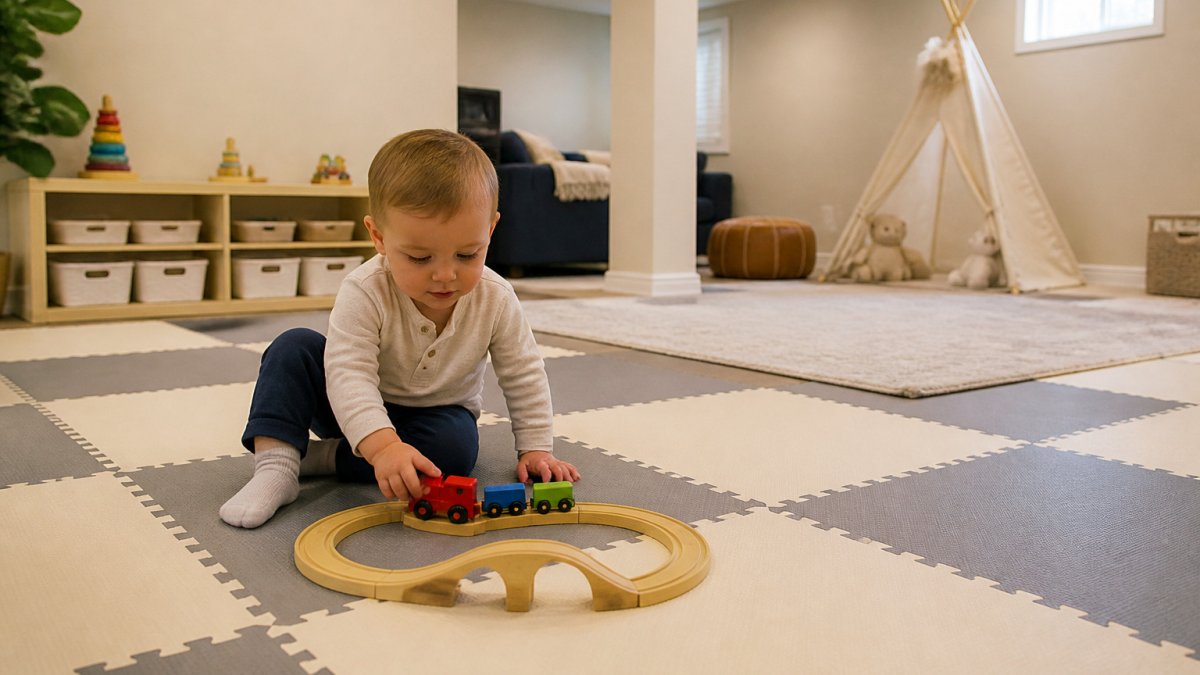
- Interlocking foam tiles give good cushioning and are simple to replace one piece at a time. To compare the strongest basement flooring materials side by side, see the best basement flooring materials.
- Choose tiles made without strong odors, and air the room out after installation.
- Use a low-pile rug on top of a vapor barrier if the concrete feels cold or damp.
- Avoid carpet directly on concrete, since moisture trapped underneath can grow mold.
Flooring choices matter because a toddler spends most of their time at floor level, and basement moisture can change which options are safe.
| Flooring option | Best for | Key difference |
|---|---|---|
| Interlocking foam tiles | Cushioning and easy repair | Replace one piece at a time |
| Low-pile rug on vapor barrier | Cold or damp concrete | Barrier blocks moisture |
| Carpet directly on concrete | Not recommended | Trapped moisture can grow mold |
Secure the Basement Stairs With a Stair Safety Gate
Add lighting over the stairs, keep the steps free of toys and laundry, and install a handrail on both sides if one is missing.
Select Age-Appropriate Play Equipment and Fall Protection
Good options for a basement playroom include:
- Soft climbing blocks with rounded corners
- A small, low jungle gym anchored to the wall
- A mini trampoline with a safety pad and a clear boundary
- Play tents and cushions that do not trap air or fold onto a child’s face
Store Toys and Hazards Out of Toddler Reach
Keep these items out of reach at all times:
- Cleaning supplies, paints, and adhesives
- Button batteries and small magnets
- Cords from blinds, lamps, and electronics
- Medications and vitamins, which should be locked away
Schedule Your Basement Safety Inspection and Next Steps
If you are planning a larger renovation to turn the basement into a finished family space, Berry Basements offers a free estimate. Contact us to talk through the next steps for your home.
Frequently Asked Questions
How do you make a basement safe for toddlers?
Start with a hazard walkthrough at toddler eye level. Check for exposed electrical outlets, water heaters, furnace and utility areas, sharp edges, and unsecured shelving. Install stair gates at the top and bottom of basement stairs, block access to laundry chemicals and tools, and confirm that smoke and carbon monoxide alarms are working. Keep a clear path to an exit and make sure a caregiver can always see the play area from the stairs or doorway.
What is the safest flooring for a toddler basement playroom?
Interlocking foam tiles or rubber-backed mats are generally the safest choice for a toddler playroom because they cushion falls and are easy to clean. Choose products that are labeled free of phthalates and low in volatile organic compounds, and avoid loose rugs that can slide or create trip points. If the basement is damp, avoid carpet, since it can trap moisture and mildew. Check that any floor covering sits flat and has no gaps where small objects can get stuck.
How can I childproof basement stairs?
Install a hardware-mounted safety gate at the top of the stairs, and a pressure-mounted gate only at the bottom if the staircase has no landing wall. Make sure the gate has no openings wider than 2-3/8 inches and no diamond-shaped gaps that a toddler could catch a head in. Add contrasting tape to the leading edge of each step, keep stair lighting on, and remove toys or laundry from the stairs so they never become a tripping hazard.
How do I check a basement playroom for moisture or mold?
Look for water stains, white or chalky residue on walls, musty odors, and peeling paint. Use a basic hygrometer to keep indoor humidity between roughly 30 and 50 percent, and run a dehumidifier if levels stay high. Check the foundation walls and floor for cracks or standing water after heavy rain. If you find visible mold covering more than a small area, or if moisture keeps returning, have a qualified professional assess the source before the room is used for play.
