

Table of Contents
- What Relocating Basement HVAC Vents Involves
- Cost to Reroute HVAC Ductwork in Your Basement
- Cost to Add a Return Air Vent
- How to Reroute Basement Ductwork: What the Process Looks Like
- Basement Ductwork Installation Cost: Labor, Materials, and Complexity
- Factors That Affect Your Total Project Cost
- Is Relocating Basement HVAC Vents Worth the Investment?
- Frequently Asked Questions
Last Updated: October 10, 2026
What Relocating Basement HVAC Vents Involves
Relocating basement HVAC vents is a structural modification that requires moving supply lines, return-air ducts, or registers to accommodate basement remodeling projects. When you’re converting an unfinished basement into a finished living space, the existing ductwork often sits in the way of walls, ceilings, or open-concept layouts you want to create. Understanding what’s actually involved in relocating basement HVAC vents helps you plan realistic timelines and budgets before work begins.
The scope of relocation varies dramatically. Moving a single register might take a few hours. Rerouting an entire branch duct around new framing can take days. The complexity depends on what you’re moving and where it needs to go.
Supply Vents vs. Return-Air Vents
Supply vents deliver heated or cooled air from your furnace or air conditioning unit into the basement. Return-air vents pull air back to the system for reconditioning. The two require different approaches when relocating.
Supply vents are typically easier to reroute because they’re under positive pressure, the system pushes air through them. You can bend flexible ducts, extend them, or reroute them around obstacles with less concern about airflow balance. Return-air vents are trickier. They pull air back passively, so undersizing or creating too many bends can starve the system and reduce efficiency. Return vents need adequate sizing and relatively straight paths back to the main trunk.
Register Relocation vs. Ductwork Rerouting
A register is the visible grille where air enters or exits the room. Ductwork is the hidden infrastructure that carries air. Moving a register alone is simpler than rerouting the ducts behind it.
If you’re just relocating the register itself, shifting it 3-4 feet along the same wall, a contractor can often extend the existing duct with flexible ducting, seal connections, and call it done. If you’re moving a register across the basement or to a different wall, you’re likely rerouting branch ducts, which means working around joists, existing plumbing, and electrical lines. That’s more involved and takes longer.
Cost to Reroute HVAC Ductwork in Your Basement
Rerouting ductwork depends on the scope of work. Moving a single branch duct around new basement framing costs less than relocating a main trunk or adding multiple new supply and return lines.
The cost difference between a simple register relocation and a full duct reroute can be substantial. A single register move might run a few hundred dollars. Rerouting multiple ducts or the main trunk can run into thousands, depending on how much structural work is involved and what materials you’re using.
At Berry Basements, we’ve managed basement renovations where ductwork relocation was a critical part of the project. The most common scenario is a homeowner wanting to create an open-concept layout or add a new bedroom in the basement, and the existing ducts are blocking the vision. The good news is that it’s almost always solvable.
Labor typically accounts for 60-70% of the cost when rerouting ductwork. Materials, flexible ducts, fittings, insulation, duct sealant, make up the remainder. The exact split depends on how much ductwork needs to move and whether you’re replacing old metal ducts with new flexible ones or reusing existing ducts in a new configuration.
Cost to Add a Return Air Vent
Adding a new return-air vent is often necessary when you’re finishing a basement and creating a new enclosed room. A finished basement bedroom needs a return vent so air can cycle back to the HVAC system. Without it, the room becomes pressurized, efficiency drops, and comfort suffers.
Adding a single return-air vent involves cutting an opening in the basement rim joist or band board, running ductwork back to the main return trunk, and installing the grille. The challenge is that return ducts need to be sized correctly. An undersized return vent creates back pressure that reduces system performance. An oversized return is wasteful but less problematic than undersized.
The cost depends on where the return trunk is located relative to where you need the new vent. If the main return is nearby, the job is straightforward. If you need to run ductwork across the entire basement or through structural elements, the labor increases significantly. Permits are often required for adding return vents, especially in finished spaces, which adds cost and timeline.
How to Reroute Basement Ductwork: What the Process Looks Like
Rerouting basement ductwork follows a logical sequence. First, your contractor assesses the existing system, measures the space, and determines the new duct path. They identify obstacles, joists, existing plumbing, electrical lines, structural supports, and plan around them.
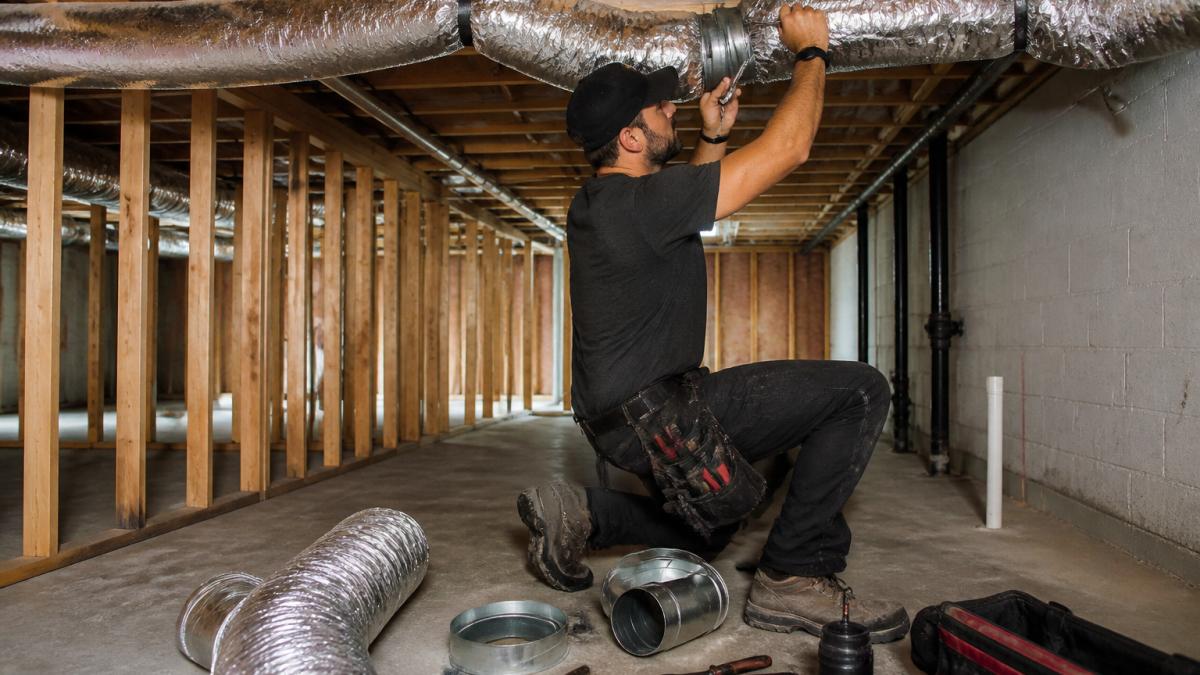
Next comes the physical work. If you’re reusing existing ducts, they’re disconnected from the old location, carefully removed, and repositioned. If you’re installing new ducts, flexible ducting is run along the planned route, secured to joists or the rim board every 3-4 feet, and sealed at all connections.
After ducts are in place, connections are sealed with mastic sealant and sometimes metal tape. Leaky duct connections waste energy and reduce system performance, so this step matters. Once sealed, the system is tested for airflow and balanced if necessary.
The final step is inspection. If permits were required, the local building inspector checks that the work meets code, proper duct sizing, adequate clearances, correct support spacing, and appropriate sealing.
Basement Ductwork Installation Cost: Labor, Materials, and Complexity
Labor costs for relocating basement HVAC vents vary by contractor and region, but the work is skilled and time-intensive. A simple register relocation might take 4-6 hours of labor. Rerouting a branch duct around new framing might take 8-12 hours. Relocating or adding a return vent can take 10-16 hours depending on how far the ductwork needs to run.
Material costs depend on duct type and length. Flexible ductwork is less expensive than rigid metal ducts but less durable. Fittings, elbows, reducers, and sealants add up quickly when you’re running new ducts across a basement. Insulation for ducts in unconditioned spaces (like an unfinished basement before renovation) may or may not be required by code, but it’s often recommended to prevent condensation and energy loss.
Complexity multiplies costs. A basement with low ceiling clearance, dense framing, or existing obstacles requires more careful planning and slower installation. A basement with plenty of headroom and a simple layout is faster and cheaper. Finished surfaces, drywall, flooring, or ceilings, that need to be cut for ductwork add labor and material costs because you’re paying for both the HVAC work and the finishing work to repair the cuts.
Factors That Affect Your Total Project Cost
Several variables determine the final price for relocating basement HVAC vents. Understanding these helps you anticipate where costs might climb.
Ceiling Type and Access
An unfinished basement with exposed joists and rim board is easier and cheaper to work in. You can run ducts freely, access connections easily, and make adjustments without cutting into finished surfaces.
A finished basement with drywall ceilings, drop ceilings, or concrete ceiling treatments complicates the work. Ducts may need to run inside walls or through existing framing cavities, which requires more careful planning and sometimes rework if the path doesn’t work as expected. Cutting into finished ceilings to access or reroute ducts adds labor and finishing costs.
Basement ceiling height matters too. A basement with 7.5 feet of clearance leaves little room for ductwork, especially if you’re adding insulation or wrapping. A basement with 8+ feet of clearance is more forgiving. Very low ceilings force ducts to run through walls or along the rim board, which is more complex.
Duct Material and Existing Layout
Existing metal ductwork is harder to move than flexible ducts. Metal ducts require rigid support, precise measurements, and skilled fitting. Flexible ducts are easier to route around obstacles but degrade faster over time.
If your current system uses old metal ducts that are corroded or damaged, a contractor might recommend replacing them during relocation rather than reusing them. That increases material costs but gives you a more efficient, longer-lasting system.
The existing duct layout also affects cost. A system with a simple trunk running down the center of the basement is easier to modify than a system with ducts running in multiple directions. More complex layouts require more careful planning and longer installation times.
Permits and Code Compliance
Permit requirements vary by jurisdiction. Some areas require permits for any HVAC work. Others only require them for significant modifications like adding return vents or replacing ductwork. Permits involve inspections, which add time and cost but ensure the work meets code.
Code requirements for ductwork include minimum sizing, support spacing, and sealing standards. An older basement system might not meet current code, and bringing it up to code during relocation adds cost. For example, return-air ducts must be sized to avoid back pressure, and all ducts must be sealed to prevent leakage. These requirements are non-negotiable if permits are involved.
Is Relocating Basement HVAC Vents Worth the Investment?
The answer depends on your renovation goals and the current state of your basement HVAC system.
If you’re finishing your basement to add livable space, a bedroom, gym, entertainment area, or office, relocating HVAC vents is usually necessary and worth the investment.
If your current HVAC system is old, inefficient, or undersized for your home, relocation is a good opportunity to upgrade.
If you’re doing a minor cosmetic renovation or just finishing a small corner of the basement, and the existing ducts don’t interfere, you might skip relocation. But most finished basements require at least some duct work to function properly.
The financial return depends on the scope and quality of the overall renovation. A finished basement with proper climate control, electrical, plumbing, and finishes can add to your home’s resale value. That improves livability and appeal.
Berry Basements has worked on projects where homeowners initially questioned the cost of ductwork relocation, then realized during the renovation that proper ducting made the finished space genuinely usable year-round. That comfort and functionality is worth the investment.
Relocating basement HVAC vents is one of the most overlooked cost factors in basement renovations. Berry Basements can help you evaluate your basement’s current HVAC layout, identify what needs to move, and provide a transparent estimate for the work involved. Get a free estimate to see exactly what relocating your basement HVAC vents will cost for your specific space.
| Relocation Scenario | Typical Scope | Cost Range Indicator |
|---|---|---|
| Single register move (same wall) | Extend existing duct 3-4 feet, seal connections | Lower cost |
| Register relocation to different wall | Reroute branch duct, new connections, balancing | Moderate cost |
| Add new return-air vent | Cut opening, run ductwork to main trunk, seal | Moderate to higher cost |
| Reroute main trunk or multiple branches | Extensive ductwork replacement, new supports, permits | Higher cost |
| Full basement HVAC redesign | Complete ductwork replacement, sizing, balancing, code compliance | Highest cost |
Frequently Asked Questions
How much does it cost to relocate basement HVAC vents?
The cost of relocating basement HVAC vents depends on the scope of work. Moving a single register may cost significantly less than rerouting ductwork or installing a new return-air vent. Labor, materials, ceiling type, and system complexity all influence the final price. For an accurate estimate specific to your basement layout and goals, contact Berry Basements to assess your existing ductwork, access points, and finished surfaces.
Does relocating a basement vent require new ductwork?
Not always. If you’re moving a register on an existing branch duct, you may only need to extend or reroute that branch. However, relocating a main trunk or adding a return-air vent often requires new ductwork installation. The existing duct material, layout, and your new vent location determine whether you can reuse sections or need to replace them entirely.
Will moving basement vents affect my heating and cooling?
Yes, vent relocation can affect airflow and system performance if not done correctly. Moving vents changes air distribution patterns and may require airflow balancing and system sizing adjustments. A professional HVAC contractor will ensure your system is properly sized and balanced after relocation to maintain comfort and energy efficiency throughout your basement and home.
Can I relocate basement ductwork myself, or do I need a professional?
HVAC work is complex and often requires a licensed professional. Improper rerouting can damage ducts, reduce airflow, void warranties, and violate local building codes. Permits and inspections are typically required for ductwork relocation. A licensed contractor ensures the work meets code, maintains system efficiency, and includes proper safety measures, protecting both your investment and your home.