

Table of Contents
- The Verdict: When a Basement Bathroom Pays Off
- Average Cost to Add a Bathroom in Basement
- Basement Renovation Cost Per Square Foot
- Basement Bathroom ROI: What the Numbers Actually Show
- Full Bath vs. Powder Room: Which Adds More Buyer Appeal?
- Permits, Egress Windows, and Code Requirements You Cannot Skip
- Moisture Control and Maintenance Risks That Kill Resale Value
- Conclusion: Making the Right Call for Your Home
- Frequently Asked Questions
Last Updated: September 18, 2026
The Verdict: When a Basement Bathroom Pays Off
Adding a basement bathroom is worth it for resale when the home has only one full bath upstairs, when the basement is already finished or being finished anyway, and when the new fixture count matches local buyer expectations. It rarely pays off as a standalone project in a home that already has three or more bathrooms, the answer depends on what it does to your home’s usable square footage and total bathroom count.
Average Cost to Add a Bathroom in Basement
The average cost to add a bathroom in basement projects varies widely, mostly because basement plumbing is rarely straightforward. A powder room tied into existing drain lines costs far less than a full bath needing a new sewage ejector pump and below-grade drainage path.
Cost drivers include:
- Proximity to existing plumbing rough-in
- Whether a sewage ejector pump and pit are required
- Venting and drain line routing through concrete
- Fixture quality and tile selection
- Permits and inspection fees
Breaking Down the Plumbing and Labor Line Items
Plumbing is where basement bathroom budgets usually break. Moving or adding drain lines below the slab means cutting concrete, running pipe, and re-pouring, labor that is a much larger share of the total than on an upper-floor bathroom.
Basement Renovation Cost Per Square Foot
Basement renovation cost per square foot is the number appraisers and buyers actually care about, because it tells you whether you’re building value or just spending money. Finished basement space generally costs less per square foot than an above-grade addition, which is why finishing below grade is attractive.
| Project Type | Relative Cost | Value Impact |
|---|---|---|
| Powder room (toilet + sink) | Lowest | Adds convenience, modest value |
| Full bath (tub/shower, toilet, sink) | Highest | Adds a bedroom-legal bathroom |
| Bathroom as part of full basement finish | Moderate per sq ft | Highest overall value gain |
| Standalone bathroom in already-finished space | High per sq ft | Depends on existing bathroom count |
Why Below-Grade Work Costs More Than Upstairs Builds
Below-grade work costs more because gravity works against you. Basement drain lines can’t rely on a downward slope to the main sewer, so waste often has to be pumped up and out through a sewage ejector pump.
Basement Bathroom ROI: What the Numbers Actually Show
Basement bathroom ROI is real but modest, and it almost never happens in isolation. The return shows up best when the bathroom is part of a larger finished basement project that turns unfinished space into living space.
The bathroom rarely carries the ROI on its own. The finished basement around it does. Budget for the bathroom as part of the whole project, not as a standalone bet.
How Appraisers Actually Value Below-Grade Space
This part determines whether your project shows up in the appraisal at all.
What that means in practice:
- A 600-square-foot finished basement does not add the same dollar-per-square-foot value as a 600-square-foot above-grade addition, even when the finish quality is identical.
- The bathroom inside that basement is usually valued as part of the finished basement package, not as a standalone line item.
- The bathroom count still matters, because appraisers and buyers both track total bathrooms, but the marginal value of each additional bathroom drops sharply as the count rises.
The Bathroom-Count Brackets Buyers and Appraisers Use
Bathroom count moves value in steps, not in a straight line:
- One full bath to two full baths: the largest jump. A home with a single full bath is functionally limited for most buyer profiles, and adding a second full bath, upstairs or down, expands the pool of buyers.
- Two full baths to three: a meaningful but smaller gain. This is where a basement full bath often lands, and it is the bracket where the project most reliably pays back.
- Three full baths to four or more: marginal. At this point the bathroom is a convenience feature, not a value driver, and the appraisal adjustment is often small.
Why the Finished Basement Around the Bathroom Does the Heavy Lifting
The bathroom’s ROI is inseparable from the space it sits in. An unfinished basement with a new bathroom is an odd configuration, the bathroom is finished, the surrounding space is not, and buyers read that as an incomplete project. A finished basement with a bathroom reads as usable living space, and the bathroom makes that space legally and practically functional.
What Depresses the Return
Three things reliably undercut basement bathroom ROI:
- Unpermitted work. An unpermitted bathroom may not be counted in the appraisal, and it becomes a negotiation problem when a home inspector flags it.
- No egress for an adjacent bedroom. If the bathroom is meant to serve a basement bedroom, that bedroom needs a code-compliant egress window. Without it, the bedroom is not legally a bedroom, and the bathroom loses much of its purpose.
- Unresolved moisture. A basement that has ever taken on water will discount the entire finished space, bathroom included. See the moisture section below for the long-term math.
A Realistic Way to Frame the Decision
Rather than asking whether the bathroom alone pays back, ask whether the finished basement pays back, and whether the bathroom is required to make it usable. If both answers are yes, the bathroom is worth it. If the basement is already finished and the home has three or more bathrooms, it is a convenience upgrade and should be budgeted as one.
Full Bath vs. Powder Room: Which Adds More Buyer Appeal?
A full bath adds more buyer appeal than a powder room in most cases, because it can serve a basement bedroom and makes the lower level genuinely livable. A powder room adds convenience but doesn’t unlock the same functionality.
Choose a full bath when:
- You want the basement to support a bedroom or guest suite
- Local buyers expect two or more full baths
- The space will be used daily by family members
Choose a powder room when:
- Budget is tight and plumbing is complex
- The basement is primarily a rec room or gym
- You mainly need a toilet and sink near the entertainment area
Homeowners adding a basement bedroom or guest suite. A full bath is what makes that room legally and practically usable.
Permits, Egress Windows, and Code Requirements You Cannot Skip
Building permits are not optional, and skipping them is the fastest way to erase the value you’re trying to add. Most jurisdictions require permits for new plumbing, electrical, and structural work in a basement bathroom.
Moisture Control and Maintenance Risks That Kill Resale Value
Moisture control is the single biggest threat to a basement bathroom’s resale value, and the risk most homeowners underestimate because the damage is invisible until it is expensive. Water finds below-grade walls and floors, and a bathroom adds a constant source of humidity on top of that.
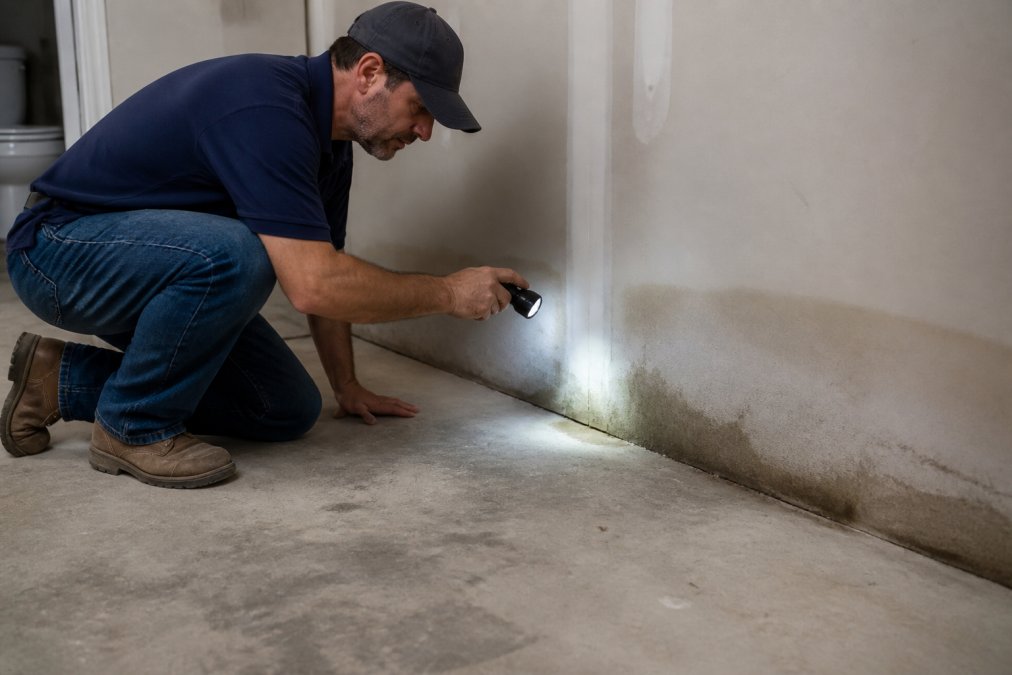
Finishing a basement bathroom before solving existing moisture problems traps water behind new walls. The repair cost later is far higher than waterproofing upfront, and a home inspection will flag it.
The Long-Term Cost Nobody Puts in the Pro Forma
Most basement bathroom ROI discussions stop at the installation invoice. The number that actually determines whether the project was worth it is the ten-year cost of owning a bathroom below grade, and that is where resale value quietly leaks away.
- Sewage ejector pump service. The pump that lifts waste to the main sewer has a finite service life and needs periodic testing. When it fails, it fails wet, and the cleanup is not a small line item.
- Exhaust fan replacement. A fan sized for a basement bathroom runs longer and harder than an upstairs fan because the ambient humidity is higher. Undersized or clogged fans let moisture sit on surfaces.
- Grout and caulk resealing. Below-grade temperature swings and humidity cycles break down sealant faster than they do upstairs.
- Dehumidification. Many finished basements need a dehumidifier running through the humid months to keep relative humidity in a range that discourages mold. That is an ongoing electricity cost and a piece of equipment a buyer will notice during a showing.
- Periodic moisture inspection. The drywall behind a basement shower is the last place a homeowner looks and the first place mold establishes itself.
Why Buyers Discount a High-Maintenance Basement
A buyer who has owned a basement before knows the maintenance pattern. Seeing a finished basement bathroom, they are not just valuing the fixtures, they are pricing in the pump, the fan, the dehumidifier, and the possibility the previous owner did not stay ahead of the moisture.
How to Protect the Value You Are Adding
Homeowners who protect their basement bathroom’s resale value do four things before and after the build:
- Fix the water source first. Grading, gutters, downspout extensions, and a working sump or drainage system come before tile. A bathroom built over an active water problem is a future repair bill.
- Waterproof the wet areas properly. Cement board or a comparable substrate behind tile, a correctly sloped shower pan, and a sealed envelope around the bathroom footprint.
- Size the ventilation for the room. An exhaust fan that actually moves the air volume the room requires, vented to the exterior, not into the joist space.
- Keep a maintenance record. Receipts for pump service, fan replacement, and any moisture remediation are documentation a buyer’s inspector and appraiser can use. Undocumented maintenance is assumed to be absent.
The Honest Trade-Off
A basement bathroom can be a durable, low-drama addition, but only when the moisture work is done first and the maintenance is kept up. Otherwise it becomes the room that costs money every year and discounts the home at sale. Installation cost is a one-time number; moisture and maintenance cost is recurring, and it determines whether the project was actually worth it.
Conclusion: Making the Right Call for Your Home
The decision comes down to your home’s current bathroom count, your local market, and whether the basement is being finished anyway. A basement bathroom is worth it when it turns unusable space into living space and pushes your home into a stronger bathroom bracket for buyers.
Frequently Asked Questions
Does a basement bathroom add value?
Yes, but the amount depends on your local market and the quality of the build. Adding a bathroom increases your total bathroom count, which is a key search filter for buyers. You can expect to recoup a significant portion of your costs, though it rarely reaches 100% unless the space was previously unusable.
What is the average cost to add a bathroom in basement?
The average cost to add a bathroom in basement varies widely based on plumbing rough-in needs and whether you choose a full bath or powder room. While national ranges exist, local labor and material costs dictate the final price. For an accurate quote specific to your home’s layout, contact Berry Basements for a free estimate.
Is a full bath or powder room better for basement resale?
A full bath typically offers a higher return on investment because it adds a complete living suite, which is ideal for guests or rental potential. A powder room is cheaper to install but adds less value. If your basement has the square footage, a full bath is usually the stronger choice for buyer appeal.
How does a basement bathroom impact home appraisal?
An appraiser will compare your home to similar properties in the area. A permitted, finished bathroom adds to your home’s appraised value by increasing the utility and square footage of living space. However, unpermitted work or signs of moisture damage can hurt the appraisal and cause financing issues for buyers.
A basement bathroom can be a smart move or an expensive one, and the difference usually comes down to moisture, permits, and how the project fits your home’s overall bathroom count. Berry Basements brings licensed basement contractors, a collaborative planning process, and expert management of waterproofing and structural work to every project. Get started with Berry Basements and turn your lower level into space that actually adds value.