

Table of Contents
- Assess Your Basement’s Current Light Situation
- Structural Solutions: Solar Tubes, Light Wells, and Basement Egress Window Installation
- Best Paint Colors for Dark Basements and Reflective Finishes
- Modern Basement Layout Design Ideas for Better Light Flow
- Layering Artificial Lighting to Complement Natural Light
- Rental-Friendly and Budget-Conscious Brightening Techniques
- Safety, Psychological Impact, and Professional Help
- Frequently Asked Questions
Last Updated: September 17, 2026
Assess Your Basement’s Current Light Situation
Learning how to maximize natural light in a dark basement starts with one honest walkthrough.
Natural light is the amount of daylight that reaches a space without any fixtures turned on. In a basement, that amount is usually close to zero, because the room sits below grade.
Here is how to assess your space in about 30 minutes:
- Note how many exterior walls you have below grade
- Count existing windows, and measure their width and height
- Watch where sunlight lands at 9 a.m., noon, and 4 p.m.
- Check the ceiling height, since ducts and beams limit options
- Write down which areas feel darkest all day
Most dark basements fail on three fronts: too few openings, dark finishes, and furniture blocking what little light gets in.
Fix the cheap problems first. A can of paint costs far less than a saw cut.
Walk your basement at three different times of day before you plan anything. The darkest corner at noon is rarely the darkest corner at 4 p.m., and that changes where you place windows, mirrors, and lights.
Structural Solutions: Solar Tubes, Light Wells, and Basement Egress Window Installation
Structural work delivers the biggest gains because it adds new openings for daylight. Three options lead the list: solar tubes, light wells, and basement egress window installation. Each one solves a different problem, and picking the wrong one wastes money.
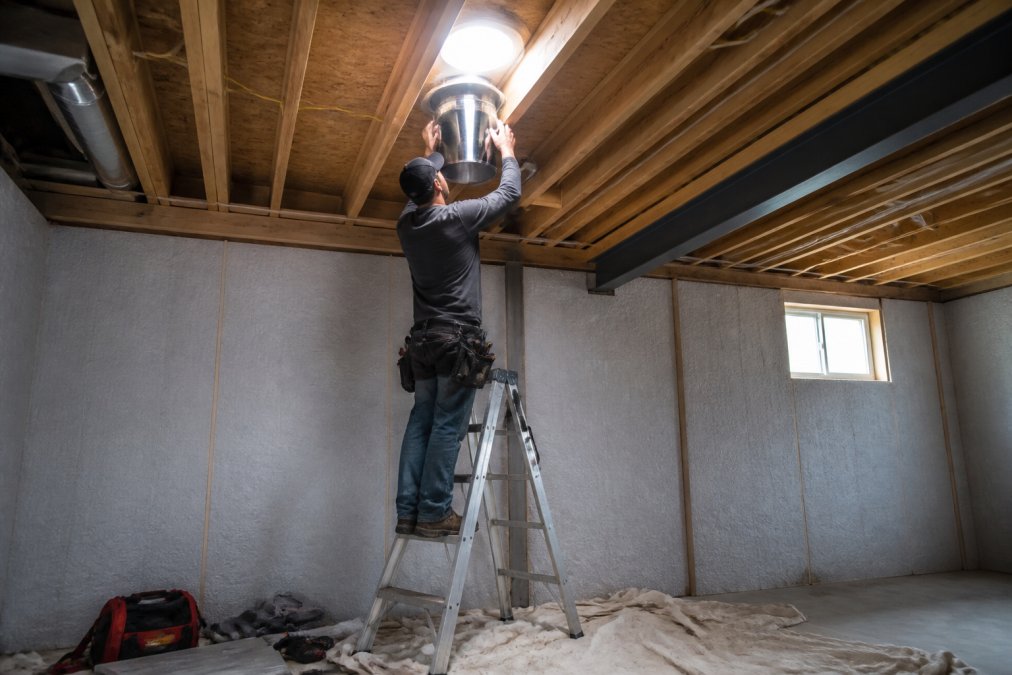
A solar tube is a small, mirrored pipe that runs from your roof to a ceiling diffuser. A rooftop dome captures daylight, and a highly reflective tube bounces it down through a diffuser that spreads the light across the room. Because the tube carries light rather than air, it needs no structural shaft and no excavation, the run typically fits between roof rafters and ceiling joists. That is why solar tubes are the fastest structural upgrade: most residential installations finish in a single day, and the roof penetration is small enough that a roofer can flash it like a vent.
A light well, sometimes called a vertical shaft, is a wider excavated opening next to the foundation. It brings in more light than a tube, but it costs more and needs digging.
Solar Tubes vs. Light Wells: Cost-Benefit Analysis
The choice comes down to budget, ceiling space, and how much light you want. Solar tubes win on cost and speed. Light wells win on volume of light. Here is how the trade-offs actually break down:
| Feature | Solar Tube | Light Well |
|---|---|---|
| Installation scope | Roof to ceiling run | Excavation and framing |
| Best for | Hallways, small rooms | Large living areas |
| Disruption level | Low | High |
| Light output | Focused, bright | Broad, diffused |
| Structural change | Minimal | Major |
| Permit burden | Often none for a standard tube | Almost always required |
| Weatherproofing risk | Roof flashing only | Foundation, drainage, and grade |
| Time to usable light | Usually one day | Weeks to months |
Egress Window Installation and Code Compliance
An egress window is a window large enough for a person to climb out of in an emergency. Building codes set minimum opening sizes, sill heights, and well dimensions. The International Residential Code, which most states adopt in some form, sets a minimum clear opening of 5.7 square feet, a minimum width of 20 inches, a minimum height of 24 inches, and a maximum sill height of 44 inches above the floor.
Cutting a foundation wall without a permit can fail inspection and force you to undo the work. Get the permit first, then schedule the cut.
What Actually Drives the Cost
Three variables move the price more than anything else: how much excavation is required, whether the foundation wall is poured concrete or block, and how far the new opening sits from existing utilities. A solar tube avoids excavation entirely, which is why it lands at the low end. A light well or egress window involves digging, drainage, and often a structural engineer’s stamp, which pushes it toward the high end.
Best Paint Colors for Dark Basements and Reflective Finishes
Color changes how a room feels faster than any other fix. The best paint colors for dark basements are warm whites, soft creams, pale grays, and light blues.
Finish matters as much as hue:
- Satin or semi-gloss walls reflect more light than flat paint
- Glossy finishes on trim and doors add small bright highlights
- Reflective surfaces like glass, acrylic, and polished stone spread light around
- Light floors and rugs keep the lower half of the room bright
Paint the ceiling the same light color as the walls. A white ceiling reflects daylight back down and makes the room feel taller.
Modern Basement Layout Design Ideas for Better Light Flow
Good modern basement layout design ideas start with one rule: keep the path from window to room clear. Light travels in straight lines, and furniture blocks it.
Furniture Placement and Mirror Strategies
Mirror placement is the cheapest light trick in the book. A large mirror on a wall opposite a window doubles the daylight in the room.
Use these placement rules:
- Hang mirrors across from windows, not beside them
- Angle a floor mirror toward the darkest corner
- Group reflective surfaces near the light source
- Keep window sills clear of tall plants and boxes
- Choose glass or metal tables over heavy wood
Layering Artificial Lighting to Complement Natural Light
Daylight fades at night, so plan fixtures that pick up where the sun stops. Ambient lighting, task lights, and accents should work on separate switches.
Think in layers:
- Ambient lighting from recessed cans or LED panels for overall glow
- Task lights over desks, bars, and game tables
- Accent lights to wash walls and highlight art
- Dimmers on every circuit to match daylight levels
Rental-Friendly and Budget-Conscious Brightening Techniques
Renters cannot cut foundation walls, so this section is for anyone who wants results without a permit. Every tip below is reversible.
Start with these moves:
- Swap heavy curtains for sheer window treatment
- Add a full-length mirror across from the window
- Use light slipcovers and bright rugs
- Place a floor lamp with a daylight bulb in the dark corner
- Move boxes and shelving away from windows
- Hang a slim LED strip under shelves
A daylight-spectrum floor lamp aimed at a light-colored ceiling spreads soft light across the whole room. It costs a fraction of a remodel.
Safety, Psychological Impact, and Professional Help
Dark basements affect more than looks. Rooms with little daylight can feel cramped and unwelcoming, and many people avoid them entirely. That avoidance is not just aesthetic preference, it reflects how the human body responds to light deprivation.
Why Light Deprivation Matters
Daylight exposure helps regulate the body’s circadian rhythm, the internal clock that governs sleep, alertness, and mood (Effects of light on human circadian rhythms, sleep and mood). When a room receives almost no natural light, the people who spend time there lose those cues. A common pattern reported by designers and wellness practitioners is that occupants of dark lower levels describe the space as heavy, cave-like, or depressing, and they use it less.
Safety Comes First
Every sleeping room below grade needs a legal escape route, and any window work must pass inspection. A licensed contractor confirms building codes, pulls permits, and signs off on the structural reframing. If the basement will ever be used as a bedroom, the egress requirements described above apply, and they are not negotiable.
When to Bring In a Professional
Complex jobs need a pro. Cutting a foundation, running a vertical shaft, or tying new windows into waterproofing all carry real risk. Berry Basements has handled these projects across the area since 2017, from basement renovation work to full basement apartment builds. We manage waterproofing, HVAC conflicts, and structural changes as one project rather than three separate headaches.
A basement is not just a lighting problem, it is a wellness problem. Fix the light, and you fix how the room feels, how often it gets used, and how much value it adds to the home.
Frequently Asked Questions
How to make a dark basement feel brighter?
Start by assessing your basement’s light sources and layout. Add solar tubes or enlarge windows for natural light, then use light-colored paint, mirrors, and layered LED lighting to amplify what you have. For structural changes like egress window installation, hire a licensed contractor to ensure safety and code compliance. Even small changes like swapping heavy curtains for sheer ones can make a noticeable difference in how bright your basement feels.
What is the 5’7″ lighting rule for basements?
The 5’7″ lighting rule suggests that window sills or light sources should be placed at or above 5 feet 7 inches from the floor to maximize light penetration and avoid blocking furniture. In basements, this means positioning windows or solar tubes higher on walls when possible, so light reaches deeper into the room. It’s a guideline, not a strict code, but it helps ensure natural light isn’t wasted on low surfaces.
Can you add windows to a basement for more light?
Yes, you can add windows to a basement, but it often requires structural modifications and may need a window well for proper drainage and egress. Basement egress window installation is a common solution that adds both light and safety. Check local building codes for egress requirements, especially if the basement will be used as a bedroom. A licensed contractor can assess your foundation and recommend the best approach for your home.
What are the best interior design tricks for dark basements?
Use light-colored paint on walls and ceilings, choose glossy or semi-gloss finishes to reflect light, and place mirrors opposite windows to bounce natural light around the room. Opt for furniture with reflective surfaces like glass or metal, and keep window treatments minimal. Layering artificial lighting with dimmers and warm LED bulbs can also brighten dark corners without making the space feel clinical. These tricks work well alongside structural upgrades like solar tubes.