

Table of Contents
- Basement Insulation Methods Compared: Rigid Foam, Fiberglass, and Spray Foam
- Rigid Foam Board vs Fiberglass for Basements: Which Wins on Cost and Performance?
- Preventing Moisture and Mold in Basement Walls
- Basement Wall Insulation R-Value Requirements and Climate-Specific Recommendations
- Cost Breakdown: What Drives the Price of Each Basement Insulation Method
- DIY Installation Steps for Cost Effective Basement Insulation
- ROI, Energy Savings, and Eco-Friendly Alternatives
- Frequently Asked Questions
Last Updated: September 16, 2026
Basement Insulation Methods Compared: Rigid Foam, Fiberglass, and Spray Foam
The most cost effective basement insulation methods balance material price against moisture resistance, R-value per dollar, and installation labor. Rigid foam board, fiberglass batts, and spray foam each win in different scenarios, and choosing wrong can mean paying twice: once for the material, and again when it fails.
This guide from Berry Basements breaks down what each option costs in time, money, and performance. Since 2017, we’ve seen the same pattern: homeowners who understand moisture management before buying insulation spend less and get better results.
Rigid foam board is a stiff panel insulation made from polystyrene or polyisocyanurate, installed directly against foundation walls. Fiberglass batts are pre-cut blankets of glass fibers that fit between framing studs. Spray foam is a liquid that expands into a solid layer, sealing gaps as it cures.
| Method | R-Value per Inch | Moisture Tolerance | Best For |
|---|---|---|---|
| Rigid foam board | 3.8-6.5 | High | Below-grade walls, DIY |
| Fiberglass batts | 3.1-3.8 | Low | Interior stud walls above grade |
| Spray foam | 3.5-6.5 | High | Rim joists, irregular spaces |
Rigid Foam Board: XPS, EPS, and Polyisocyanurate
Rigid foam board is the workhorse of basement insulation because it tolerates damp concrete without losing performance. Extruded polystyrene (XPS) offers around R-5 per inch and handles moisture well; expanded polystyrene (EPS) costs less at roughly R-4 per inch. Polyisocyanurate delivers up to R-6.5 per inch and includes a foil facing that acts as a radiant barrier.
For most basement walls, XPS is the practical middle ground: it resists moisture, installs with adhesive and cap fasteners, and creates a continuous thermal break that reduces thermal bridging through concrete.
Fiberglass Batts and Mineral Wool
Fiberglass batts are the cheapest material per square foot, but they are the wrong choice directly against a concrete foundation: they lose R-value when damp, and a damp batt against a cold wall becomes a mold risk. Mineral wool resists water absorption and holds its shape, though it costs more.
Use fiberglass batts only on interior stud walls that sit above a properly sealed vapor barrier, never in direct contact with below-grade concrete.
Rigid Foam Board vs Fiberglass for Basements: Which Wins on Cost and Performance?
Rigid foam board wins for basement walls in almost every case: it resists moisture, delivers more R-value per inch, and doesn’t degrade when the wall wicks water. Fiberglass costs less up front but fails the two tests that matter below grade: moisture tolerance and thermal bridging.
The trade-off is price: rigid foam board costs more per square foot and takes more cutting and fitting. But the failure cost of fiberglass in a wet basement, mold remediation plus replacement, erases any upfront savings.
Installing fiberglass batts directly against a concrete foundation wall traps moisture between the batt and the concrete. That trapped moisture feeds mold growth and quietly destroys the insulation’s R-value. If your basement has any history of dampness, rigid foam or spray foam is the only safe choice.
Preventing Moisture and Mold in Basement Walls
Moisture control comes before insulation, always. Insulating a wet basement wall traps water and creates mold conditions. The sequence: fix water intrusion, seal air gaps, then insulate.
Vapor Barriers, Air Sealing, and Condensation Control
A vapor barrier blocks water vapor from passing through a wall assembly. In basements, it goes on the warm side of the insulation to stop interior moisture from condensing on the cold concrete.
Air sealing matters just as much. Gaps around rim joists, sill plates, and pipe penetrations let humid air reach cold surfaces, where it condenses. Seal them with caulk or spray foam before installing insulation, condensation control is really air control.
If your basement has had moisture issues for years, that’s a waterproofing problem, not an insulation problem. Berry Basements handles waterproofing and structural work as part of a full renovation, so you’re not coordinating two contractors.
Basement Wall Insulation R-Value Requirements and Climate-Specific Recommendations
R-value measures thermal resistance, or how well a material blocks heat flow. Basement wall insulation R-value requirements vary by climate zone, and colder zones demand more.
For colder climates, aim for R-15 to R-20 on basement walls, typically achieved with 2 to 3 inches of rigid foam board or a combination of foam and batt. In milder zones, R-10 to R-13 is often sufficient. Check your local building code before you buy, because requirements are set at the state and municipal level and are updated periodically. The U.S. Department of Energy insulation guide outlines recommended R-values by climate zone.
Climate also changes your material choice.
Cost Breakdown: What Drives the Price of Each Basement Insulation Method
Most guides quote a single number per square foot and stop there. That number is almost never what you pay, because basement insulation pricing is four separate line items stacked together. Understanding each one is how you tell a fair quote from an inflated one.
Ask any contractor to separate insulation cost from moisture remediation cost in the quote. Bundled pricing hides where the money goes, and if a wet basement needs waterproofing first, that line item should be visible and itemized. A quote that lists only one lump sum is a quote you cannot audit.
Why the Cheapest Quote Is Often the Most Expensive
The lowest bid usually wins by cutting the prep line item: no waterproofing, no air sealing, and fiberglass batts pressed straight against concrete. The job looks done. Two winters later, the batts are damp, the R-value is gone, and the wall behind them is growing mold. Replacement means removing the failed insulation, remediating mold, waterproofing, and re-insulating correctly, the “savings” get spent twice.
DIY Installation Steps for Cost Effective Basement Insulation
Rigid foam board is the most DIY-friendly option for basement walls. Here’s how to install it correctly.
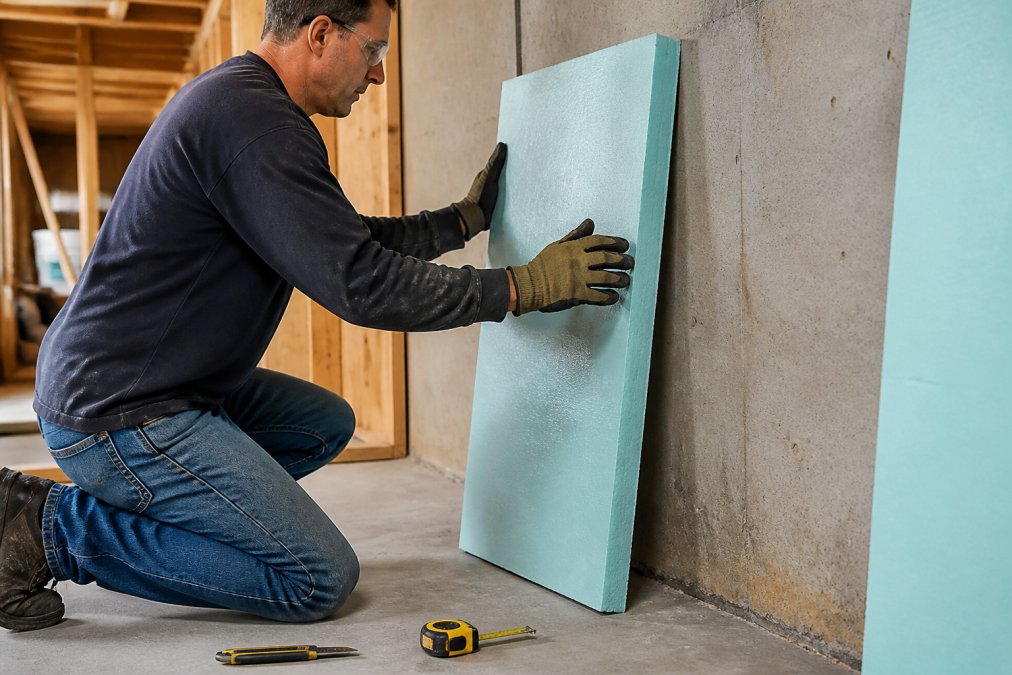
What You’ll Need:
- Rigid foam board (XPS or polyiso)
- Construction adhesive rated for foam
- Cap fasteners or tapcons
- Utility knife and straightedge
- Tape measure and level
- Safety glasses and work gloves
- Fix moisture first. Repair any leaks and confirm the wall is dry before insulating.
- Measure and cut. Measure each wall section and cut foam board with a utility knife against a straightedge.
- Dry-fit the panels. Test-fit each piece before applying adhesive.
- Apply adhesive. Run beads of construction adhesive on the back of each panel in an S-pattern.
- Press and fasten. Press the panel against the wall and secure with cap fasteners at the edges and center.
- Seal the seams. Tape or seal seams between panels to maintain a continuous barrier.
- Frame and finish. Build stud walls in front of the foam for drywall, keeping wiring on the interior side.
Common Mistakes to Avoid
The most common mistake is insulating before fixing water intrusion. The second is leaving gaps at the rim joist, which is where most basement heat loss and air infiltration happen. The third is compressing fiberglass batts to make them fit, which reduces their R-value. A fourth mistake is skipping the vapor barrier on the warm side, which invites condensation inside the wall assembly.
ROI, Energy Savings, and Eco-Friendly Alternatives
This is the section most basement insulation guides skip, and it is the one that actually answers whether the project is worth doing. Upfront cost is only half the equation. The other half is what the insulation saves you every month and what it does to the value of the finished space.
How Basement Insulation Pays You Back
Heat loss in a basement happens through three paths: conduction through the concrete, air infiltration through rim joists and penetrations, and thermal bridging where framing touches the cold wall. Insulation addresses all three, but payback depends on which path dominates in your home.
Eco-Friendly and Lower-Impact Alternatives
Traditional foam and fiberglass are not the only options, and the sustainable choices are better than most guides admit.
A Simple Way to Estimate Your Own Savings
Multiply your basement wall area by the R-value increase you are adding, then compare the reduced heat loss against your current heating bill. It’s a rough estimate, not an engineering calculation, but it tells you whether the project is in the right range. A contractor can refine it with your utility data and local climate zone.
The cheapest insulation is the one that does not have to be replaced. Moisture-resistant materials cost more up front but avoid the mold remediation and re-installation costs that follow a failed fiberglass job in a wet basement. The real ROI is measured over the life of the wall, not the day of purchase.
Frequently Asked Questions
How much does it cost to insulate a 1000 sq ft basement?
Costs vary widely based on material and whether you hire a pro. Fiberglass batts are the cheapest material, while spray foam costs the most. Rigid foam board sits in the middle. Labor, moisture remediation, and wall prep add to the total. Berry Basements provides free estimates so you get an accurate number for your specific basement rather than a generic range.
What is the cheapest but most effective insulation for basement walls?
Rigid foam board, specifically EPS or XPS, offers the best balance of low cost and performance for basement walls. It resists moisture, adds R-value per inch, and reduces thermal bridging. Fiberglass batts cost less upfront but fail when exposed to moisture. For a cost effective basement insulation approach, rigid foam paired with proper air sealing delivers the most value.
Do I need a vapor barrier when insulating my basement?
It depends on your wall assembly and climate. In most cases, rigid foam board acts as both insulation and a vapor retarder, so a separate polyethylene sheet is unnecessary and can trap moisture. Preventing moisture and mold in basement walls means managing water from the outside first, then choosing an insulation strategy that lets the wall dry. A contractor can assess your specific situation.
Can I use fiberglass batts in a basement?
You can, but only with precautions. Fiberglass batts must never touch concrete foundation walls directly because moisture wicks through and compresses the insulation, killing its R-value and inviting mold. If you use batts, install rigid foam board against the concrete first, then frame stud walls and place batts in the cavities. This hybrid approach protects the fiberglass and meets basement wall insulation R-value requirements.